












Help & resources
Choosing the right door hardware.
Door hardware breaks down into six lock-set types, each suited to different doors, different rooms, and different privacy needs. This guide walks through each one so you can specify with confidence.
01: How to choose
Start with the room, not the style.
Style, finish, and collection are personal decisions. Lock-set type is a functional one: it depends on the door, the room behind it, and whether the door needs to lock. Get the set type right first, then choose the look.
- Dummy: no moving parts. Decorative use only (e.g. wardrobes, fixed doors).
- Passage: latches but does not lock. Internal doors where privacy isn’t needed.
- Privacy (snib): locks from one side with emergency release. Bathrooms, bedrooms.
- Privacy (rose button): button release on the latched side. Cleaner aesthetic, same use case.
- Entry (mortice key): key-locked deadbolt. Front doors, secured rooms.
- Entry (thumb turn): deadbolt with interior thumb turn. Front doors with quick interior lock/unlock.
Each section below covers one set type in detail: what’s in the box, where it’s typically used, and what to specify when you order.
02: Dummy set
Dummy set.
No latch, no lock, no moving parts. The handle is decorative: it doesn’t turn and won’t catch on a strike plate. Sold as a pair.

When to use it
Generally used on unused double doors, wardrobes, or doors with edge latches where the handle is for pulling rather than latching. If the door has a magnetic catch or roller catch built into the frame, a dummy handle is what you want.
Suitable for
Sold as a pair and intended for the applications described. Please consult with us or your project lead to confirm suitability based on specific site requirements.
03: Passage set
Passage set.
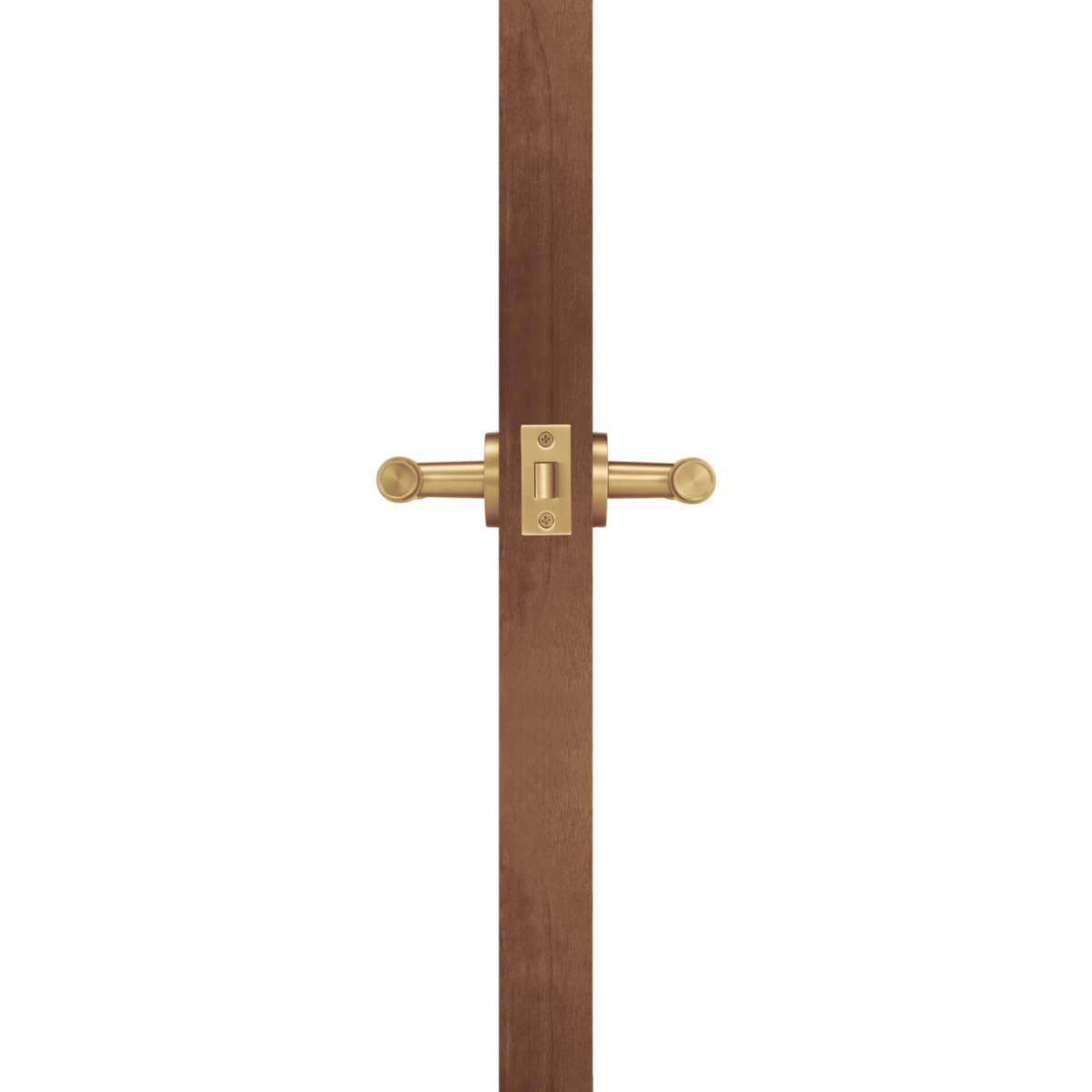
Includes a sprung non-locking latch. The handle turns, the latch retracts, the door opens, but there’s no way to lock it. The default for most internal doors.
When to use it
Use this set anywhere you need the door to stay closed but don’t need it to lock. The most common spec for internal doors throughout a house.
Suitable for
Sold as a pair and intended for the applications described. Please consult with us or your project lead to confirm suitability based on specific site requirements.
04: Privacy set (snib)
Privacy set (with snib).
A passage latch with an added privacy bolt. The snib (a small turn-bolt) locks the door from the inside, with an emergency release accessible from the outside, usually a slot you can turn with a coin or screwdriver.

When to use it
The standard fitting for any room where someone needs to lock the door briefly but the household needs to be able to override it: bathrooms and bedrooms in particular. Not a security lock; it’s for privacy only.
Suitable for
Sold as a pair and intended for the applications described. Please consult with us or your project lead to confirm suitability based on specific site requirements.
05: Privacy set (rose button)
Privacy set (rose button).
Functionally identical to the snib version, but with the locking mechanism integrated into the rose itself. The locked side has a small button; the other side has a discreet emergency release. Cleaner look on the latched face.

When to use it
Same use case as the snib version: bathrooms, bedrooms, anywhere brief privacy is needed. Choose this over the snib if you prefer the minimal aesthetic. Specify the locked side when ordering: button placement is configurable on request.
Suitable for
Sold as a pair and intended for the applications described. Please consult with us or your project lead to confirm suitability based on specific site requirements.
06: Entry set (key lock)
Entry set (mortice key lock).
Includes a heavier-duty deadbolt operated by a key on both sides. The latch handles day-to-day opening; the deadbolt secures the door when locked. This is the spec for any door that needs proper security: front doors, side entrances, secured internal rooms.

When to use it
Use for entry doors and any internal door that needs to be properly lockable from both sides: offices, storerooms, treatment rooms. Mortice means the lock body sits inside the door, so the door needs to be drilled for it; let us know your door thickness when you order.
Suitable for
Sold as a pair and intended for the applications described. Please consult with us or your project lead to confirm suitability based on specific site requirements.
07: Entry set (thumb turn)
Entry set (mortice thumb turn lock).
Same heavy-duty deadbolt as the key-lock version, but the interior side has a thumb turn instead of a keyhole. You unlock by twisting the thumb turn, no key needed from inside. Convenient for front doors, faster to operate in an emergency.

When to use it
The right choice for front entry doors where the interior side is always accessed by household members and you want quick locking without finding a key. The exterior side still uses a key, so external security is unchanged. As with the key-lock version, specify door thickness on order.
Suitable for
Sold as a pair and intended for the applications described. Please consult with us or your project lead to confirm suitability based on specific site requirements.
08: Common questions
Things customers ask us most.
A few of the questions our team answers most often. If yours isn’t here, drop us a line: we read everything that comes in.
How do I know whether I need a passage, privacy, or entry set? +
Walk through the room: does the door need to lock? If no, a passage set is enough. If yes for privacy only (bathroom, bedroom), use a privacy set. If yes for security (front door, secured rooms), use an entry set with a key or thumb-turn lock.
What’s the difference between a rose button and a snib? +
Both lock a door from the inside with an emergency release on the outside. The snib is a small turn-bolt above the handle, clearly visible. The rose button is integrated into the rose plate itself: cleaner aesthetic, same function. Choose based on the look you want.
Can I retrofit a lock onto a passage handle later? +
No: the mortice body inside the door is different for each set type. If there’s any chance you’ll want to lock the door later, specify a privacy or entry set from the start. The visible hardware looks the same; it’s the internal mechanism that changes.
Do I need to know my door thickness when I order? +
For passage and privacy sets, no: the spindle accommodates a standard range. For entry sets (mortice key or thumb turn), yes: the lock body sits inside the door and the spindle length needs to match the thickness. Standard UK doors are 35–45mm; let us know if yours is outside that range.
What’s a backset, and why does it matter? +
The backset is the distance from the door edge to the centre of the handle. Standard UK backsets are 55mm or 70mm; the difference affects how the latch lines up with the strike plate. If you’re replacing existing hardware, match the existing backset to avoid re-drilling. New installs are flexible: tell us your preference at order.
Are these compatible with European or US door standards? +
Our mortice locks are made to the European DIN standard, which is the same standard used across the UK, EU, and most of Asia and the Middle East. For US installations, we can supply ANSI-spec mortice bodies on request: contact the trade team for project work.
Still unsure which set you need?
Send us your door dimensions, a photo, or just describe the room. We’ll recommend the right lock set and finish, usually within a working day.