















Help & resources
Hardware should feel intentional, not lost in the space.
The most common mistake we see is choosing hardware based on how it looks in a photograph rather than how it relates to the surface it sits on. This guide simplifies the process so you can specify with confidence, no matter the room, the fitting, or the region.
01: Measuring principles
Start with proportion, not preference.
Three rules make up about ninety per cent of getting hardware sizing right. Read these once and the rest of the page becomes a reference, not a tutorial.
The one-third to two-thirds rule
A handle should cover roughly one-third to two-thirds of the drawer or door width it sits on. Too short and the piece looks timid; too long and it overwhelms the frontage. Start here before considering style, finish, or collection.
Centre-to-centre vs total length
The most common measurement misunderstanding in hardware. Centre-to-centre (CTC) is the distance between the centres of the two screw holes. Total length is the full measurement from end to end of the handle, which is always longer than CTC. When we list a handle as 128mm, that is the CTC dimension. The total length will be approximately 25–40mm longer depending on the collection.
Regional standards
Hardware sizing conventions vary by region. The table below shows the most common CTC sizes you will encounter. All meraki handles are manufactured in metric and include M4 threaded fixings as standard.
| Size | UK | EU | US / CA |
|---|---|---|---|
| Small | 64mm, 96mm | 64mm, 96mm | 3″ (76mm), 96mm |
| Medium | 128mm, 160mm | 128mm, 160mm | 5″ (127mm), 6″ (152mm) |
| Large | 192mm, 224mm | 192mm, 224mm | 8″ (203mm), 10″ (254mm) |
| Extra large | 256mm, 320mm | 256mm, 320mm | 12″ (305mm), 14″ (356mm) |
All meraki handles use M4 threaded fixings. Screws are supplied in two lengths, 25mm and 35mm, covering door thicknesses from 16mm to 30mm. For thicker doors, longer M4 bolts are available on request.
02: Cabinet handles & pulls
Size handles to the drawer, not the kitchen.
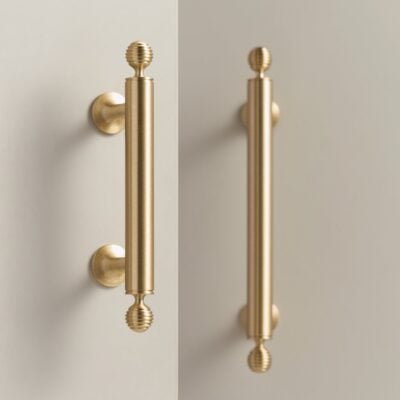
Cabinet handles are touched multiple times a day, and their size relative to the drawer front affects both visual balance and ergonomic comfort.
Use the proportion rule from Section 01: a handle should span one-third to two-thirds of the drawer width. On a 600mm drawer front, that means a handle between 200mm and 400mm CTC. Most customers land on 192mm or 224mm, the sweet spot for standard kitchens.
Proportion calculator
Find the right handle size for your drawer.
Recommended handle size (CTC)
192 mm
Range: 200–400mm CTC for 1/3 to 2/3 proportion
Tip from the studio
Spec 128mm on drawers up to 500mm wide, step up to 160mm or 192mm for wider. Keep CTC consistent across the whole kitchen: uniform centre spacing creates rhythm even when drawer widths vary.
Projection depth for comfort
Projection is how far the handle stands off the surface. 25–40mm is standard for cabinet pulls. In tight kitchens where you walk past cabinetry, stay closer to 25–30mm to avoid catching clothing or hips. On island drawers where there is more clearance, 35–40mm feels more substantial in the hand.
03: Knobs & T-bars
Single-fixing hardware has its own logic.
Diameter matters less than projection, and spacing matters more than either when you are using two on a wide drawer.
Spacing two knobs on a wide drawer
Position each knob one-quarter in from each edge. On a 600mm drawer, that means each knob sits 150mm from the side, with 300mm between them.
| Specification | Knobs | T-bars |
|---|---|---|
| Best for | Cabinet doors, narrow drawers under 400mm | Drawers 400–600mm wide, horizontal grip |
| Fixing | Single screw, central | Single screw, central |
| Projection | 25–35mm | 30–45mm |
| Diameter / width | 25–40mm diameter | 60–120mm bar length |
Minimum clearance: Allow 50mm total space between the edge of the hardware and any adjacent wall, appliance, or other handle.
04: Door lever handles
Standardised mechanisms, regional differences.
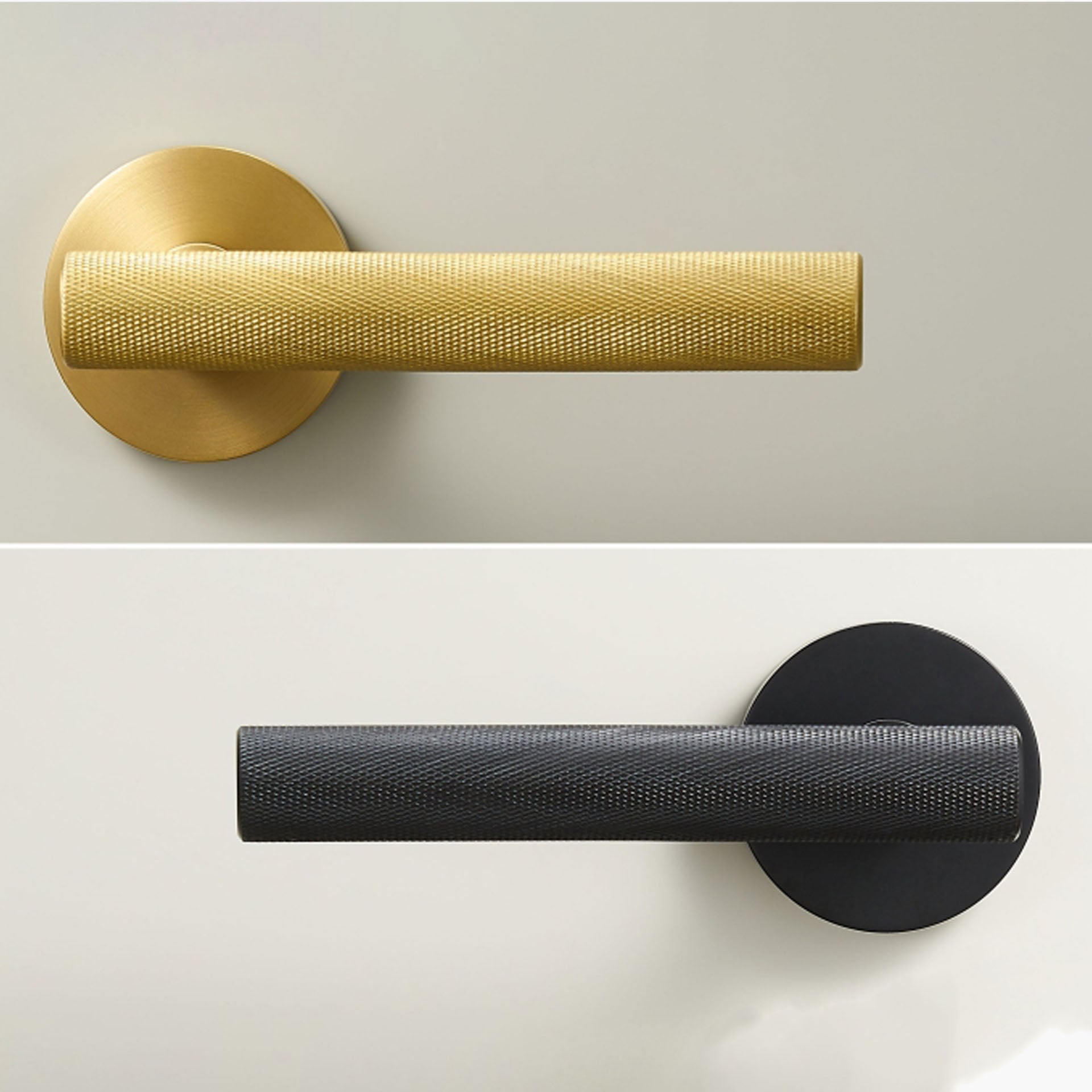
Door furniture requires more precise measurement than cabinet hardware because you are working with standardised latch and lock mechanisms. Standards vary significantly by region.
| Specification | UK | EU | US / CA |
|---|---|---|---|
| Latch backset | 57mm or 45mm | 55mm or 60mm | 2⅜″ or 2¾″ |
| Spindle size | 8mm square | 8mm square | ⅝″ round or 8mm sq |
| Door thickness (int.) | 35–44mm | 35–45mm | 1⅜″–1¾″ |
| Door thickness (ext.) | 44–54mm | 45–60mm | 1¾″–2″ |
| Mount height | 1000–1050mm | 1000–1050mm | 914–965mm (36–38″) |
North America note: US and Canadian doors typically use a round spindle (⅝″) rather than the 8mm square spindle standard in UK and EU. All meraki door handles ship with 8mm square spindles. Check your existing latch mechanism before ordering.
05: Hinges
Size by door weight, not door thickness.
Hinges are measured by the length of the leaf when open. Choose by door width and weight, not thickness.
Top hinge: 150–200mm from the top of the door. Bottom hinge: 200–250mm from the bottom. An optional third hinge sits centred or slightly below centre, recommended for doors over 1980mm tall or heavier than 30kg.
| Door type | UK | EU | US / CA |
|---|---|---|---|
| Lightweight cupboards | 2″ or 2.5″ (51–64mm) | 50–65mm | 2″ or 2.5″ |
| Standard internal doors | 3″ (76mm) | 75mm | 3″ or 3.5″ |
| Heavy / light external | 3.5″ or 4″ (89–102mm) | 90–100mm | 3.5″ or 4″ |
| Full-size external | 4″ or 5″ (102–127mm) | 100–125mm | 4″ or 4.5″ |
06: Finish & size interplay
How finish changes the way size reads.
The relationship between hardware size and finish is not purely aesthetic: it affects how brass reads in different lights and spaces.
Satin brass
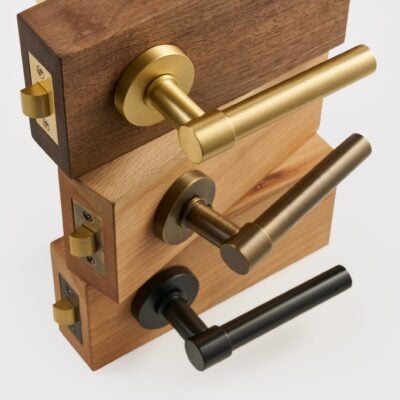
Muted and soft on larger forms; reads bolder and warmer on smaller hardware like knobs. The most versatile finish across all sizes.
Polished and mirrored brass
Reflective finishes amplify presence. Better for lower-contact areas (upper cabinet knobs, decorative hooks) where fingerprints are less of a concern.
Antique and unlacquered brass
Develops character over time. Patina forms unevenly on smaller hardware (more hand contact relative to surface area). Keep finish consistent across mixed sizes in the same room.
Tip from the studio
Not sure how a finish will look at the size you need? Our finish & care guide covers every finish in detail, and you can build a sample kit to hold the finishes in your hand before committing.
07: Common questions
Things customers ask us most.
Pulled from real customer support conversations.
What does “centre-to-centre” mean? +
Centre-to-centre (CTC) is the distance between the centres of the two screw holes on a handle, not the total length of the handle itself. When we list a handle as 128mm, that is the CTC measurement. The total length will be 25–40mm longer. Always measure the distance between your existing screw holes before ordering a replacement.
Can I replace cabinet hardware without drilling new holes? +
Yes, if the new handle has the same CTC as your existing one. Measure the distance between the centres of your current screw holes and match that to the CTC on our product pages. If you want a different CTC, you will need to fill and re-drill.
Can I mix handle sizes in one room? +
Yes, in fact most well-specified kitchens do. A common approach is one size for base drawers and a different size (usually smaller) for wall units. The key is consistency within each zone. Avoid mixing three or more CTC sizes in one room.
What is the difference between knobs, pulls, and T-bars? +
Knobs are single-point, round hardware with one central screw. Pulls (also called bar handles) span two fixing points and are measured by CTC. T-bars are a shorter version of pulls, also with a single central fixing, offering a grip without the length of a full bar handle.
How much clearance should I allow between handles? +
At least 50mm between the edge of one handle and the nearest obstacle (wall, appliance, or adjacent handle). For paired knobs on a wide drawer, position each one-quarter in from the edge.
What screw length do I need for my cabinetry? +
All meraki handles ship with 25mm and 35mm M4 screws, covering standard door thicknesses from 16mm to 30mm. If your doors are thicker (e.g. Shaker-style with a raised panel), contact us for longer M4 bolts.
Can I use UK/EU hardware in North America? +
Cabinet hardware: yes, CTC and fixing standards are compatible. Door lever handles: check spindle compatibility. UK/EU uses an 8mm square spindle; North America often uses a ⅝″ round spindle. Our door handles ship with 8mm square. You may need an adaptor for US latch mechanisms.
What height should door handles be mounted? +
Standard mounting height is 1000–1050mm from the finished floor in the UK and EU, and 914–965mm (36–38″) in North America. This should align with the height of the latch mechanism in the door.
What is backset on a door latch? +
Backset is the distance from the edge of the door to the centre of the latch or lock mechanism. In the UK, the most common backset is 57mm. In the EU, it is 55mm or 60mm. In North America, 2⅜″ or 2¾″. Check your existing latch before ordering a new handle set.
How do I choose the right size door hinges? +
Match hinge size to door weight and type: 3″ (76mm) for standard internal doors, 4″ (102mm) for heavier or external doors. See the hinge sizing table in Section 05 for a full breakdown by region.
Are cabinet handles universal between brands? +
CTC measurements are standardised, so a 128mm handle from any brand will fit 128mm screw holes. However, total length, projection, and screw specifications may differ. Always check the full dimensions on the product page, not just CTC.
Ready to specify?
Browse the full collection or send your project details to our trade team for technical support on larger jobs.