







In short
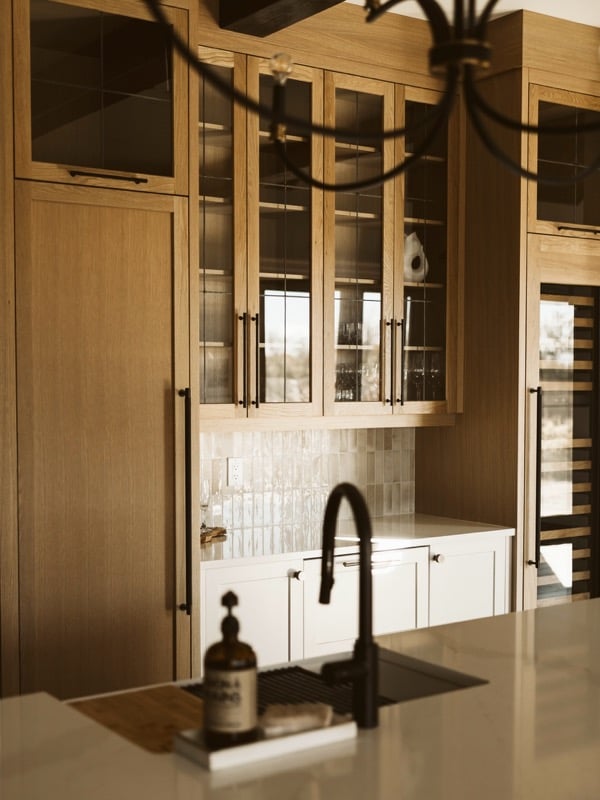
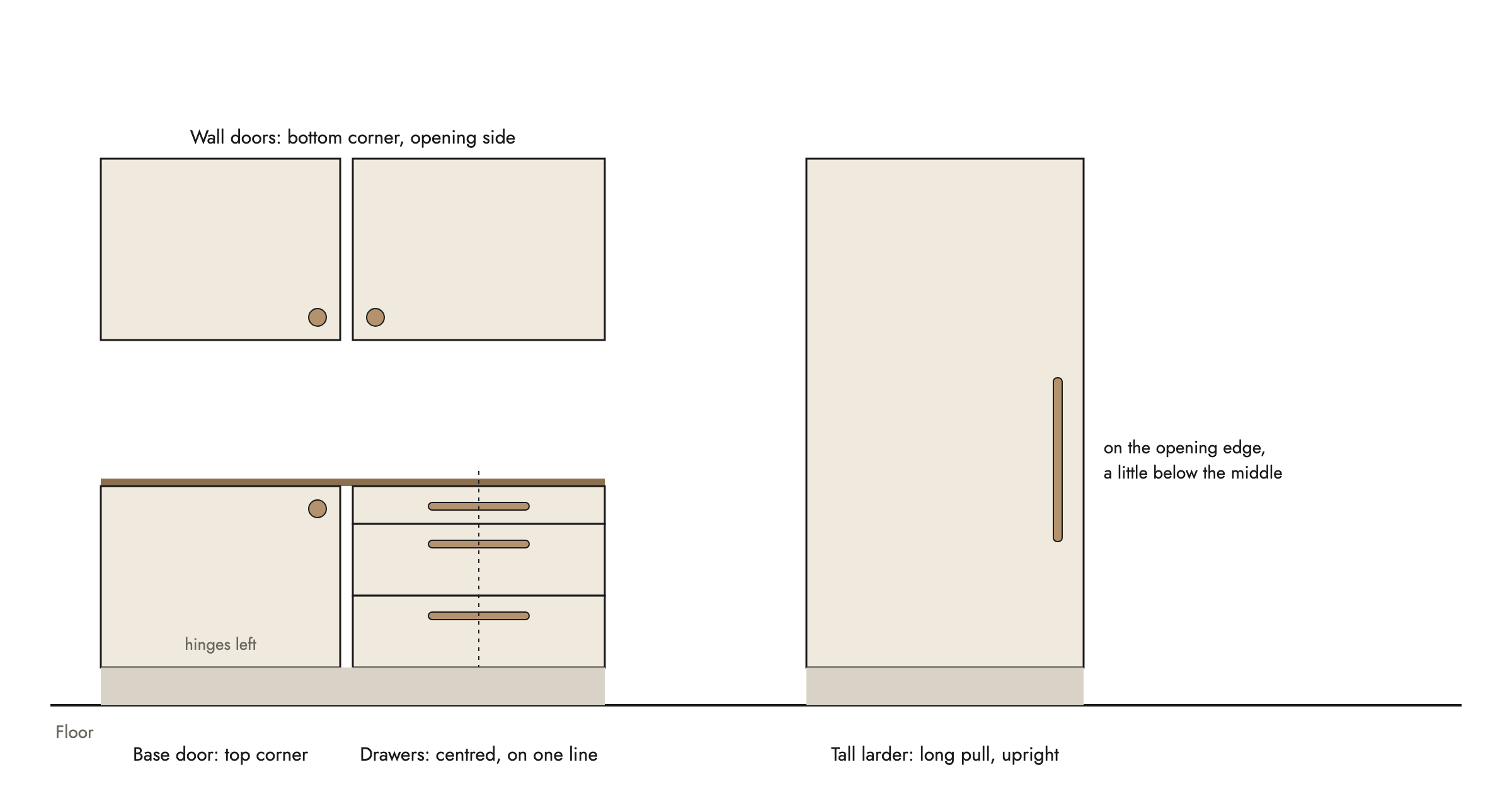
Fit knobs and handles on the opening side of each door, in the top corner on base units and the bottom corner on wall units. Centre drawer handles and keep stacked drawers on one line. Designers give heavy pan drawers a handle rather than a knob, and set a long pull on a tall larder a little below centre.
The kitchen designer Bob Bakes describes hardware as the jewellery of the kitchen: small, eye-catching and the part of the room you touch most. The New York designer Steven Gambrel, quoted by House & Garden, credits it with bringing detail to otherwise ordinary joinery. Where it sits matters as much as what it is. A run of fronts with every handle in the same place reads as one piece of furniture, while handles at slightly different heights read as a kitchen finished in a hurry.
No regulation tells you where a cupboard handle goes in a home, but kitchen and interior designers share a set of habits, and they agree more than they differ. These are the seven rules they come back to in the design press, with the fitting makers’ advice added where it helps and our own view marked as ours.
1. Put door hardware in the corner on the opening side
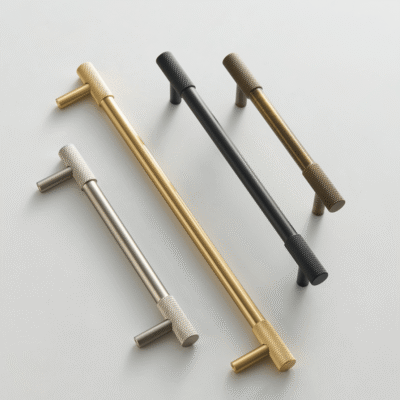
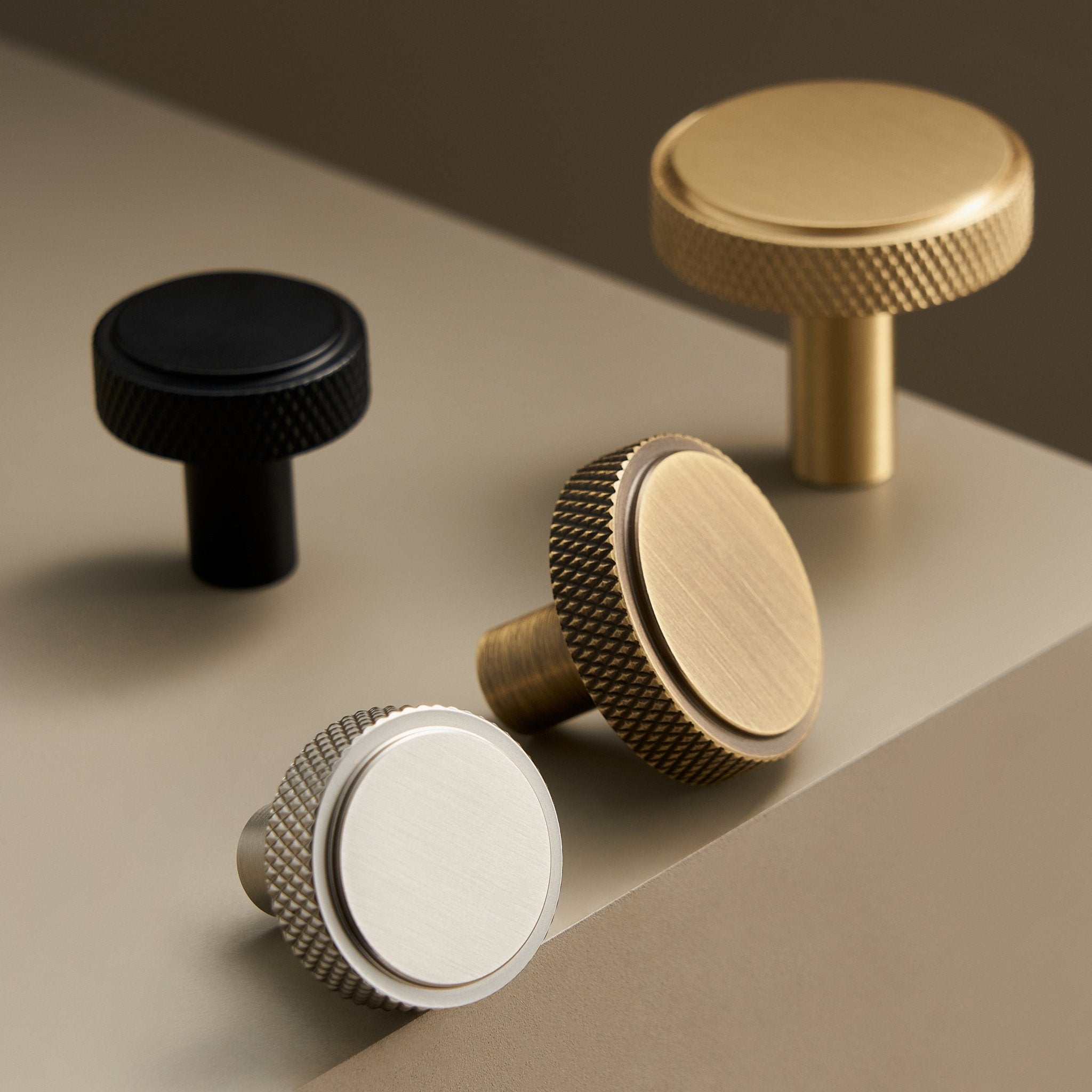
The architect Katherine White set this out for Livingetc: hardware on a door belongs in the corner of the opening side, the edge furthest from the hinges, the same distance from both edges of the door. On a base unit that corner is at the top, because you’re reaching down, and a knob such as our VELA knob, or a bar handle on 96 or 128 mm centres, sits comfortably there. On a wall unit it’s at the bottom, the part of the door closest to you as you reach over the worktop.
The interior designer Kristen Harrison told the same magazine how far in to go. Her working range is 1 to 4 inches, about 25 to 100 mm, from the top or bottom edge, with the exact figure decided by whatever detail the door carries. A panelled door, such as a shaker, takes its handle a bit higher than a flat slab; we read that as keeping it on the frame, clear of the recessed panel. Livingetc’s own rule of thumb for a knob is narrower, 2.5 to 3 inches, or roughly 65 to 75 mm, in from the corner. We’d treat Harrison’s range as the limits and pick one figure inside it for the whole kitchen.
2. Run bar handles upright on doors and level on drawers
Katherine White’s version of the usual pattern is bar handles vertical on wall unit doors and horizontal on base unit doors and drawers. We’d fix bar handles upright on base unit doors as well, which keeps them clear of the worktop edge, but either works if every door matches.
Plenty of designers would put a knob on the door instead. John McDonald, founder of a company making fronts for flat-pack kitchens, told Livingetc that doors typically take knobs and drawers take pulls, a split Bob Bakes says gives each piece of cabinetry a clear role. The interior designer Kate Guinness put it to Homes & Gardens as knobs on under-counter doors, handles on drawers and larger handles for appliances. The interior designer Mallory Robins looks at the whole room first: if the run already reads as a lot of straight lines, a round knob gives the eye a rest.
3. Keep the hardware on wall cupboards small
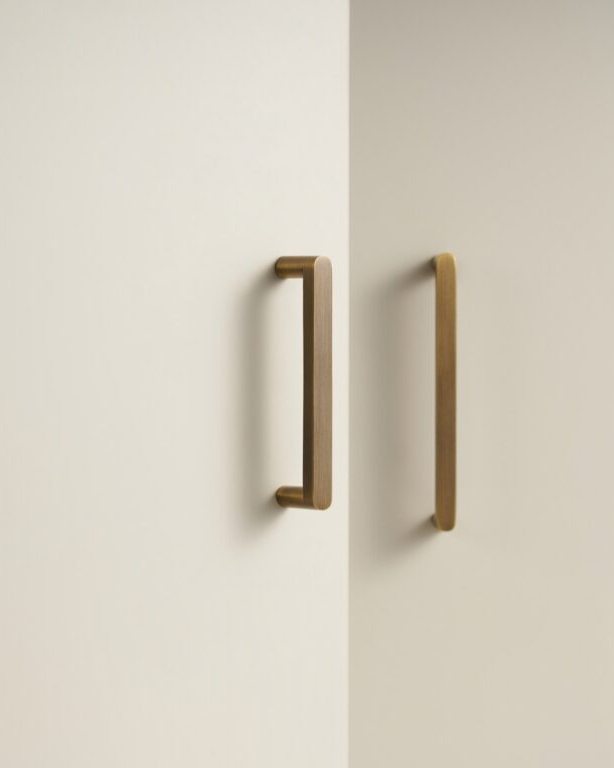
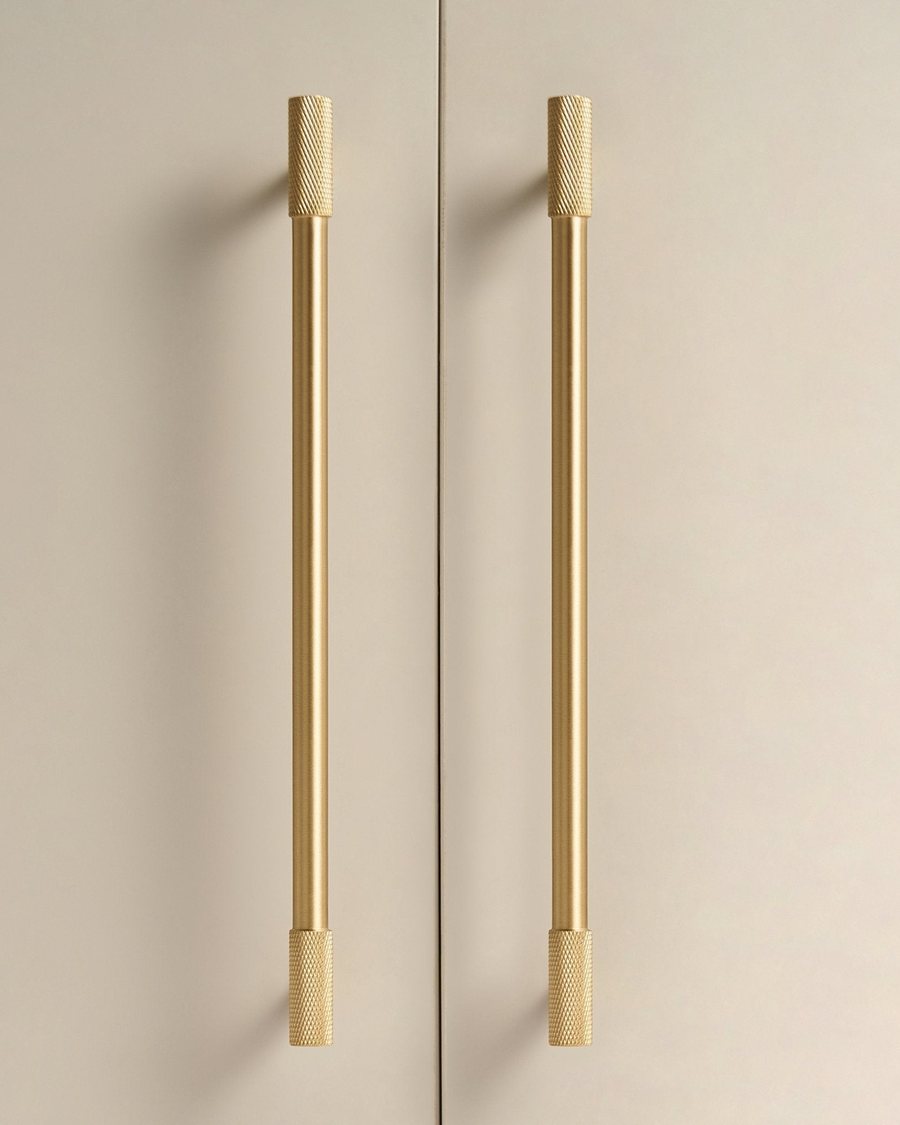
The interior designer Irene Gunter told Homes & Gardens that knobs work well on lighter fronts such as small drawers and wall-hung cupboard doors. The kitchen designer Jayne Everett added in the same magazine that a cup handle works horizontally but not vertically, so an upright wall door is better with a small knob. We’d keep bar handles on wall doors short, on 96 mm centres or so, because a long upright bar runs up towards eye level.
Lift-up doors follow the same logic. Blum’s guidance for its AVENTOS HF bi-fold lift is that the handle should ideally sit near the bottom edge of the lower front, within easy reach. Blum chooses the lift mechanism from the weight of the front including its handle, so tell your fitter if you’re putting solid brass on a lift-up door.
4. Centre drawer handles and keep stacked drawers on one line
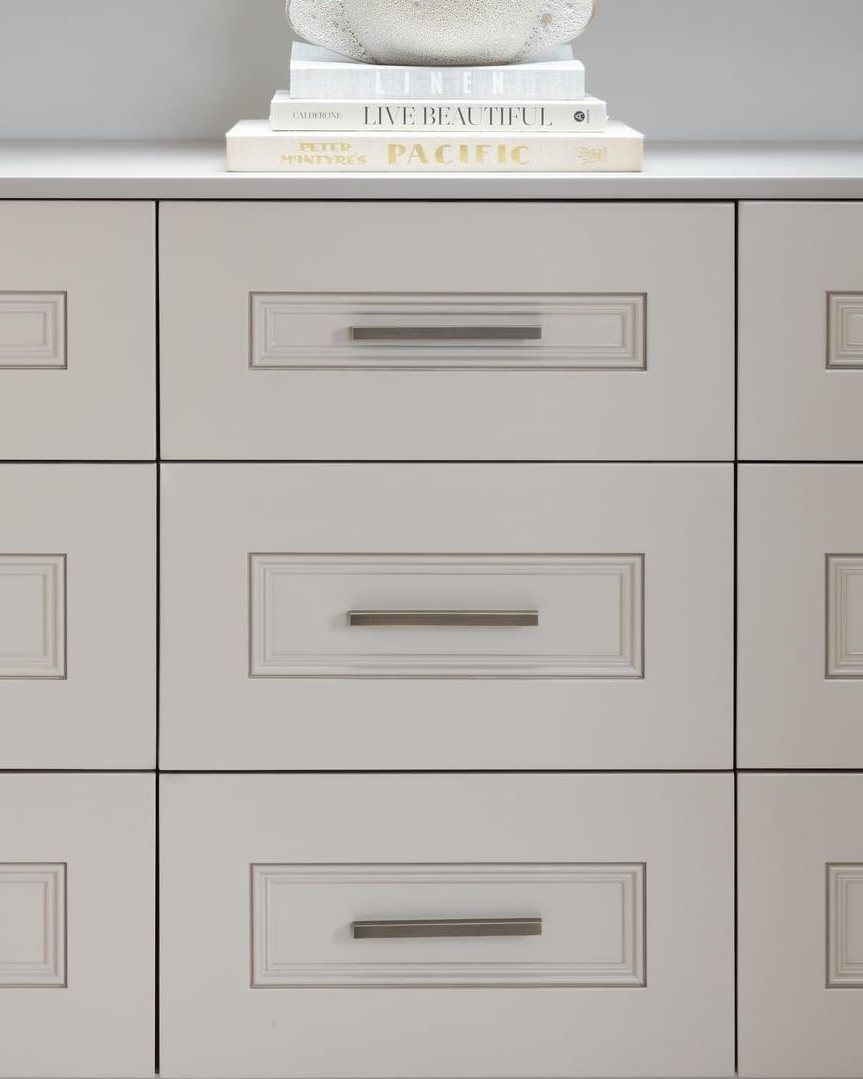
Katherine White centres drawer hardware, and Hettich’s guide to furniture fittings shows how to find the middle from side to side: the width of the drawer front minus the distance between the holes, divided by two. So a handle on 192 mm centres on a 600 mm drawer front has its first hole 204 mm in from each side. On the height, setting every handle the same distance down from the top edge also works, and keeps one line across drawers of different depths. Either way, stacked drawers should share one vertical centreline.
Wider drawers want longer handles. The industrial designer Will Zhang, who designs hardware, told Remodelista that longer pulls across wider drawers are easier to use and look more intentional than small ones. The interior designer Elle Cantrell warned Homes & Gardens against letting that run away with you: she works out the smallest and largest fronts first and keeps to two or three handle lengths for the whole kitchen.
5. Give heavy pan drawers a handle, not a knob
The kitchen designer Amy Kreutz told Livingetc that the weight of a drawer’s contents can settle the choice between knob and pull on its own, and a deep pan drawer is where designers most often insist on a handle. John McDonald’s reasoning in the same magazine is that drawers carry more weight and need more force to open, and Livingetc’s Luke Arthur Wells concluded that a knob on a pan drawer is a poor match. Irene Gunter lists wide drawers alongside fridges and pantry cupboards as fronts that need a proper handle.
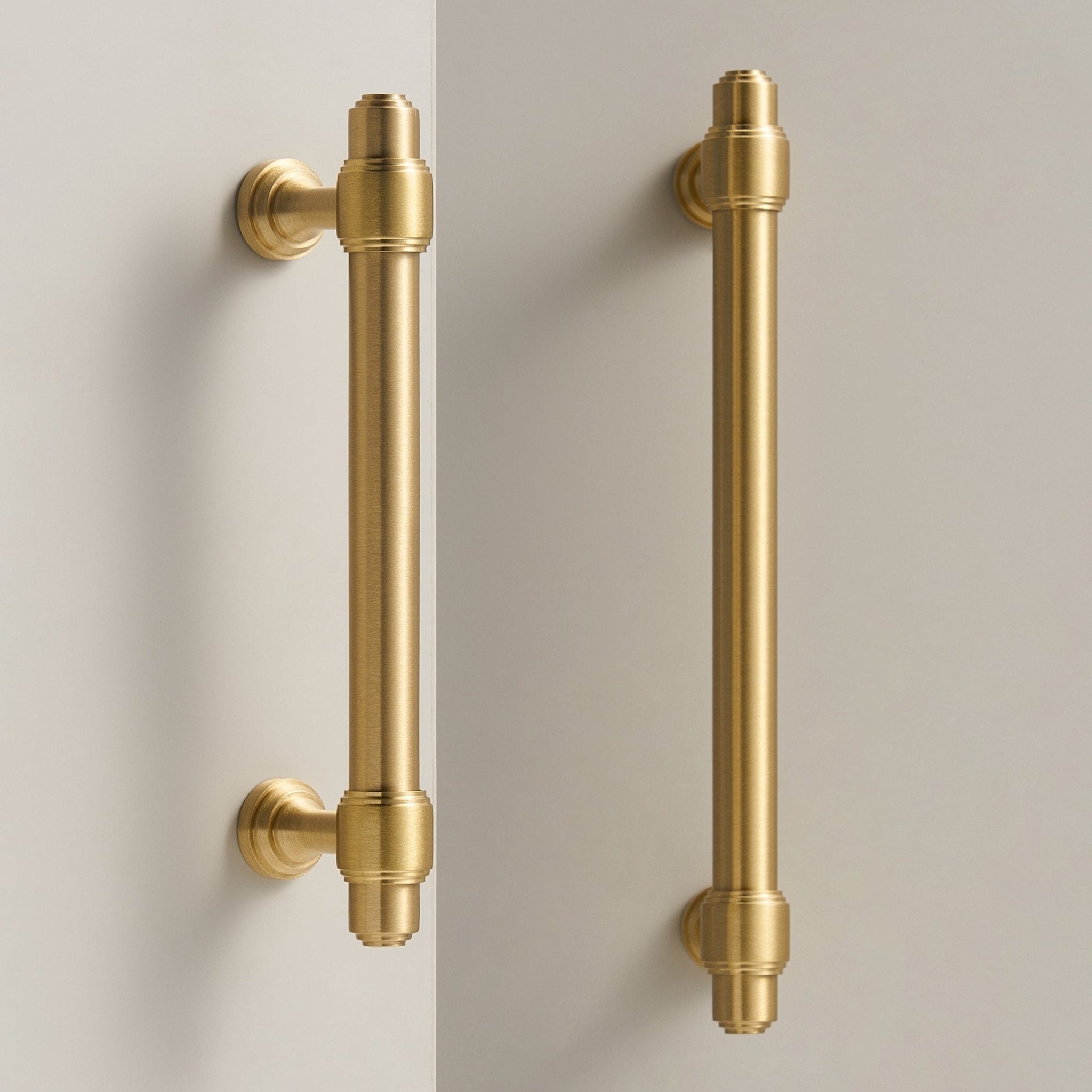
We’d put the handle in the upper part of the front, on the line of the drawers beside it, so you aren’t bending to a heavy load. Our GREPP handle runs from 64 to 320 mm centres, which covers most pan drawer widths. On a very wide drawer, two handles set symmetrically spread the pull. Our cabinet handle guide covers sizing in more detail.
6. Set a long pull upright on a tall larder, a little below the middle
Will Zhang’s advice to Remodelista is not to centre the pull on a tall pantry door but to set it slightly lower, which he says is « more ergonomic and easier to open ». It should be a long pull, fitted upright on the opening edge: a tall larder or integrated fridge door is the exception John McDonald makes to his knobs-on-doors rule, because a long pull suits its scale, and the interior designer Ariel Bleich agreed in Livingetc that long, linear pulls look and work best on oversized doors. We’d aim for the middle of the handle to sit around worktop height or a little above, where the hand falls when you’re standing at the counter.
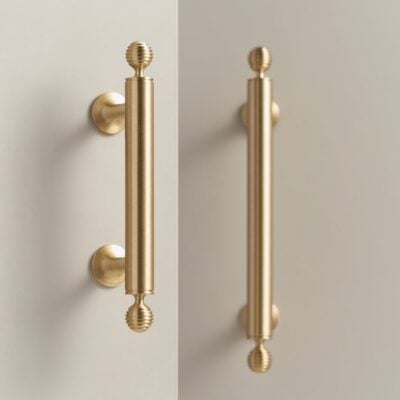
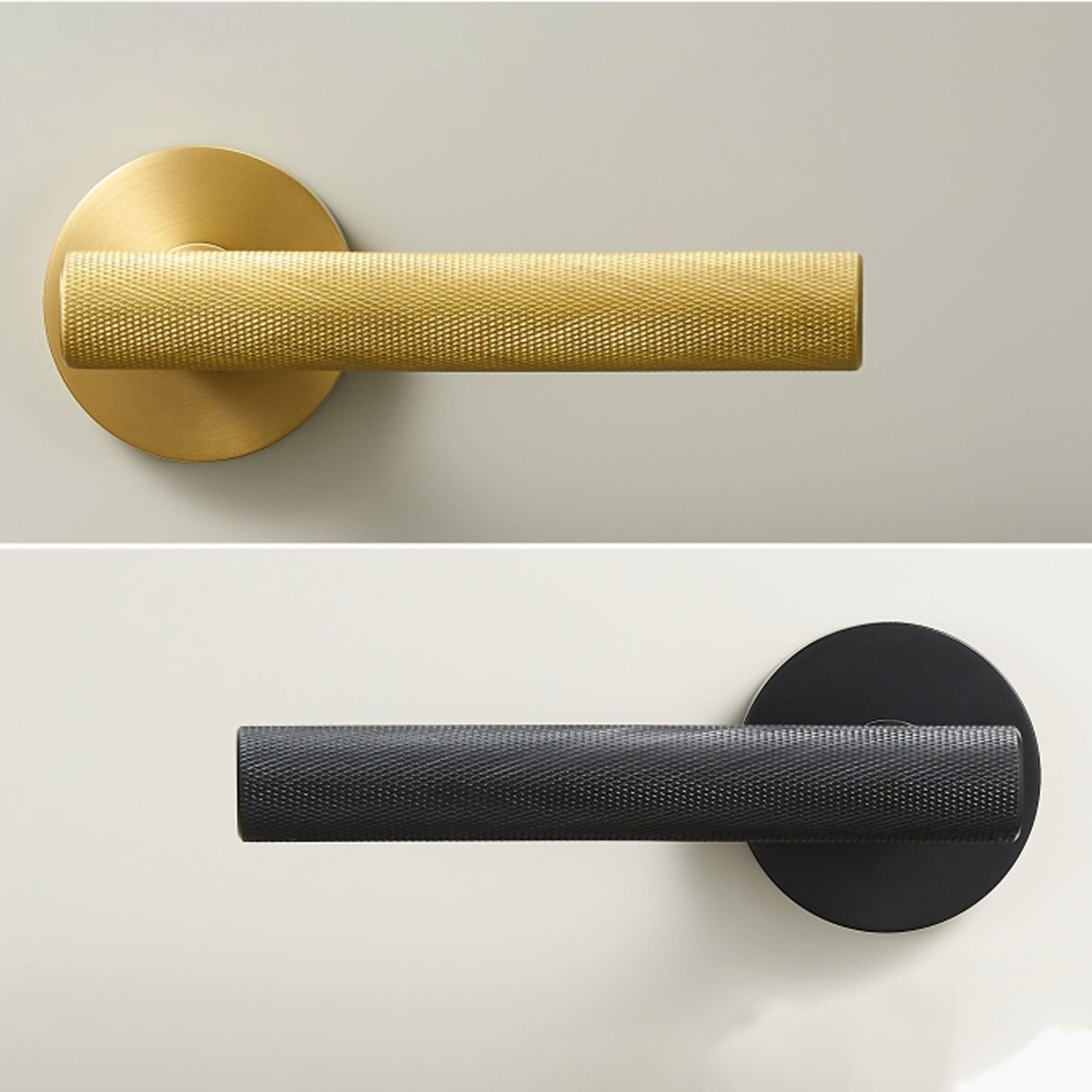
Integrated appliances need a firm grip. The Berlin kitchen designer Sina Gwosdzik told Livingetc that even in kitchens with milled finger grips, the studio often gives the fridge a handle, because its door needs more force to open. Elle Cantrell asks for a larger handle on panelled appliances, in proportion to the rest of the hardware. In our range, the GROVE handle and the VELA handle both go up to 320 mm centres. On an integrated appliance door, check the appliance maker’s instructions before drilling.
7. Keep one line across the whole kitchen, and mock it up before you drill
Elle Cantrell decides at the start how the hardware mounts on each kind of front, so the placement stays the same everywhere. A kitchen looks calm when its handles line up: knobs on base doors the same distance from the top, wall unit hardware the same distance from the bottom, drawer handles on one line along the run.
That includes the island and the corners. On an island, place the hardware as on the main run so the drawers line up across the room, and watch the projection, since the handles face a walkway. The NKBA recommends a work aisle of at least 42 inches, or 1067 mm, for one cook, measured between counter fronts, and the bar handles in this piece stand 30 to 33 mm proud of those fronts. The interior designer Laura Williams told Livingetc that a pull with no protruding ends to snag on clothing is best, which is what a bow or D handle gives you. In a corner, the handles on two fronts can strike each other: IKEA’s planning guide recommends a filler of at least 50 mm between cabinets and the wall so doors and drawers open fully, and where two doors meet in a corner we’d give only one of them a handle.
Then try it before you drill. Katherine White’s advice is always to mock up positions with blue tape first, the quickest way to see the line from across the room. IKEA’s installation guide recommends a drill template, and a piece of wood held behind the front as you drill so the hole doesn’t splinter. Our guide to choosing and fitting cabinet hardware covers marking out and measuring centres.
Every front at a glance
| Front | Where the hardware goes | Figure or rule to work from | Who says so |
|---|---|---|---|
| Base unit door | Top corner on the opening side | About 25 to 100 mm from the edge; a little higher on a panelled door | Kristen Harrison and Katherine White in Livingetc |
| Wall unit door | Bottom corner on the opening side | A small knob or short handle; no vertical cup handles | Katherine White; Irene Gunter and Jayne Everett in Homes & Gardens |
| Lift-up wall door | Near the bottom edge of the lower front | Handle weight counts towards the lift mechanism | Blum AVENTOS guidance |
| Drawer | Centred side to side, on one line with its neighbours | First hole at (front width minus centres) divided by 2; 204 mm for 192 mm centres on a 600 mm front | Katherine White; Hettich fitting guide |
| Deep pan drawer | Upper part of the front, on the drawer line | A handle, not a knob; longer on wider drawers | Amy Kreutz and John McDonald in Livingetc; Will Zhang in Remodelista |
| Tall larder or appliance door | Upright on the opening edge | A long pull, set slightly below the middle of the door | Will Zhang in Remodelista; Ariel Bleich in Livingetc |
| Corner units | Clear of the neighbouring front | Filler of at least 50 mm between cabinet and wall | IKEA kitchen planning guide |
| Island and aisle | As on the main run, with low projection on tight aisles | Work aisle 1067 mm for one cook | NKBA kitchen planning guidelines; Laura Williams in Livingetc |
Quick answers
Where should handles go on kitchen cabinet doors?
On the opening side, away from the hinges: the top corner on base units and the bottom corner on wall units.
How far from the edge should a cabinet knob be?
Designers quoted in Livingetc work between about 25 and 100 mm from the edge. Pick one figure and use it on every door.
Should handles go in the middle of drawers?
Centre them side to side. For height, centre them on the front or set them all the same distance from the top edge.
Should cabinet handles be vertical or horizontal?
Usually upright on doors and level on drawers. Long handles on tall larder and appliance doors are fitted upright.
Should a pan drawer have a knob or a handle?
A handle. A full pan drawer is heavy, and designers say it needs more force than a knob comfortably gives.
What height should a handle be on a tall larder door?
A little below the middle of the door, which the designer Will Zhang says is easier to open. We’d aim for around worktop height.
Sources
- Livingetc: What’s the best kitchen cabinet handle placement? Kitchen design experts give us the rules of thumb. Kristen Harrison and Katherine White on door style, corners, distances from the edge, orientation and mocking up with tape.
- Livingetc: When should you use knobs vs pulls in a kitchen?. John McDonald, Bob Bakes and Mallory Robins on knobs for doors, pulls for drawers, pan drawers and tall pantry doors.
- Livingetc: Should I use handles or knobs on kitchen cupboards? Designers agree unanimously. Amy Kreutz on the weight of drawer contents and Sina Gwosdzik on fridge doors; the knob distance rule of thumb.
- Livingetc: I asked designers about the best shape for a kitchen drawer handle. Ariel Bleich on long pulls for oversized doors; Laura Williams on handles that don’t snag clothing.
- Homes & Gardens: Should I use handles or knobs on kitchen cabinets?. Irene Gunter on handles for heavy fronts and knobs for light ones; Kate Guinness on mixing knobs and handles.
- Homes & Gardens: 5 kitchen hardware mistakes interior designers say homeowners always make. Jayne Everett on cup handles and wall cabinets; Elle Cantrell on appliance pulls, handle lengths and consistent placement.
- House & Garden: Why handles and knobs are an interior designer’s secret weapon for making things look more expensive. Steven Gambrel on hardware bringing detail to plain joinery.
- Remodelista: Expert Advice: Hardware Shouldn’t Be an Afterthought, With Will Zhang. Pulls set slightly below centre on tall doors; longer pulls on wider drawers.
- National Kitchen & Bath Association: Kitchen Planning Guidelines. Work aisle width for one cook.
- Hettich: Furniture fittings guide (Ratgeber Möbeltechnik). Side position of a handle on a drawer front.
- Blum: AVENTOS, moving solutions for every lift system. Handle near the bottom edge of a lift-up front; front weight including handle.
- IKEA: Kitchen planning guide (UK). Filler piece of at least 50 mm between cabinets and the wall.
- IKEA: ENHET kitchen installation guide. Drill template for alignment and a backing piece to stop splintering.
Images: Product photographs and diagrams are our own.