








In short
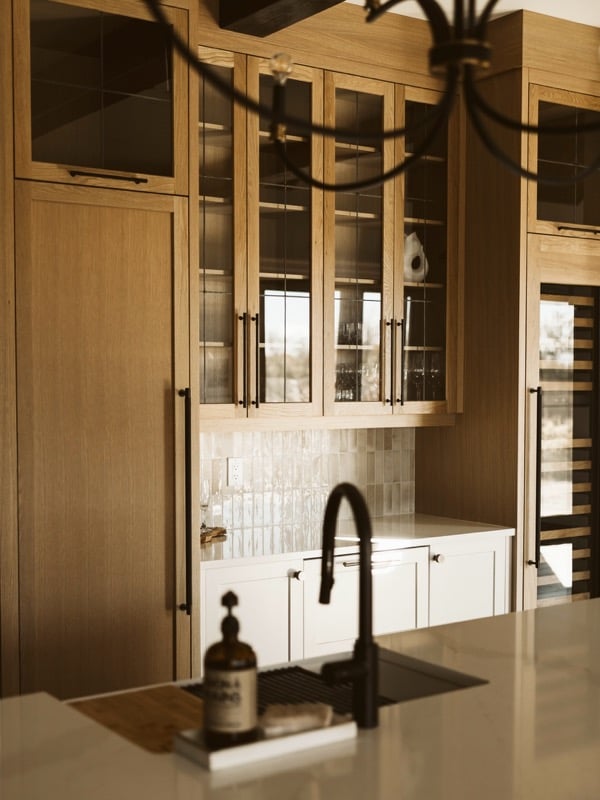
Designers keep returning to knobs on shaker doors and cup pulls or bar handles on the drawers, while a slim bar handle fixed upright on the doors gives a more modern look. Whichever you choose, fix it on the frame of the door rather than the recessed panel, and size it to the frame and the drawer.
A shaker kitchen is about as plain as a fitted kitchen gets, which is exactly why designers spend so long on its handles. The interior designer Jennifer Markowitz told Homes & Gardens that the flat surface of a shaker cabinet is the perfect canvas for interesting hardware, and in the same magazine Holly Vaughan, whose design and build practice works across the south of England, suggests bold colour and some special hardware as the way to give the style a personality of its own.
Below we look at what a shaker door is, where it came from, and how designers choose, place and size the hardware.
What a shaker kitchen door is
A shaker door is a frame and panel door with almost nothing added. Country Life describes it as a flat, recessed central panel surrounded by a raised frame with square edges, with little or no other embellishment. Remodelista’s guide to the style breaks the frame into its parts: two stiles, the uprights on the left and right, and two rails across the top and bottom, holding a flat inset panel.
The interior designer Bethany Adams told Homes & Gardens that the word can also mean a whole kitchen kept free of excess decoration, as the Shaker communities kept their rooms.
Where the shaker style comes from
The style is named after the Shakers, a Protestant sect that came to America from England in 1774. At its height in the mid nineteenth century it had more than 6,000 members in eighteen communities from Maine to Kentucky. The Metropolitan Museum of Art describes how their principles of honesty, utility and simplicity shaped their furniture: ornament was thought to encourage pride, so makers concentrated on form and proportion and gave up veneers, inlays and carving.
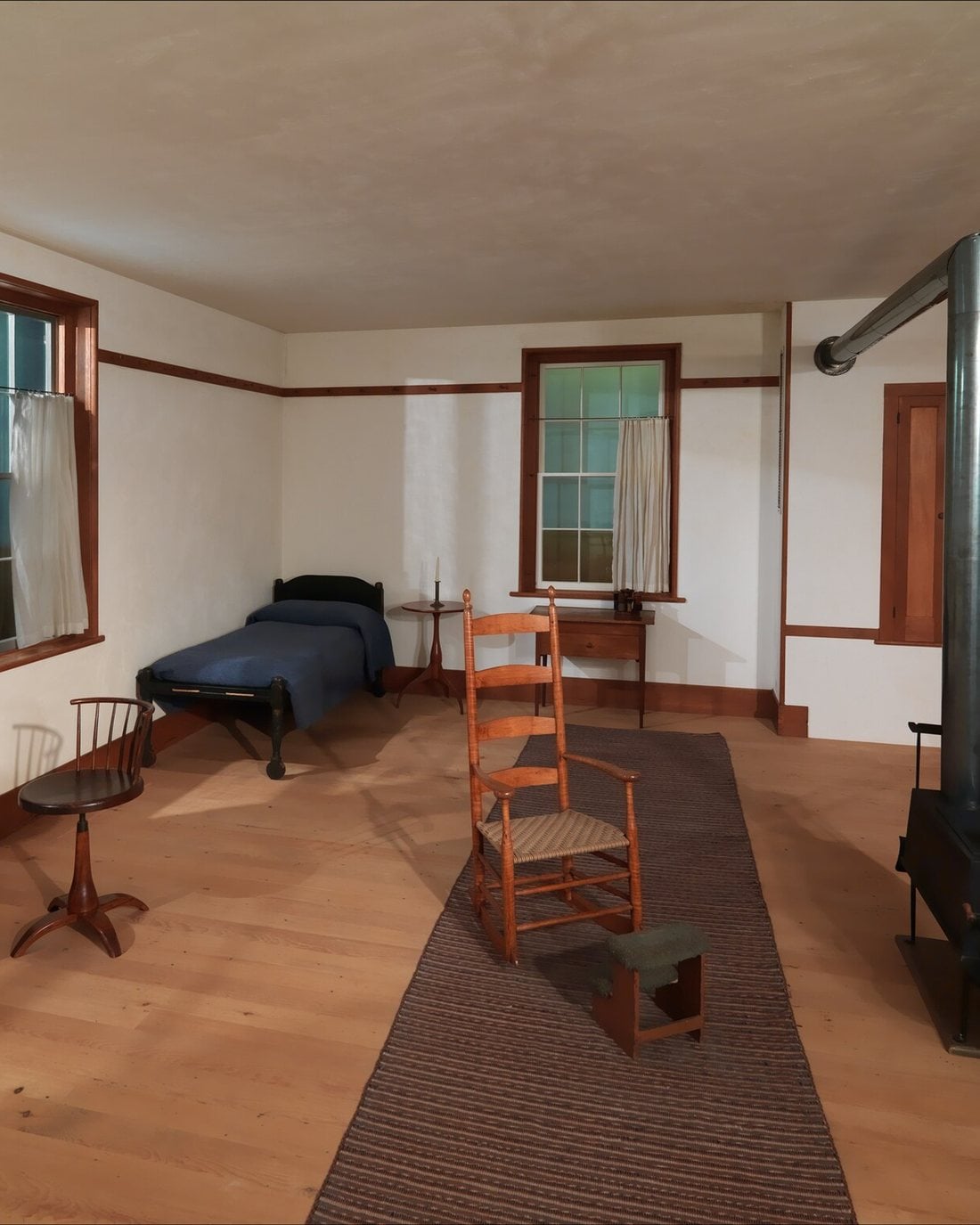
Hancock Shaker Village describes built-in units of cupboards and drawers as the feature that epitomises Shaker buildings, and the Mount Lebanon retiring room installed at The Met is lined with built-in cupboards. We think a fitted shaker kitchen owes more to those walls of cupboards than to any single piece of furniture.
Designers have long admired it. The Financial Times traced its influence from the painter Ellsworth Kelly to the architect Carlo Scarpa, and quoted the London furniture designer Russell Pinch: the Shakers were all about “finding elegance through proportion”.
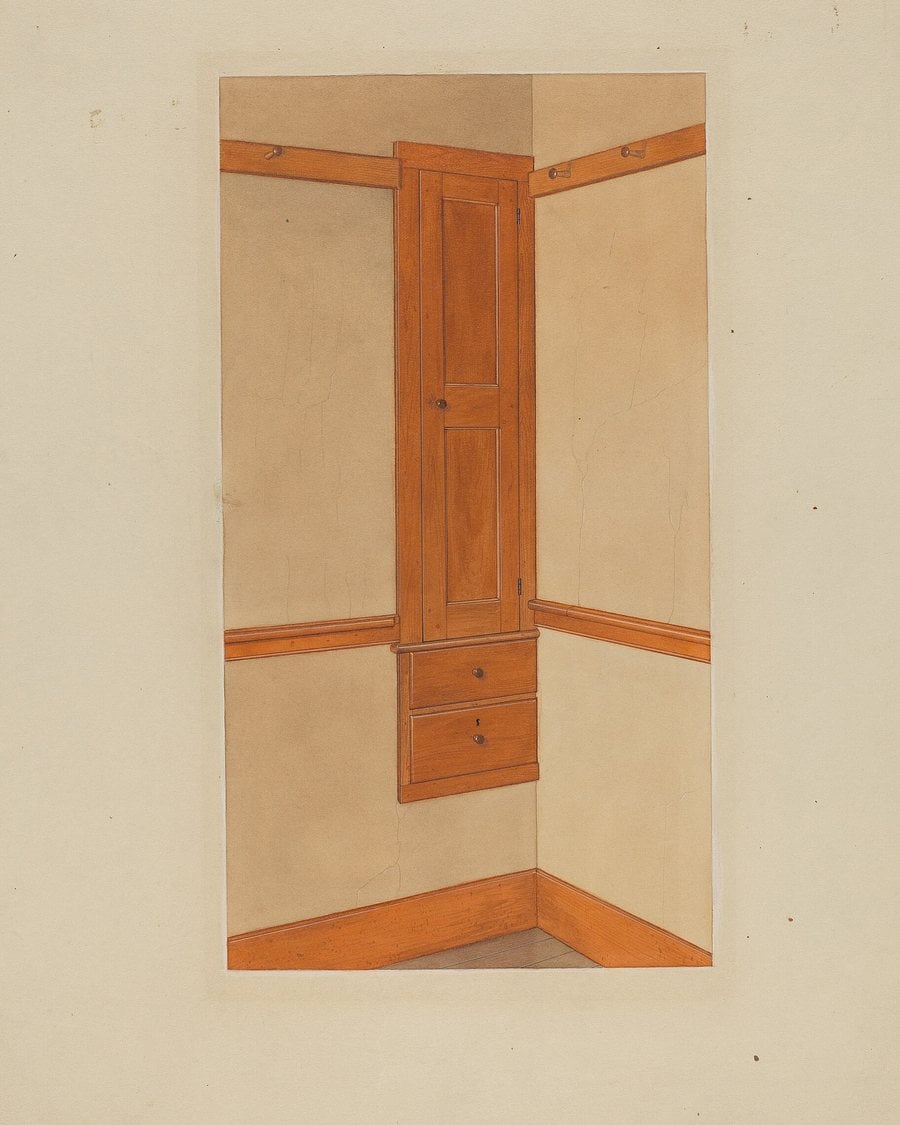
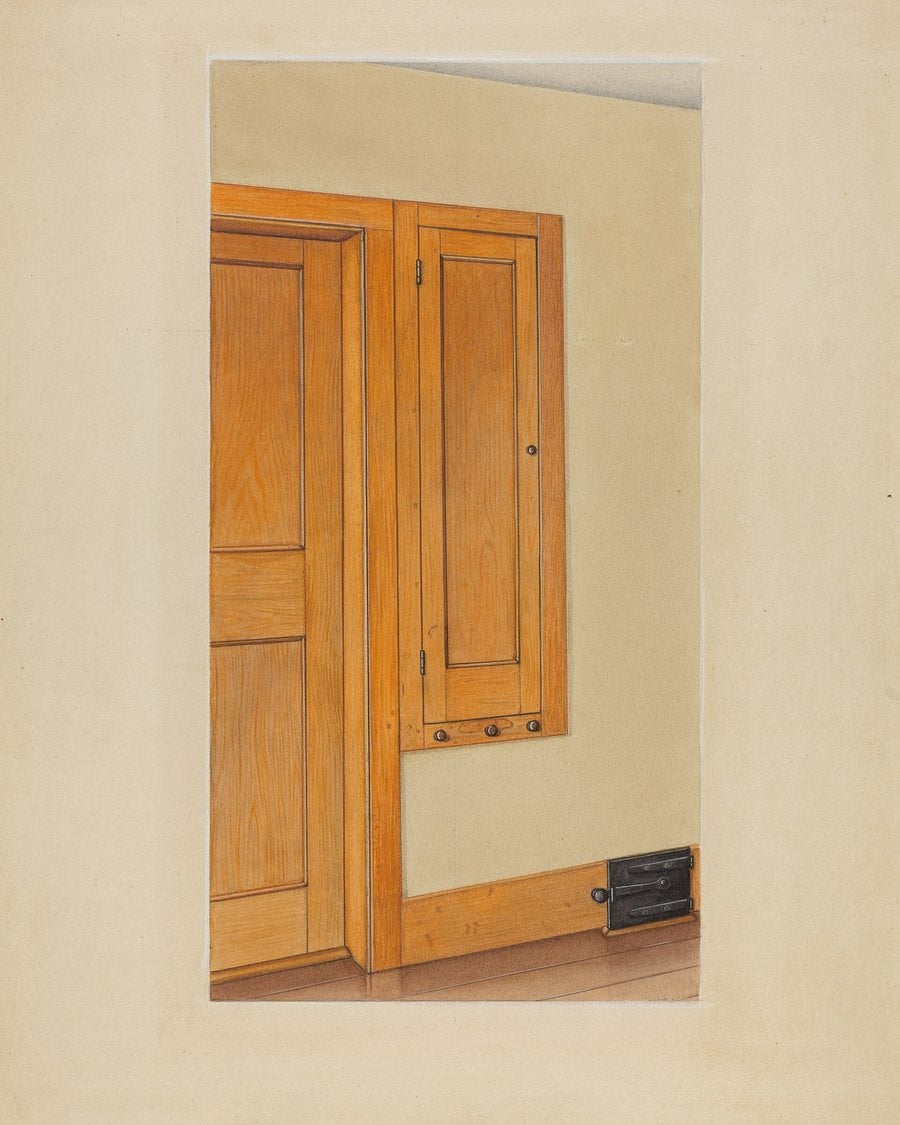
Knobs on shaker doors
Knobs are the traditional choice for shaker doors. The Met notes that in place of imported brass drawer pulls, the Shakers used simple turned wooden knobs, though the Shaker Museum at Mount Lebanon counts brass alongside wood among their traditional pulls.
Designers still start there. Merlin Wright, a kitchen designer who works in the style, told Homes & Gardens that hand-turned knobs keep a shaker kitchen true to the Shakers’ beliefs. Charles Denning, a San Francisco cabinetmaker, told Remodelista that for a traditionalist the best choice is a wooden knob or a very simple wood pull, while the New York interior designer Fawn Galli thinks brass works well and prefers it unlacquered.
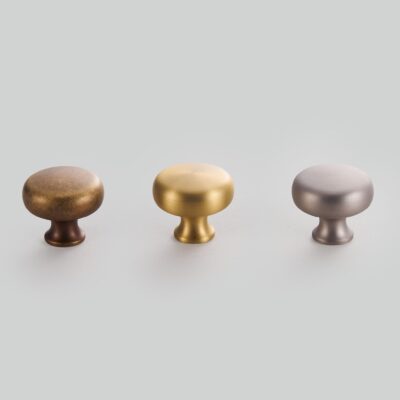
A plain round knob sits neatly on the narrow upright of the frame and keeps a long run of doors looking light. Our VELA knob, a turned shape with a flat disc top, and the rounded HIGHGATE knob are both in that spirit.
Knobs or handles: how designers mix them
The designers Homes & Gardens asked mostly mix the two, and decide by how hard each door or drawer is pulled. The interior designer Irene Gunter told Homes & Gardens that handles suit larger and heavier things such as fridges, wide drawers and larder cupboards, because they are easier to grip, while knobs work well on small drawers and wall cupboards. Kate Guinness, the London interior designer, likes knobs on the under-counter doors, handles on the drawers and larger handles on the appliances, and the designer Ginger Curtis describes the same split as pulls on the drawers and knobs on the cupboards.
That is our usual suggestion too: knobs on the doors, and cup pulls or handles on the drawers, where you pull hardest.
Cup pulls on shaker drawers
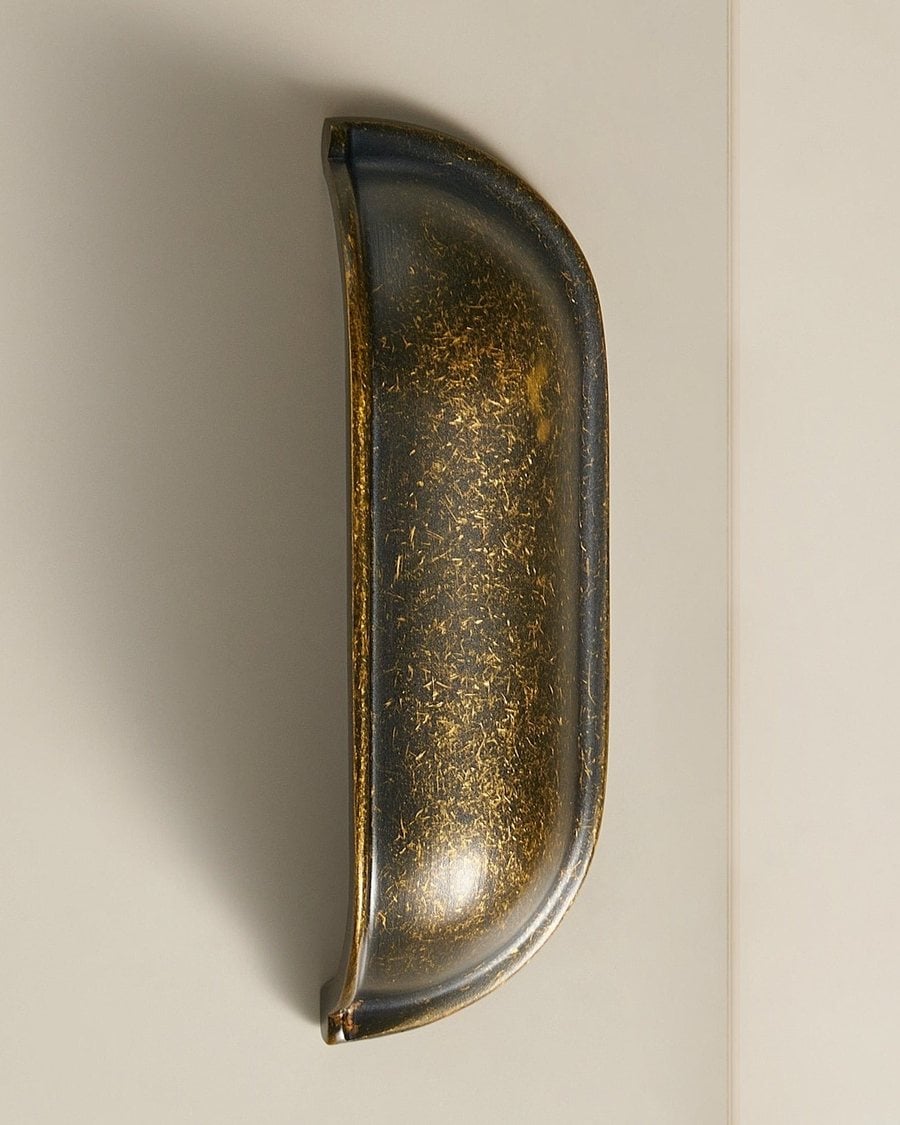
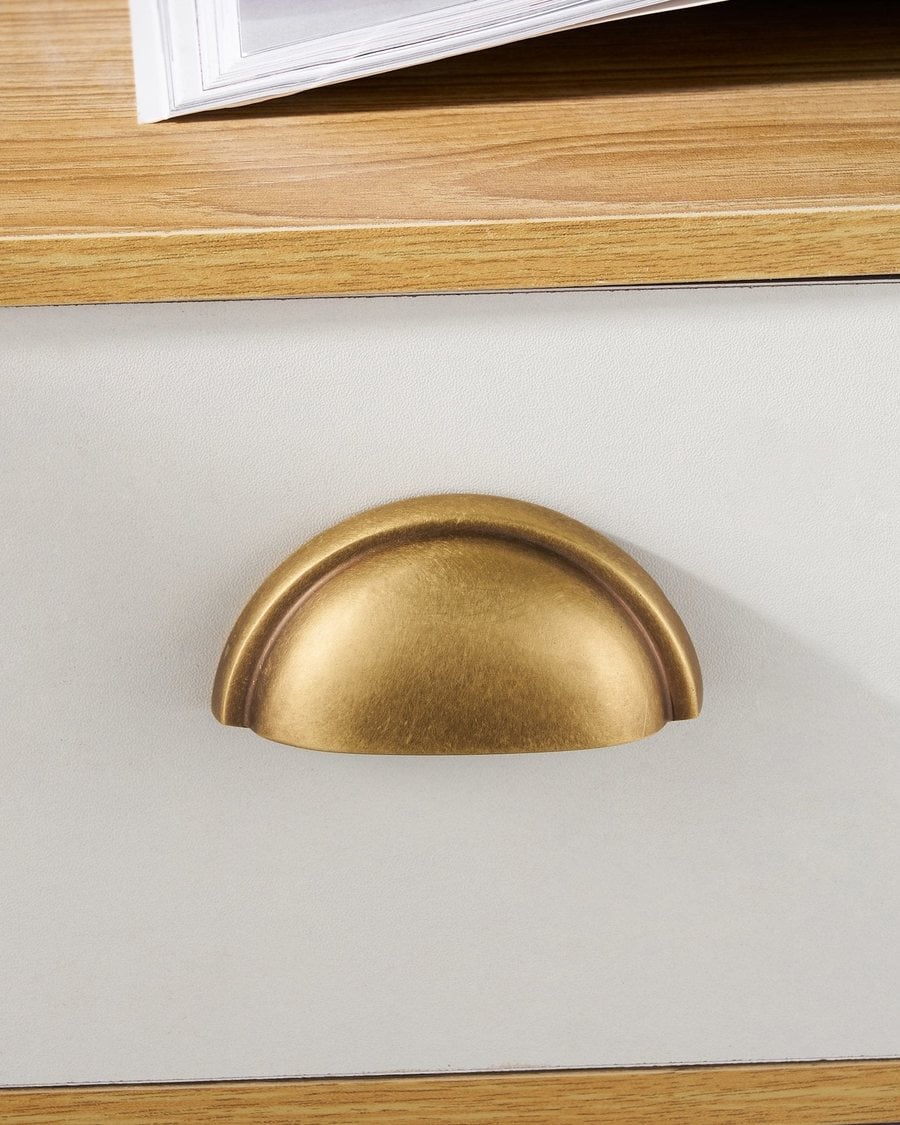
Homes & Gardens suggests cup handles in aged finishes for a traditional panelled shaker kitchen. You hook your fingers under the cup and pull towards you, which is exactly the movement a drawer needs.
The kitchen designer Jayne Everett gave Homes & Gardens a useful caution. Cup handles were once the default on a shaker kitchen and can look dated, especially fixed vertically, so she pairs them with knobs on the base and wall cupboards and keeps more practical bar handles for the tall cabinets. She adds that warm aged brass works well. We’d keep cup pulls to the drawers for the same reason.
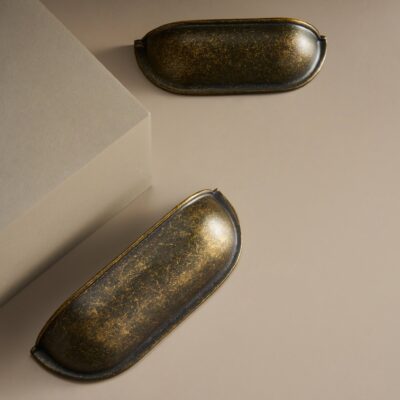
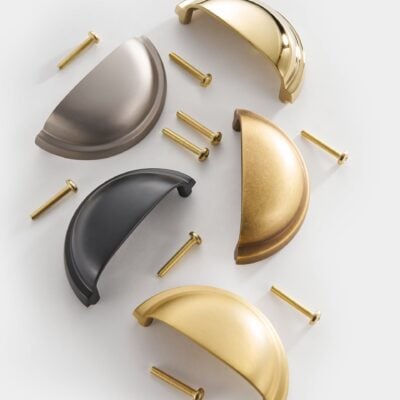
In our range, the KORA cup pull comes in 90 and 105 mm lengths in an aged vintage brass, and the HIGHGATE cup pull comes in five finishes, from satin brass to matte black. If you want a softer grip than a cup, the half-moon and edge pulls in our cup and edge pulls collection work on shaker drawers too.
A modern bar handle on a shaker door
Changing the hardware is the quickest way to make a shaker kitchen feel more contemporary. Ellen Holt, a lead designer at a Charleston studio, told Homes & Gardens that swapping the hardware makes a big impact for little work, and Jayne Everett finds T-bars more modern than cup handles.
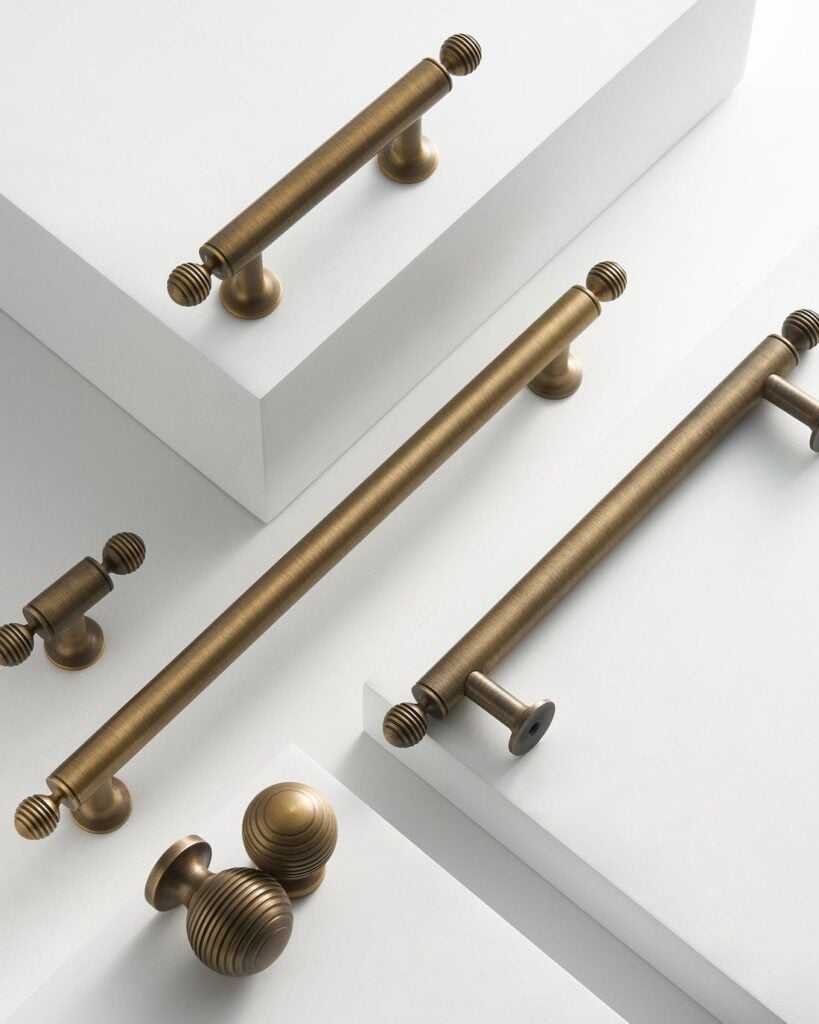
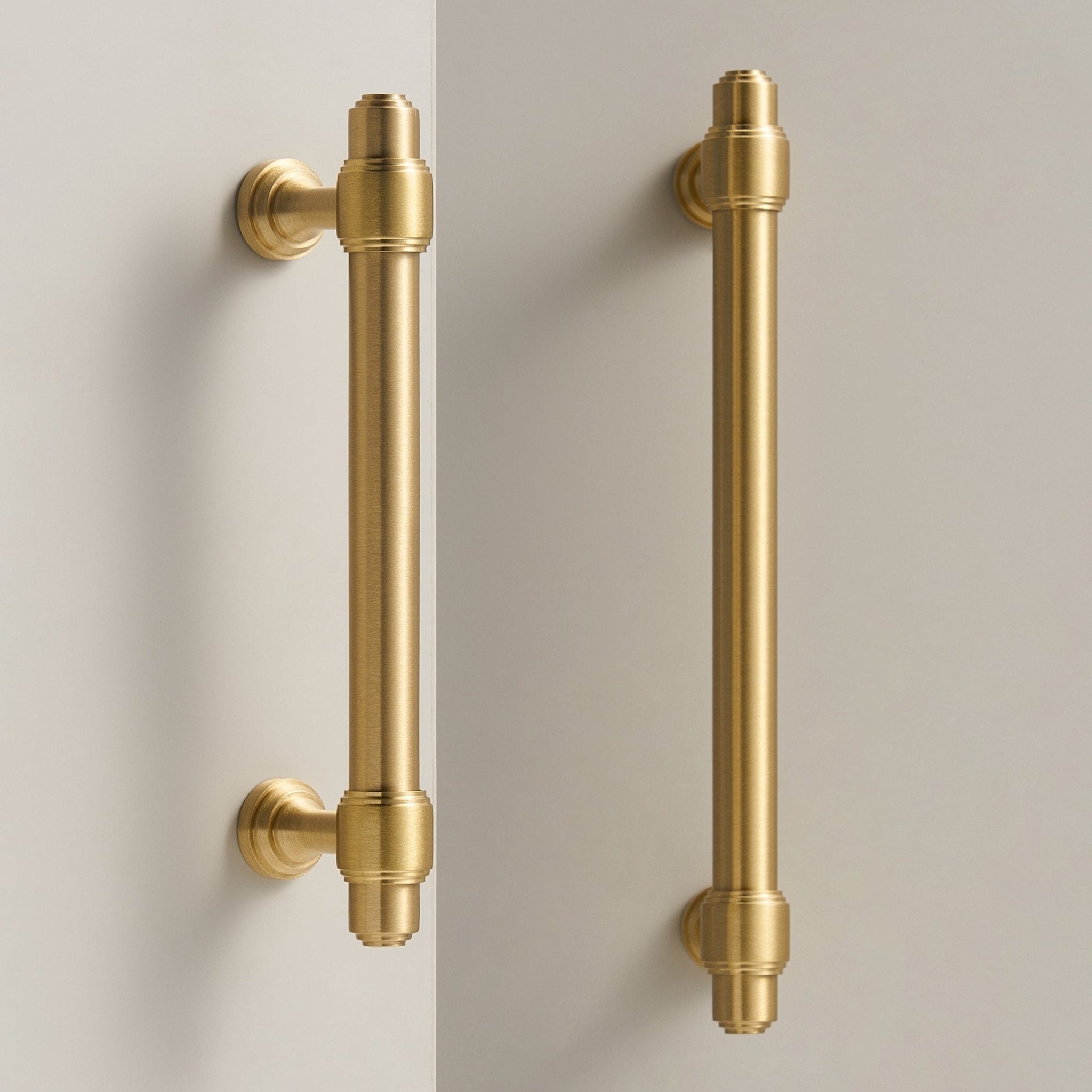
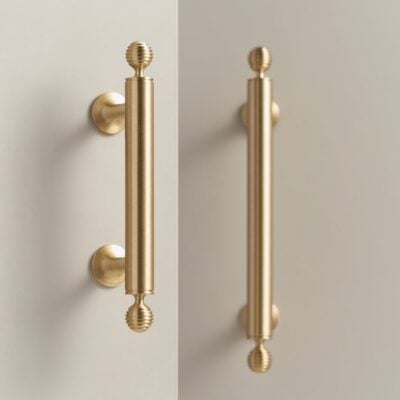
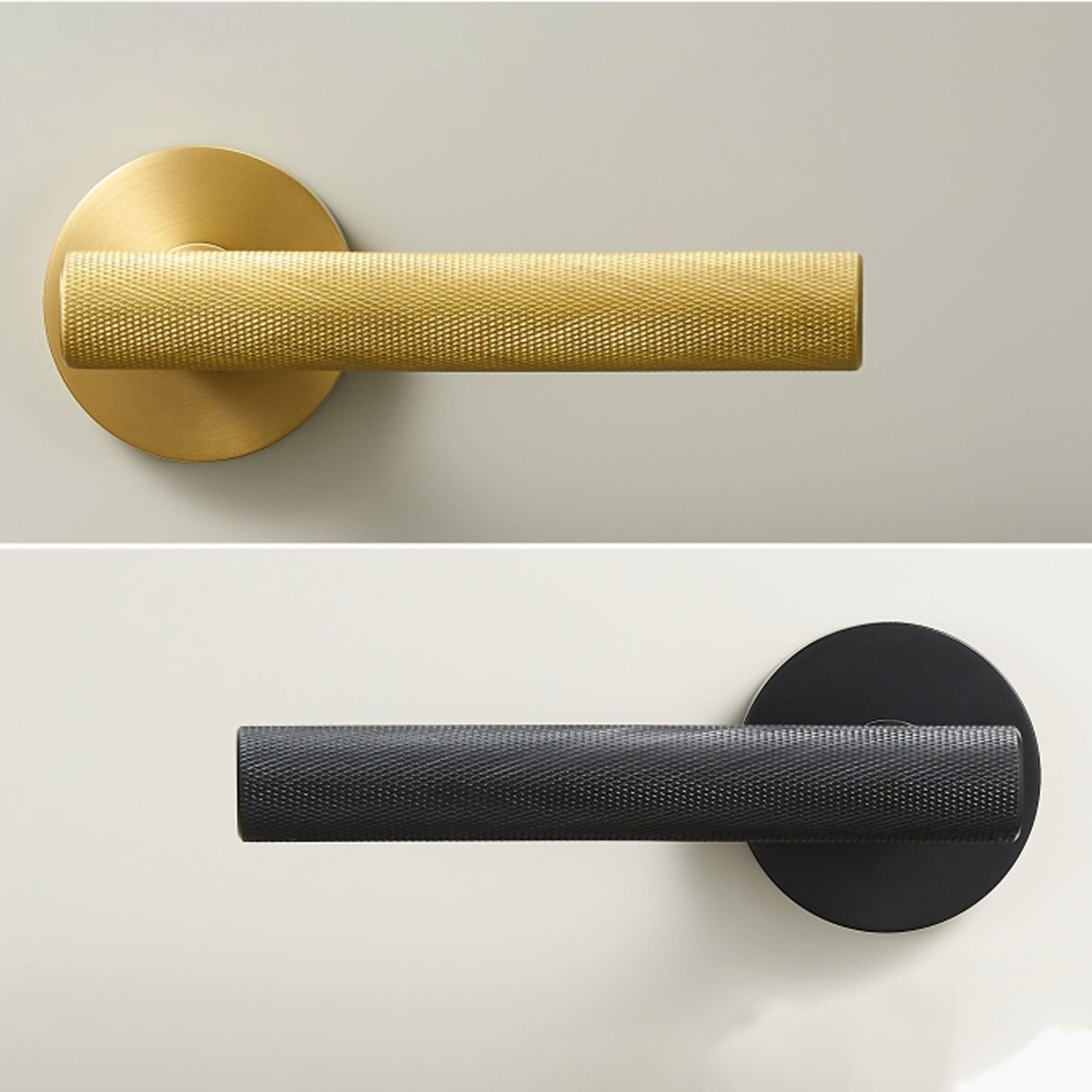
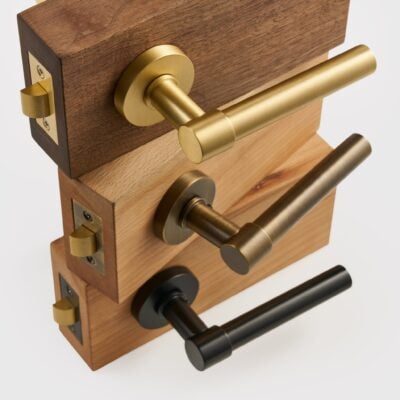
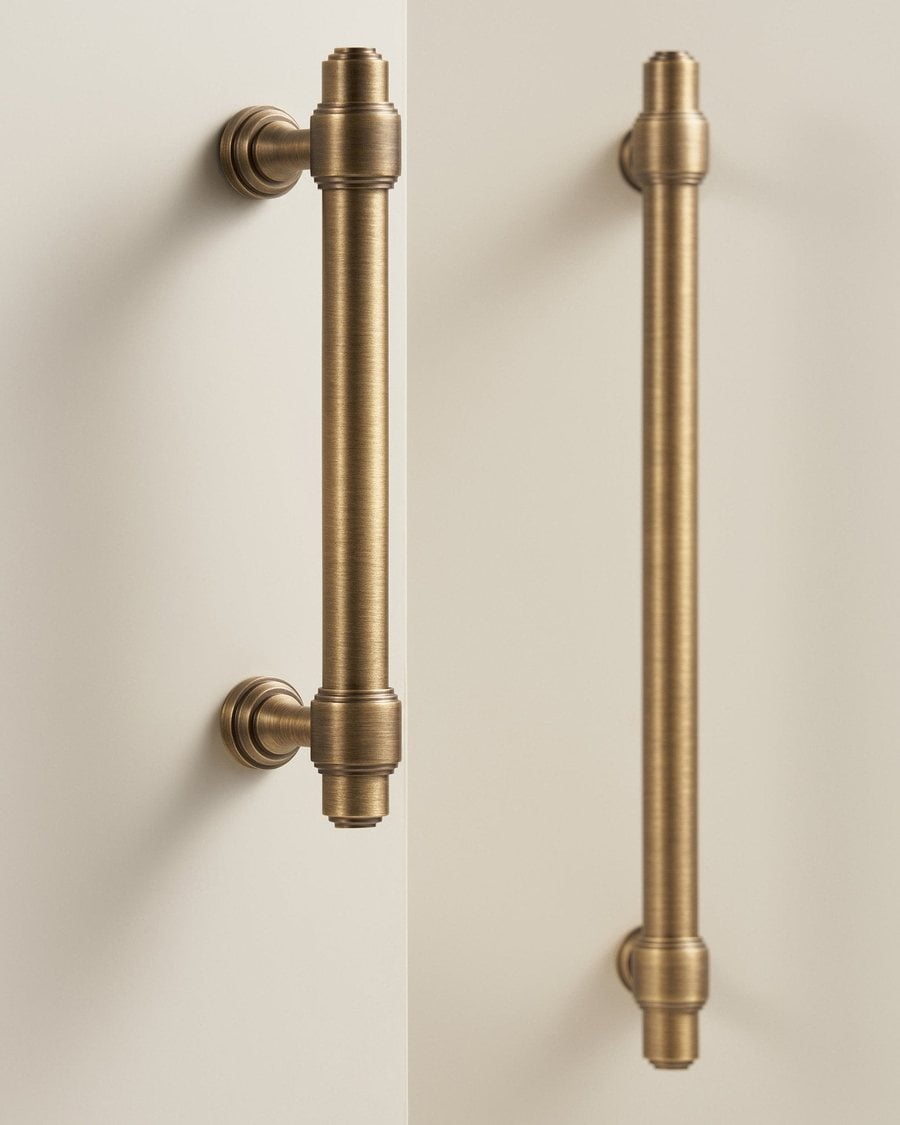
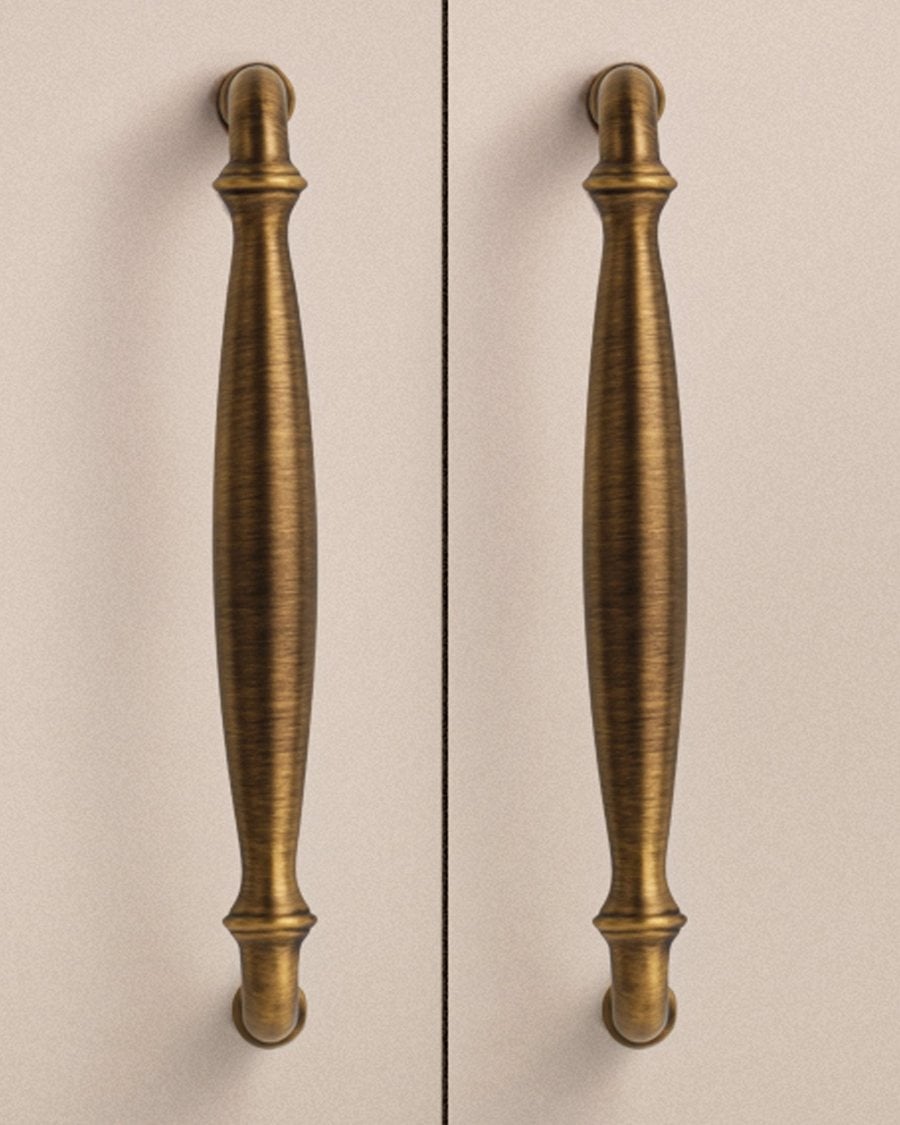
A slim bar handle, fixed upright on the stile of each door and level on the drawers, repeats the straight lines of the frame. Our VELA handle has an 11 mm bar with turned ends and comes on centres from 96 to 320 mm. The MARA handle, a turned bar in antique brass on 96 or 128 mm centres, sits between the traditional and the modern look. A T-bar fixes with a single screw like a knob but gives you a short bar to grip.
Where to fit handles on a shaker door
On a shaker door the knob or handle belongs on the stile, the upright part of the frame on the opening side, and never on the recessed panel. The panel is thinner and sits back from the frame, so a knob fixed there sits in a dip, has less to screw into and leaves your knuckles close to the edge of the frame.
The interior designer Kristen Harrison gave Livingetc her rules of thumb. On a panelled door such as a shaker door she places hardware a little higher than on a slab door, generally 1 to 4 inches, about 25 to 100 mm, from the top or bottom edge, keeping clear of the detailing. Knobs go in the corner on the opening side, bar handles run vertically on upper doors and horizontally on lower doors and drawers, and she tries every position with masking tape before drilling.
In practice that means towards the top of the stile on base units and towards the bottom on wall units. On drawers, Hettich’s furniture fittings guide gives the side position of a handle as the width of the front minus the hole spacing, divided by two, so a handle on 96 mm centres on a 500 mm drawer front has its first hole 202 mm in from the edge. If your drawer fronts are framed as well, we’d fix the hardware on the top rail, centred, so it stays clear of the panel there too.
How big shaker kitchen handles should be
Size the hardware to the frame first, and frames vary. The New York designer Tyson Ness told Homes & Gardens that classic shaker frames are about two to three inches wide, roughly 50 to 75 mm, depending on the size of the door, and that a narrower frame reads as more contemporary. Remodelista compared two makers whose frames run from about 2.25 to 5 inches between them, and the kitchen designer Helen Parker told it the frame should look substantial without looking clunky. The slimmer frames that Homes & Gardens calls micro shaker are narrower still.
Choose a knob, or the foot of a handle, that fits within the stile with a little flat frame showing on each side. The VELA knob comes in 25.5, 29.5 and 32.5 mm diameters and the HIGHGATE knob is 30.8 mm across.
On drawers we work to a handle about a third of the width of the front, the rule of thumb in our guide to choosing cabinet handles. A wide pan drawer can take one long handle, or two knobs or two cup pulls set in towards each end. If you’re replacing old hardware, measure the existing holes first: Hettich lists 32, 64, 96, 128 and 160 mm as established hole spacings, compatible with System 32, so most will match a standard size.
| Door or drawer | Hardware that suits it | Typical size from our range |
|---|---|---|
| Base unit door | A knob near the top of the stile, or a short bar handle fixed upright | Knob of 29.5 to 32.5 mm, or a handle on 96 or 128 mm centres |
| Wall unit door | A knob near the bottom of the stile | Knob of 25.5 to 29.5 mm |
| Tall larder door | A longer bar handle fixed upright on the stile | Handle on 160 to 224 mm centres |
| Small drawer | One knob or a small cup pull, centred | Knob of 25.5 to 29.5 mm, or a 90 mm cup pull |
| Standard drawer | A cup pull or a bar handle, centred | A 105 mm cup pull, or a handle about a third of the drawer width |
| Wide pan drawer | Two knobs or two cup pulls, or one long bar handle | Two 105 mm cup pulls, or a handle on 192 to 320 mm centres |
Finishes for a shaker kitchen
The Shakers painted or stained most of their furniture. According to The Met, blues, greens, reds and yellows were the most popular colours, regulated by the Shakers’ own rules, the Millennial Laws. The designers quoted above lean towards warm, quiet metals against painted doors: Jayne Everett likes warm aged brass, Fawn Galli unlacquered brass, and Helen Parker advises avoiding anything too fancy or shiny, telling Remodelista that “anything you choose that’s understated is fine”.
Satin brass is a sealed finish, so it keeps its colour. Antique brass is darker and suits a kitchen that is meant to look established from the start. Polished unlacquered brass starts bright and changes slowly: the Copper Development Association notes that indoors a noticeable change can take years, and that brass push plates at a Birmingham hospital ward had not darkened after three, so the parts you hold stay bright. For pale grey or blue paint, satin nickel is quieter. Our finish and care guide describes each one.
Check the door thickness before you order
Measure the frame where the hardware sits before you order. Our knobs and handles come with M4 x 25 mm screws, and our product pages note that longer screws are available for doors and drawers more than 20 mm thick. Our guide to choosing and fitting cabinet hardware covers marking out and drilling.
Quick answers
Should I use knobs or handles on a shaker kitchen?
Many designers mix them: knobs on the cupboard doors, and cup pulls or handles on the drawers and tall or heavy doors. Bar handles throughout look more modern.
Where do knobs go on shaker cabinet doors?
On the stile on the opening side, towards the top on base units and the bottom on wall units, about 25 to 100 mm from the edge, and never on the recessed panel.
Do cup pulls go on shaker doors or drawers?
Drawers, mainly. A cup pull is gripped from underneath, which suits a drawer. Jayne Everett pairs them with knobs on the doors and bar handles on tall cabinets.
Can you put modern handles on a shaker kitchen?
Yes. Changing the hardware is how designers often update one, and a slim bar handle fixed upright on the stiles repeats the lines of the frame.
What size knobs suit shaker cabinets?
One that sits within the stile with some frame showing each side. Classic frames are about 50 to 75 mm wide, which suits knobs of 25.5 to 32.5 mm.
Did the original Shakers use brass knobs?
Mostly not. The Met says they used turned wooden knobs in place of imported brass pulls, though the Shaker Museum counts brass among their traditional pulls too.
Sources
- Homes & Gardens: What is a Shaker kitchen? Interior designers explain the key features of this classic look. Bethany Adams on the shaker door, Merlin Wright on hand-turned knobs, Holly Vaughan on colour and hardware.
- Homes & Gardens: Should I use handles or knobs on kitchen cabinets?. Irene Gunter, Kate Guinness and Ginger Curtis on mixing knobs and handles; cup handles on traditional shaker kitchens.
- Homes & Gardens: 5 dated kitchen hardware trends. Jayne Everett on cup handles, knobs, bar handles, T-bars and warm aged brass.
- Homes & Gardens: 5 ways to update a Shaker kitchen, as recommended by designers. Ellen Holt on changing the hardware; Tyson Ness on frame widths.
- Homes & Gardens: Shaker kitchen ideas. Jennifer Markowitz on the shaker door as a canvas for hardware.
- Homes & Gardens: Micro Shaker kitchens. Slimmer frames than the classic shaker.
- Livingetc: What’s the best kitchen cabinet handle placement?. Kristen Harrison on placing hardware on panelled and slab doors.
- Remodelista: Shaker-Style Kitchen Cabinets, Remodeling 101. Stiles, rails and panel; frame widths; Fawn Galli, Charles Denning and Helen Parker on hardware.
- Country Life: Where did the Shaker kitchen come from?. The core elements of a shaker door.
- Financial Times (FT Weekend): Meet the Shakers, reproduced by the Shaker Museum. Ellsworth Kelly, Carlo Scarpa and Russell Pinch on Shaker design.
- The Metropolitan Museum of Art: Shaker Furniture. History and numbers, rejection of ornament, painted colours and turned wooden knobs in place of brass pulls.
- The Metropolitan Museum of Art: Architectural elements from a Retiring Room in the North Family Dwelling. Built-in cupboards and pegboards.
- Hancock Shaker Village: Made in Massachusetts. Built-in units of cupboards and drawers.
- Shaker Museum: Drawer pulls, what’s original?. Wooden, brass, porcelain and stoneware pulls on Shaker furniture.
- Copper Development Association: Antimicrobial Copper FAQ. How slowly bare brass darkens indoors, and handled brass staying bright.
- Hettich: Furniture fittings guide. Hole spacings and the side position of a handle on a drawer front.
Images: Product photographs and diagrams are our own. Top image: The Metropolitan Museum of Art, CC0, via Wikimedia Commons. Project photographs are reproduced with credit to the designers, homeowners and photographers named, who own them. Openly licensed images are used under the licence stated. Third-party photographs show real rooms and may include fittings and finishes that are not ours.