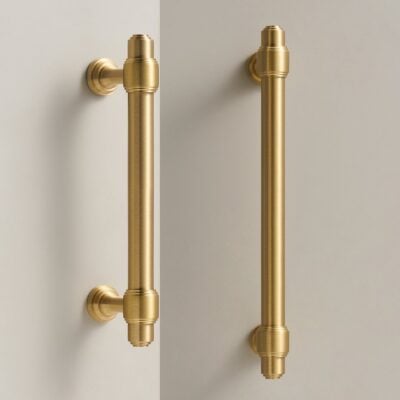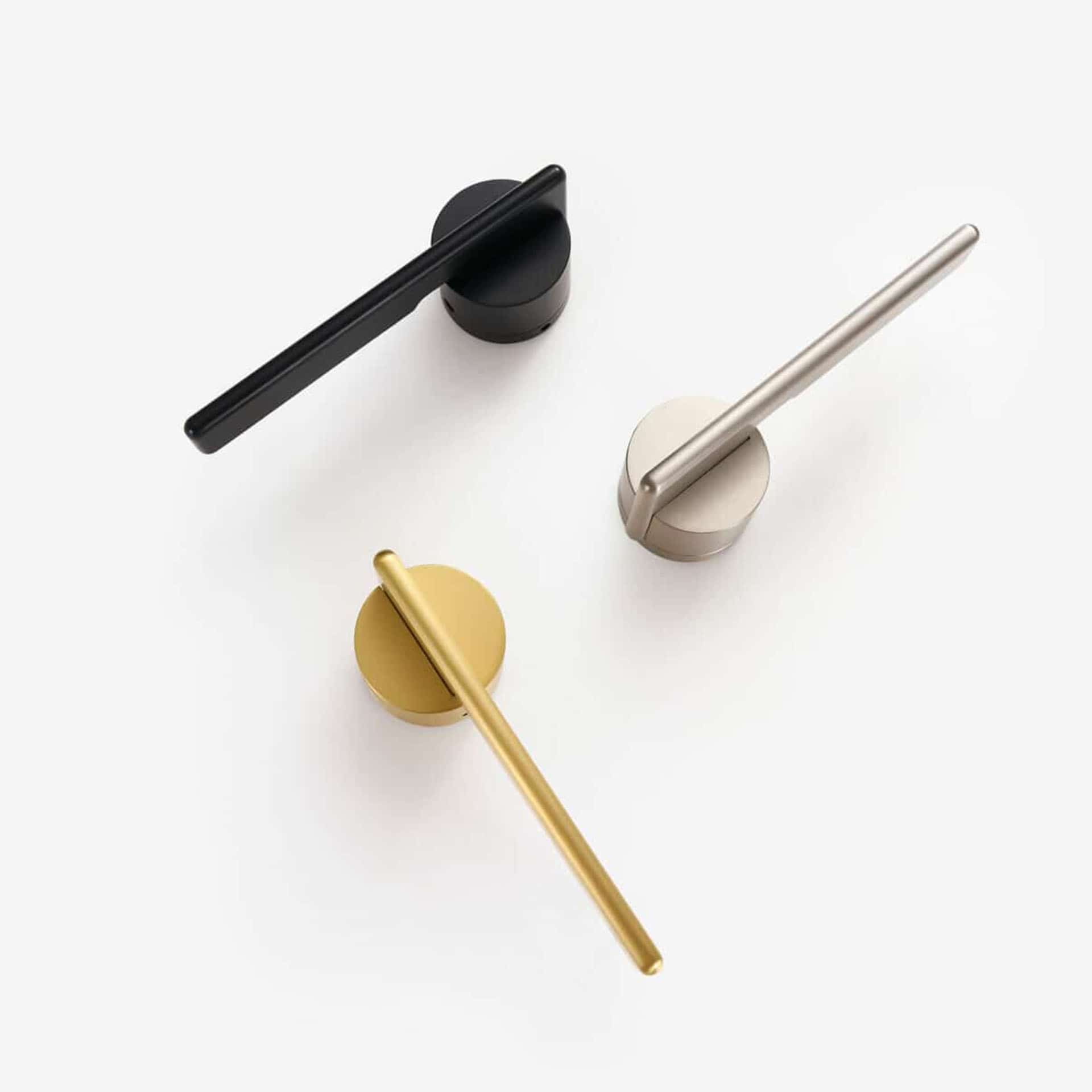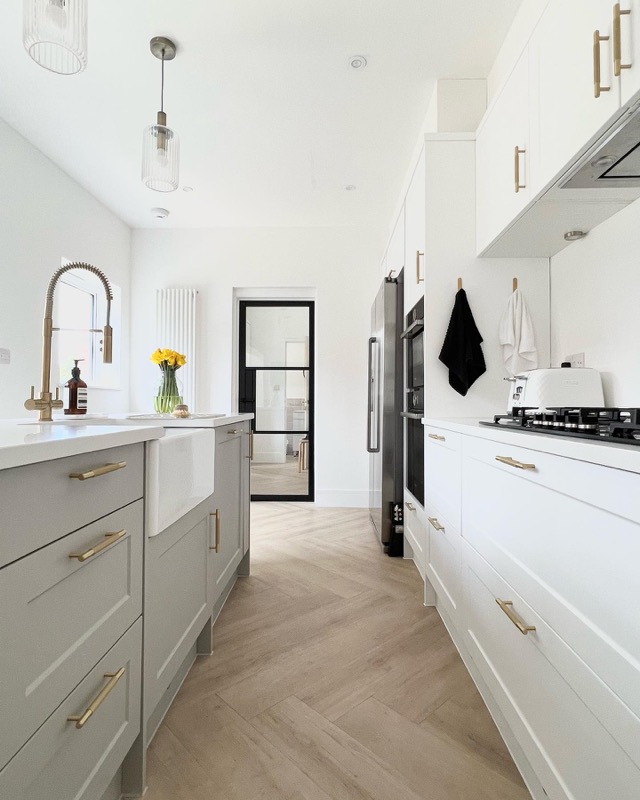




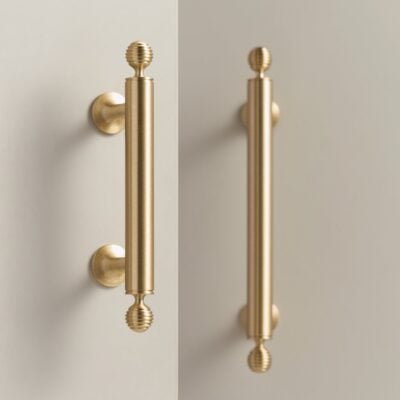








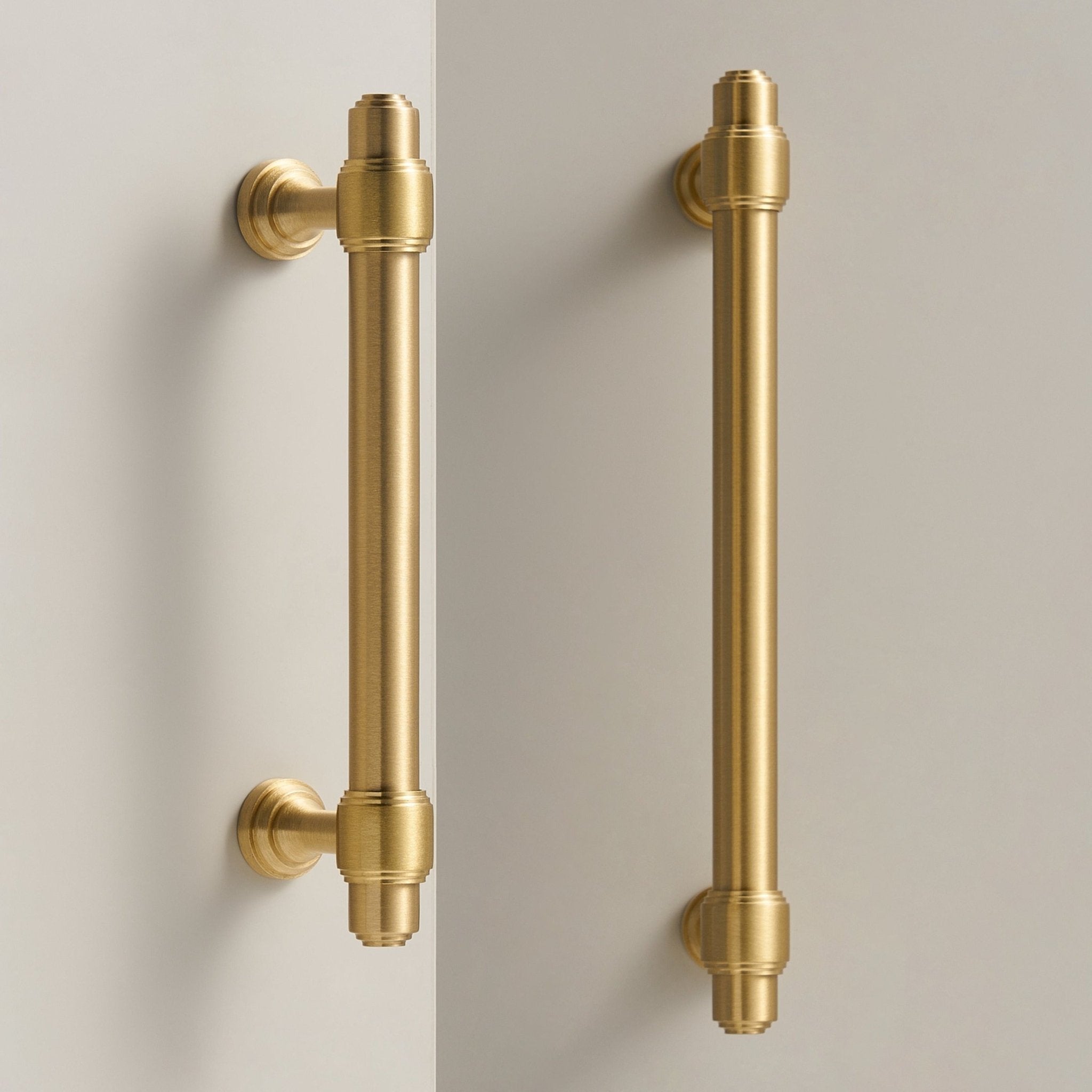
Centre to centre is the distance between the two fixing holes of a cabinet handle, measured hole centre to hole centre, not the overall length. Standard centres run 96, 128, 160, 192, 224 and 320mm.
Most of the handles that come back to us were ordered by overall length, or before anyone measured the holes already in the door. This is the measuring, sizing and retrofit logic we use ourselves, written down so you order once. Fitting steps and drilling templates live in our guide to choosing and fitting cabinet hardware.
What does centre to centre mean?
Centre to centre (written c/c or cc) is the spacing between the two threaded holes on the back of a bar handle, and therefore the spacing you drill in the front. A handle listed as “128mm overall, 96mm centres” is 128mm long end to end but fixes through holes 96mm apart. Order by centres, not overall length.
Centres is the only dimension the cabinet cares about: length, projection and bar diameter change how a handle looks; centres decide whether it fits. Knobs have no centres figure, which is why they suit odd holes.
Why are the standard sizes multiples of 32mm?
European cabinet-making works on a 32mm system (System 32): hinge plates, runners and shelf pins are bored on 32mm pitches, so handle centres followed. 96mm is 3 pitches, 128mm is 4, 160mm is 5, 192mm is 6, 224mm is 7 and 320mm is 10. That is why the same numbers recur across brands and 100mm or 150mm handles are the exception.
What are the standard cabinet handle centres and where does each size go?
Six centres cover almost every kitchen, wardrobe and bathroom job: the smaller three suit doors and narrow drawers, the larger three wide drawers, pan drawers and tall doors where a short handle looks lost.

| Fixing centres | Typical overall length | Where it usually goes | Front width it suits |
|---|---|---|---|
| 96mm | 120 to 135mm | Wall and base doors, narrow drawers, vanities, most flat-pack fronts | Doors 300 to 500mm; drawers to about 400mm |
| 128mm | 150 to 170mm | Standard doors, 400 to 500mm drawers | Doors 400 to 600mm; drawers 400 to 500mm |
| 160mm | 190 to 210mm | 500 to 600mm drawers, larder and tall doors | Drawers 500 to 600mm; doors 500 to 700mm |
| 192mm | 220 to 250mm | 600mm drawers, wide doors | Drawers 600 to 700mm |
| 224mm | 250 to 290mm | 800mm pan drawers, wardrobe doors | Drawers 700 to 900mm |
| 320mm | 350 to 400mm | 900 to 1000mm pan drawers, appliance and tall wardrobe doors | Drawers 900mm and over |
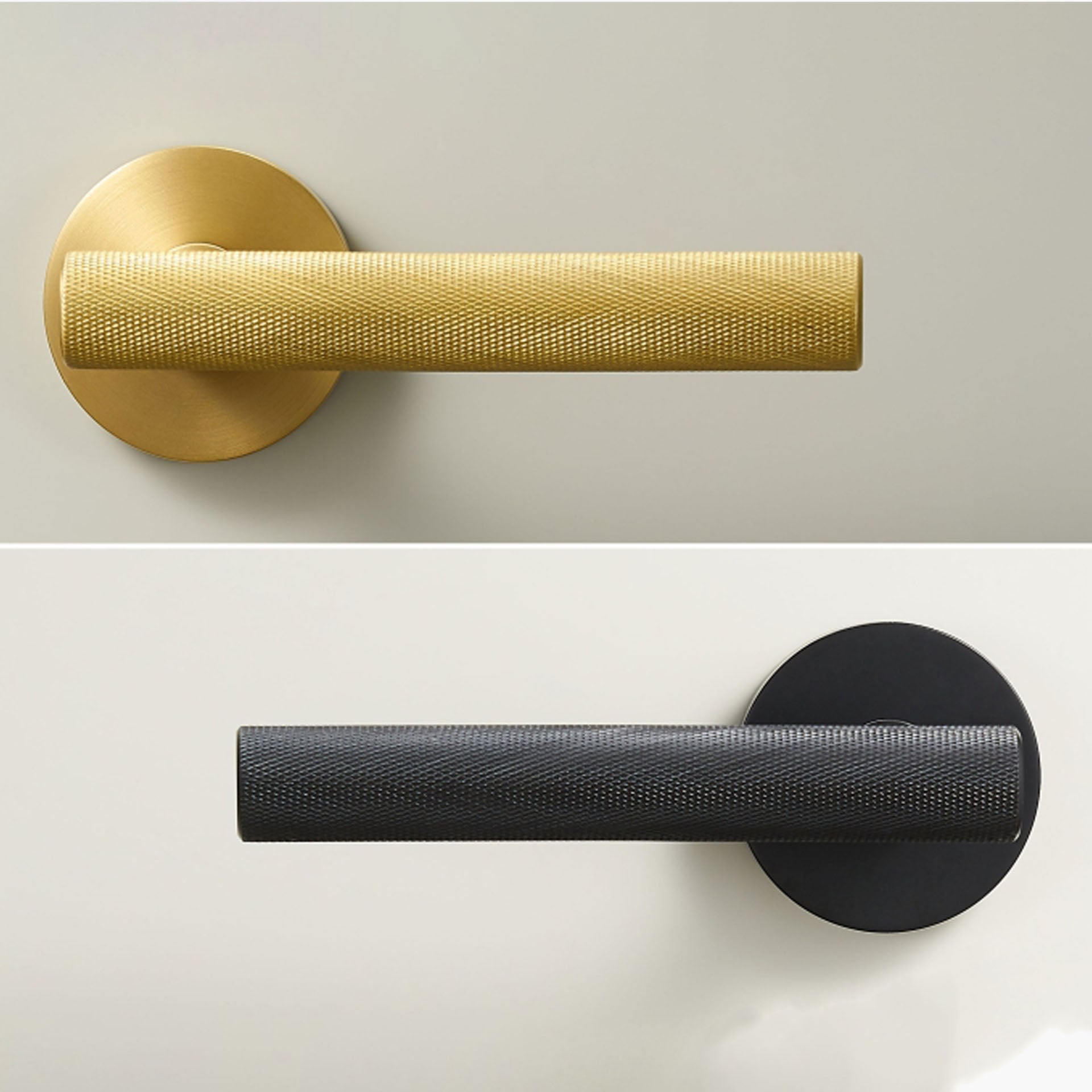
Our VELA solid brass handle is a typical example of the ladder: it runs from 128mm overall on 96mm centres up to 358mm overall on 320mm centres, so the same profile can be repeated from a narrow door to a wide pan drawer.
The overall lengths are typical trade ranges, not a rule: how far the bar runs past each hole varies by profile, so read the listing before you drill. Our cabinet handles collection covers the full ladder from 96 to 320mm.
What is the proportion rule for cabinet handle length?
A handle should span roughly one-third to one-half of the drawer front width. Below one-third it looks like an afterthought on a wide drawer; above one-half it reads as a rail. Doors are taller than wide, so proportion is judged against door height, and shorter handles mounted vertically are the norm.
The one-third guide, applied
| Front width | One-third | One-half | Sensible centres |
|---|---|---|---|
| 300mm drawer | 100mm | 150mm | 96mm |
| 400mm drawer | 133mm | 200mm | 96 or 128mm |
| 500mm drawer | 167mm | 250mm | 128 or 160mm |
| 600mm drawer | 200mm | 300mm | 160 or 192mm |
| 800mm drawer | 267mm | 400mm | 224mm, or two 128mm handles |
| 1000mm drawer | 333mm | 500mm | 320mm, or two 160mm handles |
Judge proportion on overall length, since that is what the eye sees. A 128mm-centres handle at 160mm overall on a 400mm drawer sits at 40%; on an 800mm pan drawer it sits at 20%, which is where owners feel something is off.
On doors, keep the handle short and vertical: 96 or 128mm centres for base and wall doors, 160mm for tall larder or wardrobe doors. On framed shaker doors the handle must also sit within the flat of the frame.
Should I choose a knob or a handle, and why do long bar pulls snag?
Knobs suit doors, framed fronts and small drawers; bar handles suit wide drawers and anywhere you pull with a full hand. Long bar pulls catch clothing for two reasons, projection and end profile.
Projection is how far the handle stands off the front. Many bar handles project around 30 to 40mm; at the top of that range, on a wardrobe door or beside a walkway, that is exactly belt-loop height. Where snagging is a risk:
- Lower projection: the low end of the range, or a knob or cup pull in a tight galley.
- Closed ends: a D handle, or a bar whose ends return to the door, rather than an open bar stopping in mid-air.
- Higher mounting: drawer handles at the top edge of the front, above hip height.
Wall units are the other trouble spot: a 320mm bar mounted vertically on a wall door can end at eye level, so keep them short.
How do I measure existing handle holes correctly?
Measure centre to centre before ordering anything. A 96mm handle will not go into 100mm holes.
- Remove the old handle and clean paint or filler out of the holes to expose the true bore.
- Measure from the left edge of the left hole to the left edge of the right hole. If both holes are the same diameter, that equals centre to centre without finding either centre by eye.
- Cross-check right edge to right edge. If the figures differ by more than 1mm the holes were hand-drilled or opened out; record both.
- Measure the hole diameter. Standard handle screws are M4, so 4.5 to 5mm is normal; 6mm or larger was opened out previously and may need a washer behind the handle.
- Note the front thickness. Bar handles are commonly supplied with 25mm screws to suit an 18mm front; a 22mm door or a 30mm framed door needs longer M4 screws, so check the length on the listing.
- Repeat on at least three fronts. Kitchens fitted over years often carry two spacings.
- Write the figure down as centres, in millimetres, next to the number of handles at that size. That list is your order.
A reading of 96, 128, 160, 192, 224 or 320mm means standard holes. A reading of 76, 100 or 150mm means the set was drilled outside the 32mm system and you need one of the routes below.
What are my options when the centres do not match?
Four routes: match the centres exactly, cover the old holes with a backplate, switch to a single-fixing knob, or fill and redrill. Which one depends on how far out the holes are and whether the finish can be touched up.
Route 1: same centres, different handle
The cleanest outcome. If the old holes are on a standard centre, buy the new handle at that centre; the overall length can differ, the fixings still line up.
Route 2: backplates over the old holes
A backplate sits between handle and door and hides what is underneath. It covers a pair of old holes if the plate is longer than the old centres plus one hole diameter, with a few millimetres spare, and the new fixings land within it. Backplates suit knobs particularly well: one central fixing in a fresh hole, both old holes hidden. Check plate length in our backplates collection against your old centres.
Route 3: single-fixing knobs
A knob needs one hole. Fit it through one existing hole and fill the other, or drill a fresh central hole and hide the old pair under a backplate. A central hole with two old holes showing either side is the version to avoid.
Route 4: fill and redrill
Glue a hardwood dowel or two-part filler into each old hole, sand flush, prime and touch up, then drill the new centres with a template so every front matches. On a factory-painted door the repair shows at close range unless the front is resprayed; on veneered or oiled timber a matching dowel can be near-invisible.
As a rule: a painted front you cannot respray takes a backplate; a timber front that wants a modern long bar takes fill and redrill.
What should I check on IKEA and flat-pack cabinets before ordering?
IKEA fronts are generally supplied undrilled, so any centres will fit; the checks that matter are front thickness, edge clearance and any push-to-open fitting behind the front.
Where flat-pack fronts are pre-drilled, 96, 128 or 160mm centres are most common. Confirm the spacing with the method above rather than trusting the box, and check that a long handle on a wall door clears the neighbouring unit when it swings. Our IKEA compatible collection groups the ranges that suit the common flat-pack centres, so one finish can run across the whole kitchen.
How do I mix handle sizes across a run without it looking accidental?
Use one profile and one finish, then let the centres change with front width. Mixed sizes look deliberate when handle length tracks drawer width consistently, and accidental when two same-width drawers carry different sizes or the profile changes.
Three habits keep it tidy: centre every handle on its front, or align all to the same offset from the top edge; keep stacked drawers on one vertical centreline; and when a wide drawer wants two handles, fit two of the same size symmetrically. Two 160mm handles on a 1000mm pan drawer read as considered; one 320mm handle offset to one side does not.
What should I check before I order?
- Measure: existing holes as centres, in millimetres, on at least three fronts.
- Decide the route: matching, covering, or filling and redrilling, and buy backplates in the same order if needed.
- Proportion: overall length against the one-third to one-half rule on your widest drawer, not just the doors.
- Projection and ends: anywhere the handle sits in a walkway or on a wardrobe.
- Front thickness: so screw length is right; standard fixings usually assume an 18mm front.
- One batch: every size in the same finish and profile in one order, so the run matches.
Kitchen fitters, joiners and designers specifying handles across whole projects can apply to the trade programme.
In short
- Order by centre to centre, never overall length: standard centres are 96, 128, 160, 192, 224 and 320mm.
- Measure existing holes edge to edge on at least three fronts before you buy.
- A handle should span one-third to one-half of the drawer width, judged on overall length.
- Non-standard holes take a backplate, a single-fixing knob, or a fill and redrill.
- In walkways and on wardrobes, choose lower projection and closed ends.
Frequently asked questions
Are 96mm handles standard in the UK?
Yes. 96mm centres is one of the most common sizes on UK kitchen doors and narrow drawers, with 128mm and 160mm next.
Is a 128mm handle better than a 96mm handle for kitchen drawers?
It depends on drawer width: on a 300 to 400mm drawer 96mm centres stays within the one-third to one-half range; on a 450 to 500mm drawer 128mm sits better.
What size handles do I need for kitchen drawers?
Match centres to width: 96mm up to about 400mm, 128mm for 400 to 500mm, 160mm for 500 to 600mm, 192 or 224mm for 600 to 900mm, and 320mm or two shorter handles for 900mm and wider.
Can I replace cabinet handles using the same holes?
Yes, if the new handle has the same centres. Standard readings (96 to 320mm) order directly; non-standard holes take a backplate or a fill and redrill.
How do I fill and redrill handle holes?
Dowel or two-part filler in each hole, sand flush, prime and touch up, then drill the new centres with a template. Expect the repair to show slightly on factory-painted doors unless resprayed.
Are meraki. handles IKEA compatible?
Many are, grouped in the IKEA compatible collection. IKEA fronts are generally undrilled so any centres will fit; pre-drilled fronts are usually 96, 128 or 160mm, so measure and order that size.
Do long bar handles snag clothing?
They can. A bar with open ends at hip height on a wardrobe or beside a walkway is the usual culprit; choose a lower projection, ends that return to the door, or a knob there.
How far should a cabinet handle stick out from the door?
Many bar handles project around 30 to 40mm, enough for a full-hand grip. Where clearance matters, look for the lower end of that range or a knob, and read the projection figure on the listing.
Sources and standards
- The 32mm system (System 32) cabinet-construction convention, on which 96, 128, 160, 192, 224 and 320mm centres are based.
- BS 3643 / ISO 261, ISO metric screw threads: the M4 thread used for standard cabinet handle fixings.
- meraki. hardware size measuring guide, /hardware-size-measuring-guide/, for measuring conventions across door and cabinet hardware.
- meraki. guide to choosing and fitting cabinet hardware, /how-to-choose-and-fit-cabinet-hardware/, for fitting steps and drilling templates.