











In short
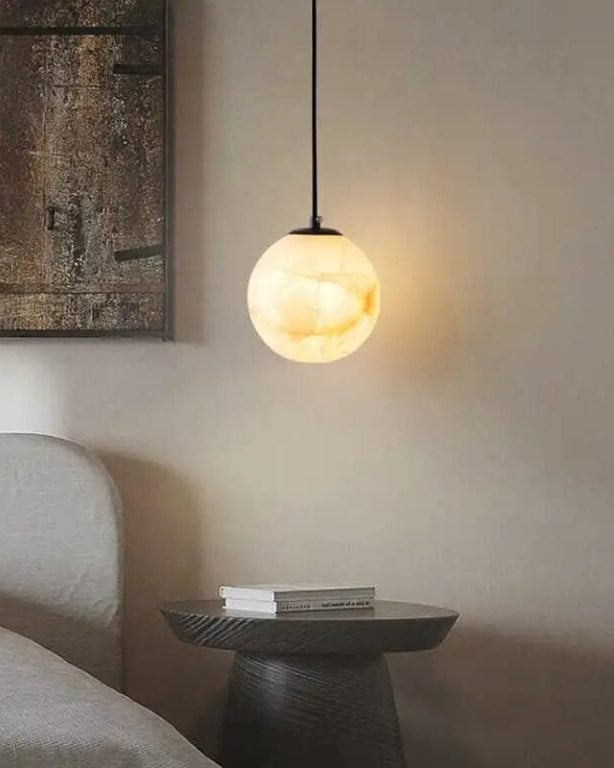
After dark, designers switch off the ceiling light, or turn it low, and light the room from lamps and wall lights, five or more to a room, each on a dimmer. The bulbs stay warm: about 2700 K in living rooms and bedrooms, no cooler than 3000 K elsewhere, with a CRI of 90 or more.
The big light, the one in the middle of the ceiling, is the light most designers leave off in the evening. In a piece on light and mood, House & Garden called ceiling lights „never a favourite of any interior designer“, and the designers below light their rooms after dark with lamps, wall lights and candles instead.
Here is how they do it, in their own advice to House & Garden, Livingetc, Homes & Gardens and Elle Decoration, and then the bulbs that make a lamp glow.
Why designers switch off the big light
Designers find that light from the middle of the ceiling flattens a room. The interior designer Janine Stone told House & Garden that a single ceiling light can feel flat and unforgiving in a hallway, where what you want is atmosphere more than brightness. Simon Temprell, an interior design lead, told Homes & Gardens that the central pendant once standard in British living rooms cast an unflattering light with no nuance or warmth. The decorator Nicky Haslam put it most simply in House & Garden: „eye level lighting is much nicer and makes people look pretty“.
There is a reason beyond looks. The environmental psychologist Sally Augustin told House & Garden that at the end of the day, warmer and dimmer light works better on your mood when it comes from lower fittings such as table and floor lamps.
Few designers would take the ceiling light out altogether. The interior designer Bethany Adams told Homes & Gardens never to remove the wiring for a central fitting, and the designer Christian Bense told Livingetc that the overhead light needn’t be central: hung in a corner it feels more like an installation, and you’re more likely to switch it on.
Light the room from below and from the walls
Designers build the evening light low down, where people sit. The interior designer Adam Bray told House & Garden that he always lights a room from the ground up, rarely uses spotlights and always allows for candles. Christian Bense sets lights at different heights, some above you as you sit and some only just above eye level. The designer Michael Winn told Homes & Gardens that low light, from under-cabinet strips, sconces or a small lamp on the counter, is what makes a kitchen feel like a room.
Designers also leave some of the room dark. The interior designer Olga Ashby told Livingetc to leave some areas unlit so the ones you light stand out, and the interior designer Philip Hooper paints the insides of lampshades a soft pink, which he told House & Garden makes the light very flattering.
How many lamps does a room need?
Christian Bense told Livingetc that a living room, and almost any other room, ideally has five sources of light: overhead light, wall lights, floor lamps, table lamps and task lighting. Charu Gandhi, the founder of the interior design studio Elicyon, says a room can have up to seven sources for ambience, each on a dimmer, from a light bright enough to find your glasses to one for watching television in the near dark.
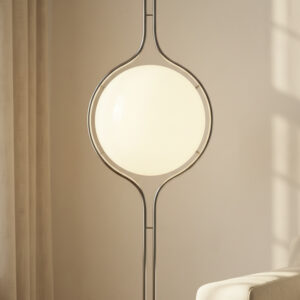
Switching them all on is the practical problem. The interior designer Pandora Taylor told House & Garden that she hates going round turning lamps on and off and would rather have them all on one switch, and Philip Hooper recommends a 5-amp lighting circuit, which lets you control a room’s lamps from a wall switch. We’d plan one into any rewire. For a corner with no room for a table, the VERSO floor-to-ceiling lamp takes up less floor than an ordinary floor lamp and washes the walls and ceiling around it with light.
Wall lights: a lamp’s glow without a table
Wall lights do a lamp’s job where there is nowhere to stand one. The interior designer Sarah Vanrenen told House & Garden not to hang them too high: like pictures, they should be at roughly eye level. The interior designer Henri Fitzwilliam-Lay spreads light round a hallway with wall lights or lamps on a console, always on a dimmer and turned down to a glow in the evening, and the interior designer McKenzie Millhousen told Livingetc that near game tables, in libraries and in dining rooms the choice is almost always a sconce.
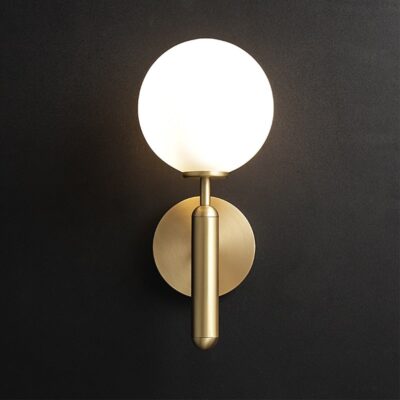
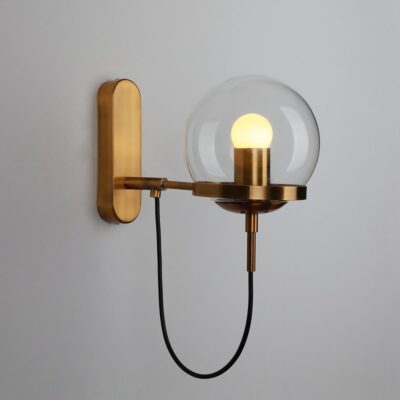
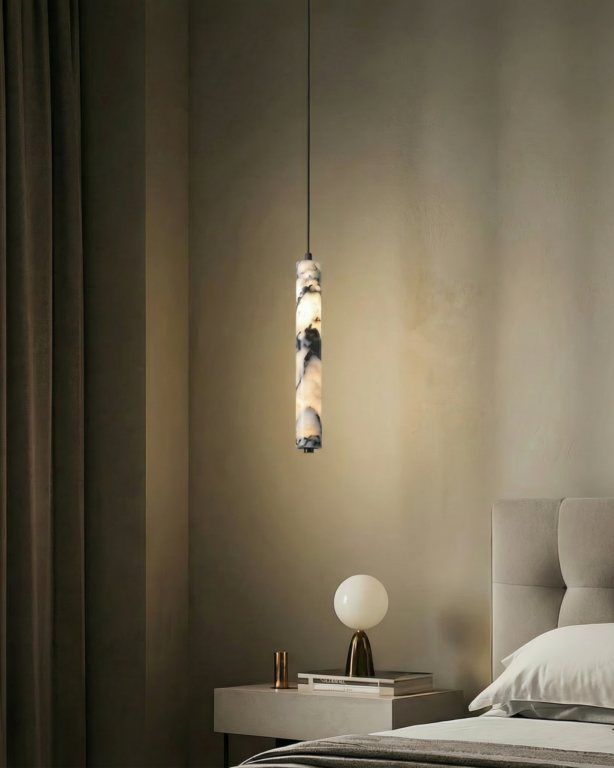
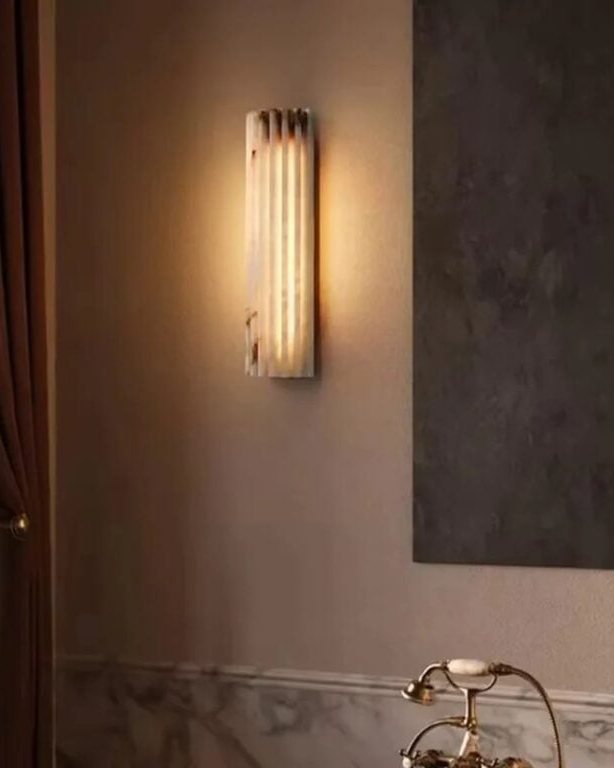
Several of our wall lights suit this kind of light. The FLEUREN wall light comes in a UK and EU plug-in version, and the PLEN has a plug-in version with a fabric cord and an inline switch, for walls with no wiring. The RAFI throws its light up and down the wall, so the wall itself glows and none of the light shines straight into the room. The page for the CELESTE single wall light suggests a pair either side of a bed in place of bedside lamps, and the alabaster TONDO and LUME glow through the stone. The rest are in our wall lights collection.
Room by room after dark
In the dining room, the interior designer Erik Munro told Elle Decoration to put out the overhead lights and use wall sconces, candles and table lamps. The architectural lighting designer Eileen Pierce told Livingetc to keep a pendant over the table dimmable and add a soft glow on the walls or ceiling, so the table doesn’t sit in an isolated bright pool. Our guide to pendant height over an island or table covers where to hang it.
Kitchens need bright light to cook by, though not all evening. The designer Kailee Blalock’s advice to Homes & Gardens is to dim the ceiling lights as the days get shorter and let pendants, sconces and smaller fittings make pockets of warmth, and the interior designer Jess Cooney suggests a lamp on the worktop, left on through the winter.
In the halls of larger houses, Janine Stone layers wall lights, picture lights and table lamps. In a bedroom, Eileen Pierce favours indirect light, a bedside light with a good cut-off and little brightness at the ceiling. Whatever the room, the interior designer Ottalie Stride told House & Garden that the light from a lamp should always be soft and warm, because it is there to create atmosphere.
Warm white: 2700K or 3000K?
A lamp glows only if its bulb is warm, and on the box that means a low colour temperature, measured in kelvin (K). The CIE, which sets international lighting terms, defines the figure by matching a bulb’s light to an ideal source glowing at that temperature. As Brendan Ravenhill’s lighting studio puts it in its bulb guide for Remodelista, the lower the kelvins, the warmer the light.
Most designers work between 2700 and 3000 K. Homes & Gardens‘ guide to lighting basics says designers lean towards 2700 K for living rooms and bedrooms, the closest to candlelight, and use 3000 K in kitchens and bathrooms. The lighting designer Sally Storey told House & Garden she would never go cooler than 2700 K in a home, and uses 2200 K for decorative lights that come on in the evening. The interior designer Alex Dauley prefers 3000 K for every bulb, and told Livingetc that filament bulbs can look a little orange. Ravenhill’s studio sets 3000 K as the limit anywhere in the house.
Whichever you choose, keep it consistent. The designer Nina Lichtenstein told Homes & Gardens that colour temperature should be the same throughout the home, and Eileen Pierce wants it consistent at least within a space. We’d never put two temperatures side by side, for example in a pair of wall lights either side of a mirror.
Colour temperature room by room
| Room | Colour temperature | Who says so |
|---|---|---|
| Living room | 2700 K, 2200 K for lamps in the evening | Homes & Gardens‘ guide; Sally Storey for evening lights |
| Bedroom | 2700 to 3000 K, dimmable | Magda Callery; Brendan Ravenhill’s studio |
| Dining room | 2700 K, dim-to-warm over the table | Ravenhill’s studio; Eileen Pierce keeps the pendant dimmable |
| Kitchen | 2700 to 3000 K, down to 2400 K for more warmth | Christina Cruz; Shannon Kadwell |
| Bathroom | About 2700 K, no cooler than 3000 K | Carolyn Cerminara; Ravenhill’s studio |
| Hallway and landing | 2700 to 3000 K | Our suggestion, matching the rooms either side |
Colour rendering: why designers ask for 90
CRI, the colour rendering index, tells you how faithfully a light shows colours. The interior designers Lauren Gilberthorpe and Olga Malyev told Homes & Gardens to aim for 90 or more, so colours look true and materials keep their richness. House & Garden adds that a low CRI makes a room look flat and washed out, and that most bulbs on the high street fall below 90.
A fitting that takes a standard screw bulb, such as the CELESTE and FLEUREN wall lights or the CANITE pendant, can take a 90 CRI bulb instead, and we’d fit one wherever paint, oak, marble or brass matter.
Dimmers and warm dimming
An old incandescent bulb turned warmer as it dimmed; an ordinary LED just gets darker. Ravenhill’s studio told Remodelista that regular LEDs on a dimmer feel cold and blue, while dim-to-warm bulbs shift towards amber as they dim, and it names the lights over the dining table, by the bed and in the living room as the places for them. Michael Winn told Homes & Gardens that dim-to-warm LEDs drop towards 2200 K as you dim them, and his designers put the ceiling lights, the pendants and the under-cabinet lights on separate controls.
The fitting has to suit the dimmer as well, and Sally Storey told Homes & Gardens to check that any pendant you buy is dimmable, especially when its LEDs are built in. In our range the CELESTE wall lights are dimmable, the FLEUREN and RAFI wall lights dim with a dimmable bulb, which isn’t included, and the MARMO Ball dims with a compatible dimmer, while the LUME and the ALMA wall light are not dimmable.
Which bulbs our lights take
E27 and E14 are screw fittings, the larger and the smaller, and G9 and G4 are small capsule bulbs that push into the holder. Among our wall lights, the CELESTE takes a supplied E14 bulb, the FLEUREN wall light and the RAFI a supplied E27, and the FLEUREN Twin supplied G4 bulbs, while the PLEN and the VERSO lamp take an E27 bulb you buy separately. Integrated LEDs have their colour set when they are made: 3000 K for the LUME, and warm white, listed as 2700 to 3500 K, for the TONDO and the MARMO Ball. The ALMA wall light and the ALMA pendant let you choose 3000 K, 4500 K or 6000 K when you order; we’d choose 3000 K, which their pages suggest for living and dining rooms.
How warm light changes paint, brass and stone
Paint shows the change first. Tash Bradley, the colour expert who co-founded the paint company Lick, writes in Livingetc that warm light lifts reds, oranges and yellows but can dull cooler tones, and advises testing a colour under the bulbs you’ll actually use.
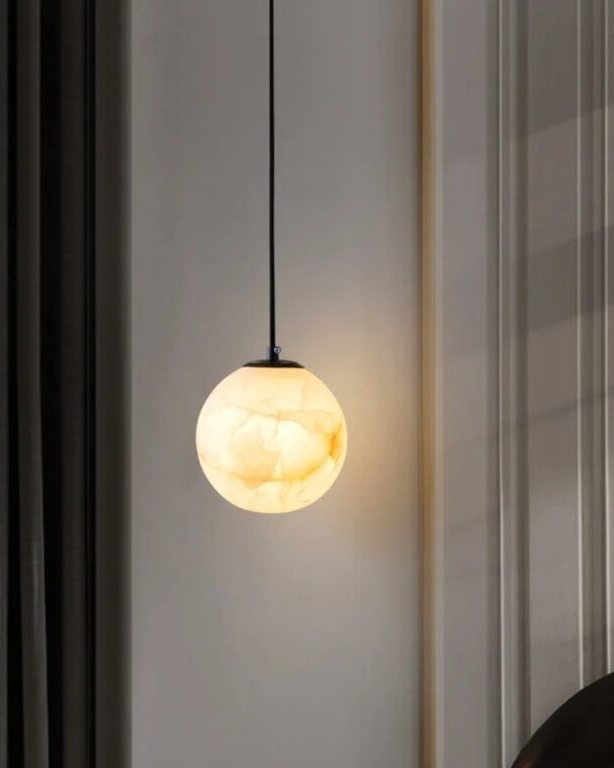
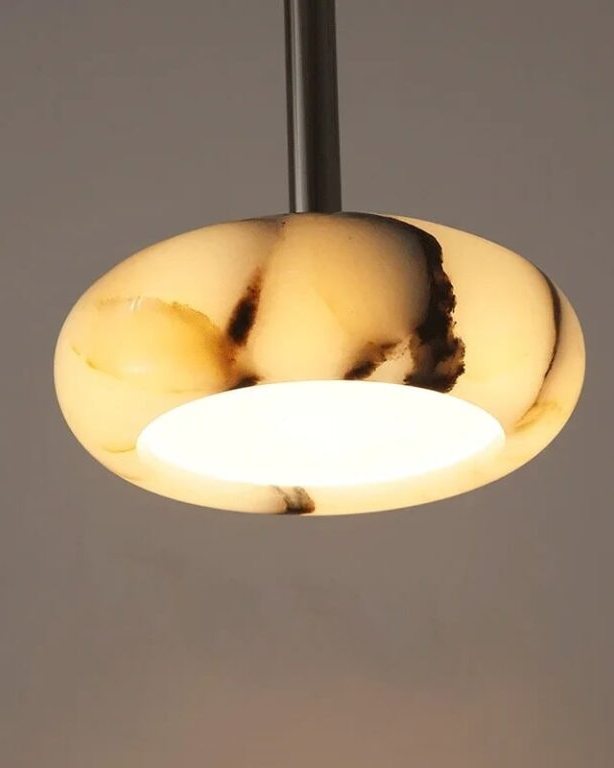
The rest is our opinion. Warm white makes brass look richer and more golden, and cool white makes it paler. Nickel and chrome pick up a faint yellow under warm light, which matters if you mix metals in one room, as our piece on mixing metals at home explains. Alabaster and marble glow with the colour of the light behind them, so a warm source brings out the cream and amber in the veining; our piece on how light moves through stone goes further.
Quick answers
Why do designers avoid the big light?
A single light in the middle of the ceiling tends to flatten a room. Designers such as Janine Stone and Simon Temprell find it flat and unflattering, and light the evening with lamps and wall lights instead.
How many lamps should a living room have?
Christian Bense aims for five sources of light in a living room, and Charu Gandhi says a room can have up to seven, each on a dimmer.
How high should wall lights be?
At roughly eye level, like pictures, according to the interior designer Sarah Vanrenen.
What is the difference between 2700K and 3000K?
Both are warm white. 2700 K has more amber in it and sits closer to an old incandescent bulb, and 3000 K is a little whiter and crisper.
What is a good CRI for a home?
Designers such as Lauren Gilberthorpe and Olga Malyev ask for 90 or more, so colours and materials look true.
Do LED bulbs get warmer when you dim them?
Ordinary LEDs don’t; they just get darker. Dim-to-warm LEDs move towards amber as they dim, like an incandescent bulb.
Sources
- House & Garden: How your lighting can affect your mood, plus advice on how to get it right for dark winter days. Ceiling lights never a designer’s favourite; Sally Augustin on low, warm light in the evening; Sally Storey on 2700 K and 2200 K; low CRI and high street bulbs.
- House & Garden: Hallway design mistakes that all designers can agree on. Janine Stone on the single ceiling light and layered hall lighting; Henri Fitzwilliam-Lay on wall lights and lamps on dimmers.
- House & Garden: Why chandeliers are such a divisive lighting feature. Nicky Haslam on eye level lighting.
- House & Garden: The dos and don’ts of living room design. Adam Bray on lighting from the ground up; Philip Hooper on 5-amp circuits and pink-lined shades; Pandora Taylor on one switch; Sarah Vanrenen on wall lights at eye level.
- House & Garden: My perfect table lamp, 14 interior designers and tastemakers shed light on their favourites. Ottalie Stride on soft, warm light for atmosphere.
- Livingetc: How to Light Any Room Really, Really Well. Christian Bense on five sources, heights and a corner pendant; Charu Gandhi on up to seven sources on dimmers; Olga Ashby on leaving areas dark; Alex Dauley on 3000 K.
- Homes & Gardens: What do designers really think of the big light?. Simon Temprell on the central pendant; Bethany Adams on keeping the wiring.
- Homes & Gardens: This Is Why Your Kitchen Lighting Feels Harsh, and How Designers Make It Instantly Warmer. Michael Winn on light below eye level and dim-to-warm LEDs; Kailee Blalock on dimming the ceiling lights; Jess Cooney on a worktop lamp; Shannon Kadwell on 2400 to 2700 K.
- Elle Decoration: Interior designer Erik Munro’s secrets to designing an inviting home. Erik Munro on switching off overhead lights in a dining room.
- Livingetc: Overhead Lighting Alternatives That Banish the ‚Big Light‘. McKenzie Millhousen on sconces.
- Livingetc: How to Build a Layered Lighting Scheme, According to Experts. Eileen Pierce on dining rooms, bedrooms and consistent colour temperature.
- Remodelista: The Best LED Light Bulbs. Brendan Ravenhill’s studio on kelvins, 2700 K, no cooler than 3000 K, and dim-to-warm bulbs.
- Homes & Gardens: Lighting 101, How to Light a Home Like an Interior Designer. 2700 K and 3000 K by room; Lauren Gilberthorpe and Olga Malyev on CRI; Nina Lichtenstein on consistency; Christina Cruz on kitchens.
- Homes & Gardens: Light sizing. Sally Storey on checking that a pendant is dimmable.
- Livingetc: How to Plan Bathroom Lighting For a Space That Functions. Carolyn Cerminara on warm light of about 2700 K.
- Livingetc: Bedroom Lighting Mistakes. Magda Callery on 2700 to 3000 K in bedrooms.
- Livingetc: Here’s Exactly How Lighting Affects Paint Colors. Tash Bradley on warm and cool light and paint.
- CIE: International Lighting Vocabulary, correlated colour temperature (17-23-068). Definition of the colour temperature given for a lamp.
Images: Product photographs and diagrams are our own.