







In short
The stops that don’t spoil a room are a magnetic stop flush in the floor, a hinge pin stop, or a small wall stop where the handle would hit plaster. Without a wall, a floor stop goes near the door’s leading edge, out of the walking line. A fire door is never wedged or held on a magnetic stop.
The door stop is usually the last piece of door hardware anyone chooses, and the first you notice when it’s wrong. Livingetc’s Hugh Metcalf has called the springy wall-mounted kind a bit of an interior design eyesore, and pointed out that most stops either sit proud of the floor or stick out from the wall, adding to the visual clutter of a room.
The stops that don’t spoil a room fall into three kinds. Some disappear: a magnetic stop set flush in the floor, which Livingetc has championed twice, or a stop that sits on the door’s own hinge. Some are small and well placed, in our view: a short wall stop where the handle would meet the plaster, or a low floor stop close to the wall, in the same finish as the handles and hinges. And some are made to be looked at, as the Victorians made their door porters and as designers from Konstantin Grcic to Virgil Abloh have done since. Below we look at each, starting with the porters, and at where floor, wall and magnetic door stops should go.
The door porter: when door stops were sculpture
In the 19th century a door stop could be a piece of sculpture. The V&A holds a door stop, or door porter, modelled by the sculptor John Bell around 1848 and cast in Sheffield: a three-headed Cerberus in black painted cast iron, with brass banners around its plinth reading “Welcome to come but not to go”. The museum notes that Bell, through his work with the Coalbrookdale foundry, was the first and perhaps the only sculptor of his day to work in cast iron.
Other door stops in the V&A’s collection show how far the idea travelled. There is a glass “dump”, possibly made in Sunderland between 1829 and 1900 from bottle glass with bubbles trapped inside, and a cast iron Mr Punch, sitting on a wall with his dog. To us they read as ornaments first and door stops second.
Designers who made the door stop an object again
Contemporary designers have picked the idea up. Konstantin Grcic made Ettore, a small mule in cast iron, for an Italian furniture brand’s 40th anniversary; Dezeen reported that the doorstop sat alongside a range in which Grcic set out to bring cast iron’s industrial character into furniture. Virgil Abloh designed a triangular red doorstop that slots over the leg of a chair, and told Dezeen the point was to make people look again at the anonymous, everyday objects they use without noticing.
Others went smaller and quieter. Michael Marriott made a bronze and steel doorstop with a local metalworking firm for London’s Kitchen, a Park Royal project at the London Design Festival that Wallpaper* covered, and the Belgian designer Cas Moor made Tjirp by hand, an oak bird whose slim tail slides under the door to wedge it open. Gardenista’s edit of doorstops included a silicone pair by the design studio Industrial Facility and a stone stop with a leather handle by Koray Ozgen.
These are loose stops, for holding an ordinary door open on a warm day. The everyday job of saving the wall from the handle still falls to a fixed stop, and that is where most of the choosing lies.
Wall and skirting door stops
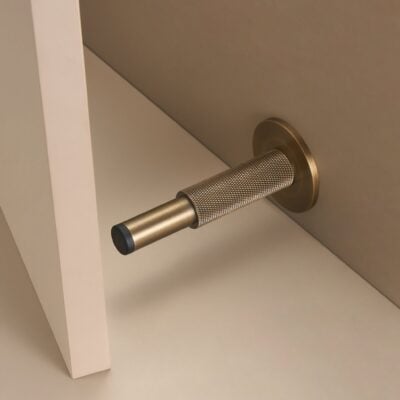
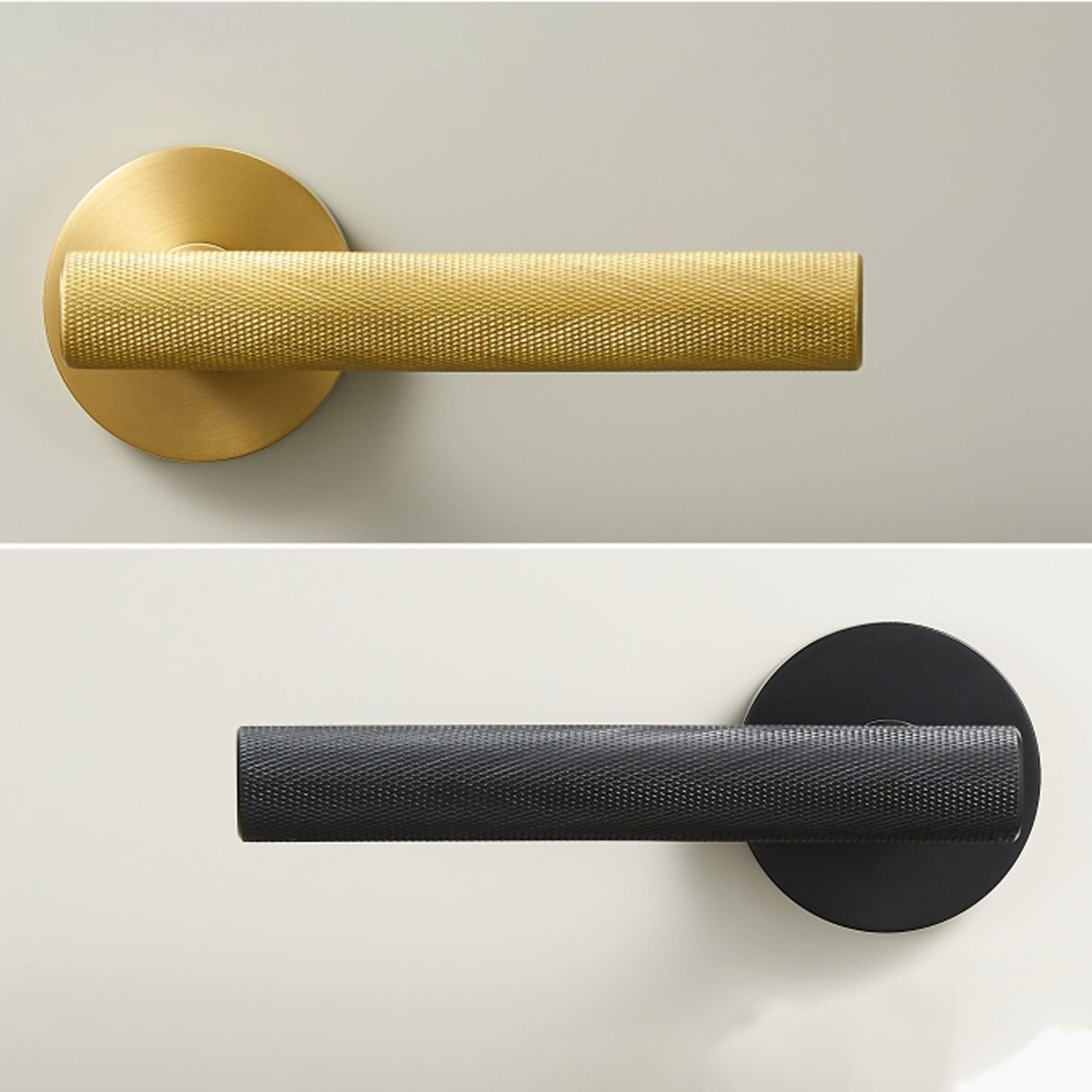
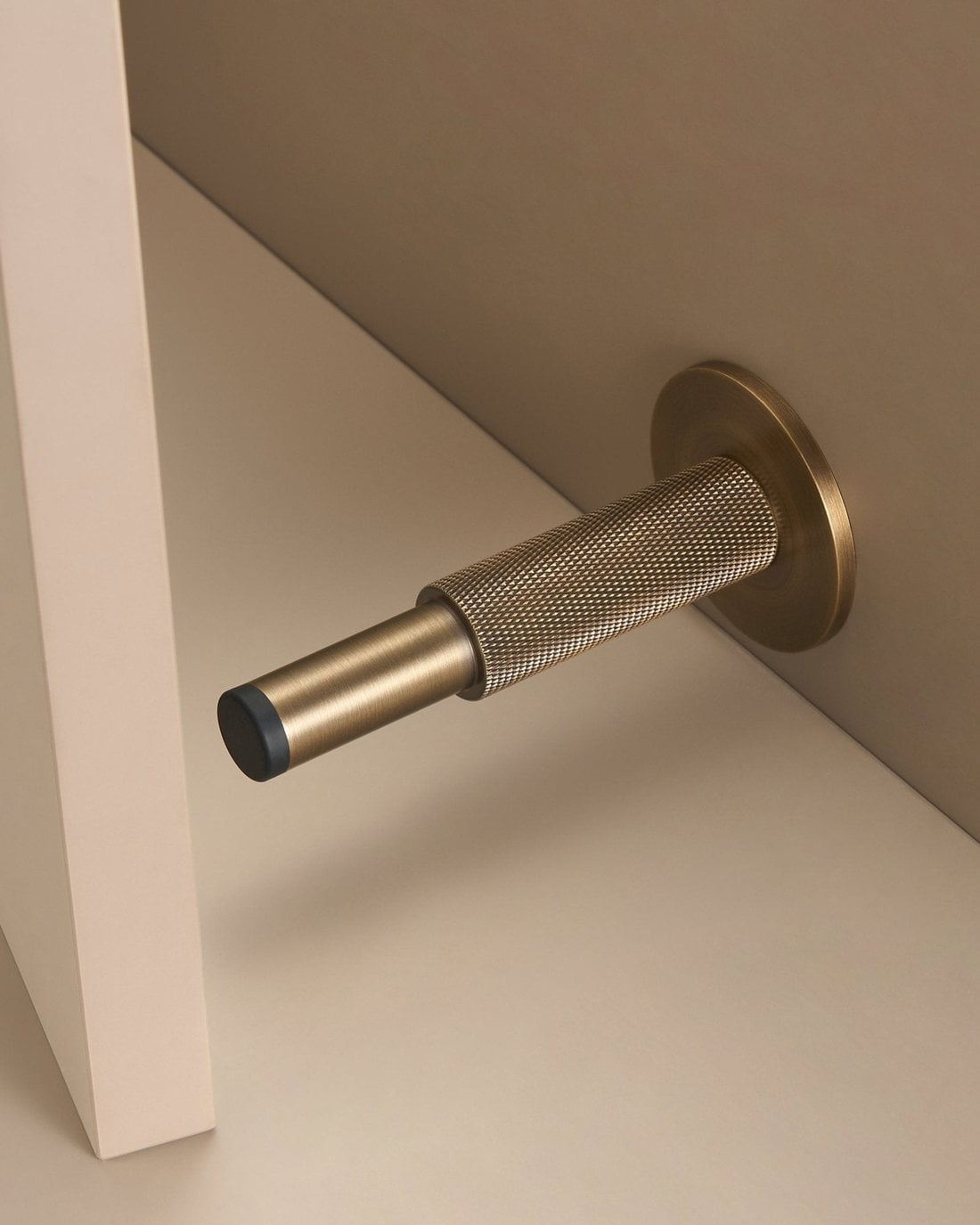
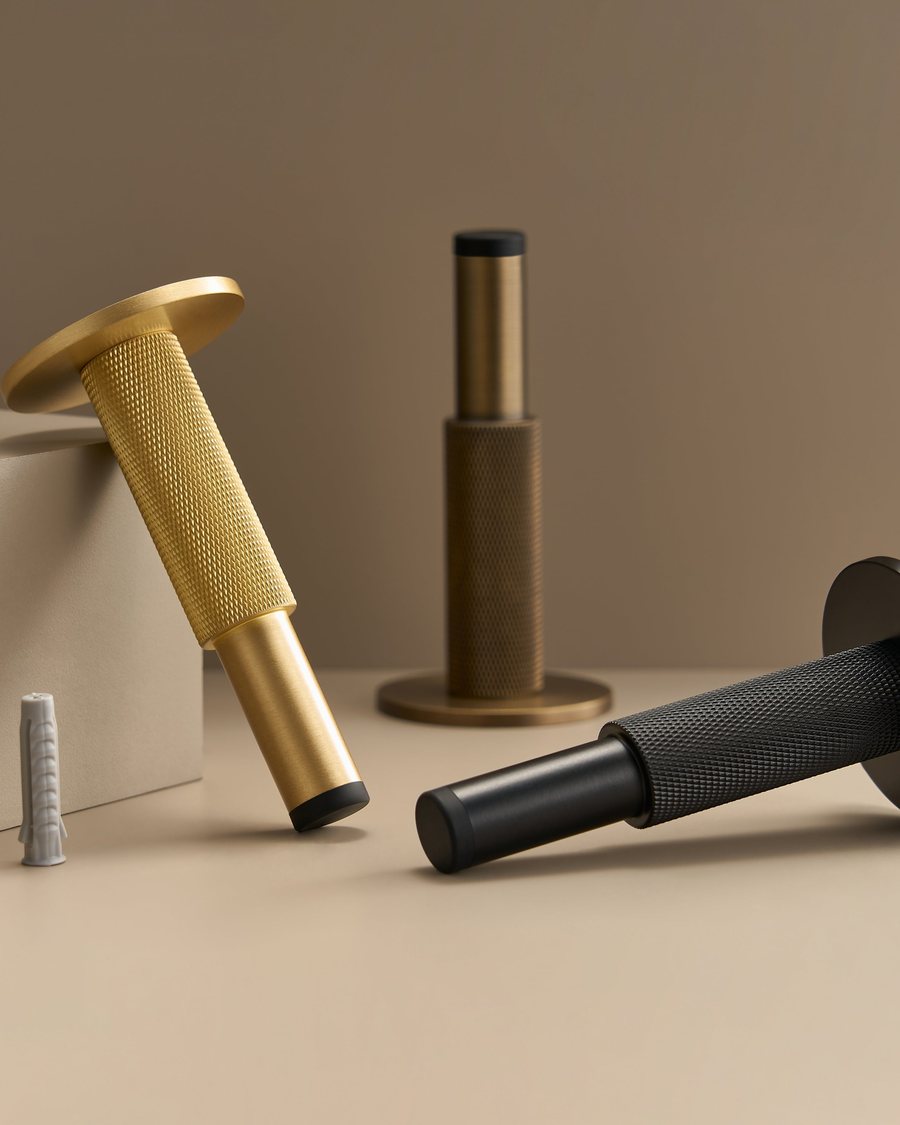
A wall door stop is fixed to the wall behind the door, so the door meets its rubber tip before the handle reaches the plaster. Our AXIO is this type: a knurled solid brass cylinder 100 mm long on a 50 mm base, with a rubber tip, fixed with a single concealed screw. Its listing says to place it where the door handle would strike the wall.
A wall stop keeps the floor clear, which is why we’d choose one in bathrooms, kitchens and anywhere with underfloor heating. Fixed low on the skirting, the same kind of stop catches the bottom of the door instead. We’d only do that where the skirting is solid and the handle still stops short of the wall.
Floor door stops, and where to put them
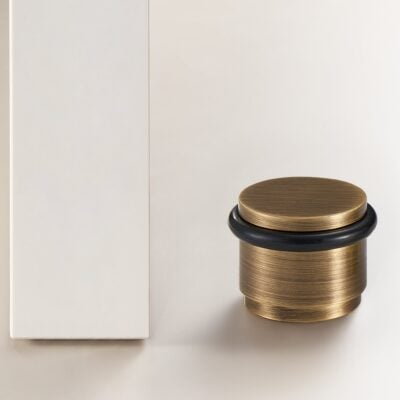
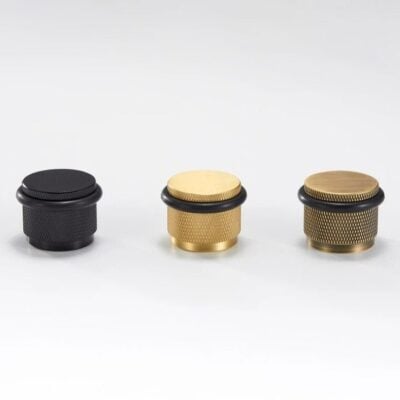
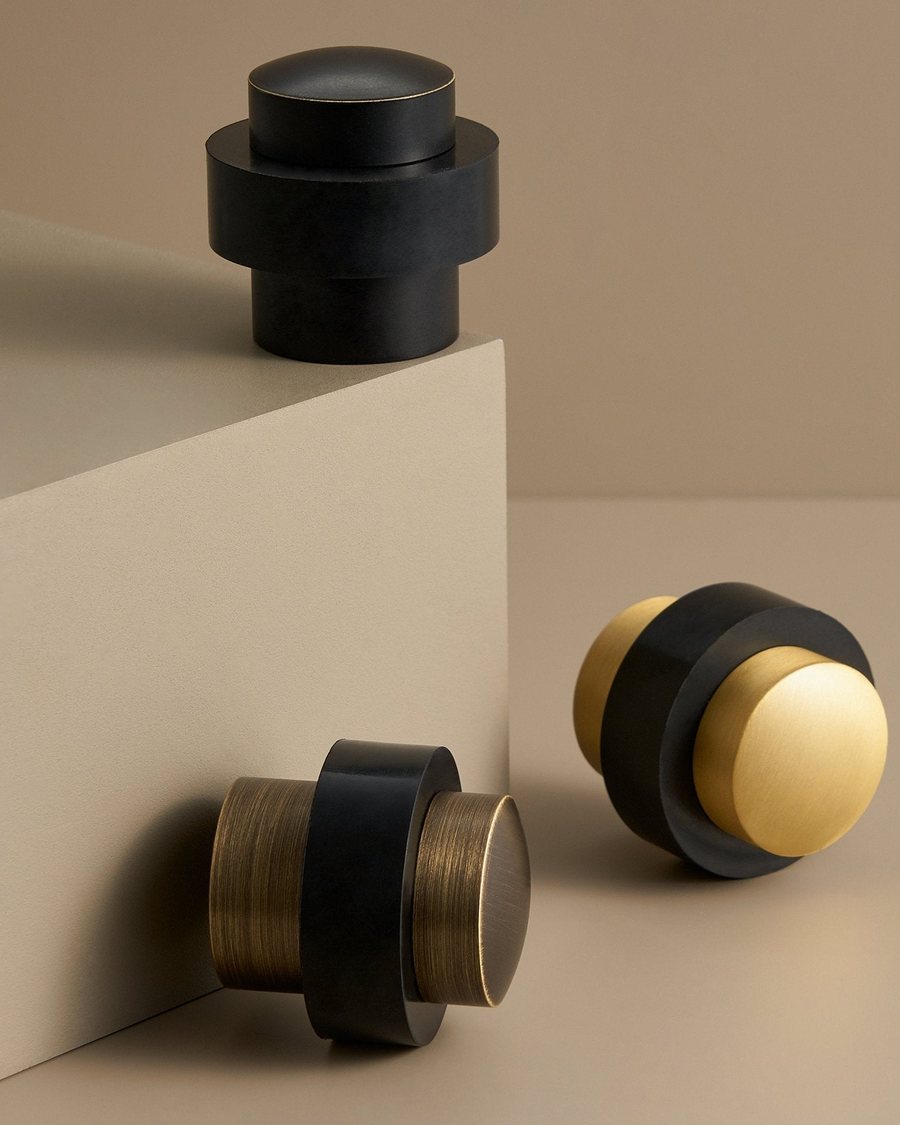
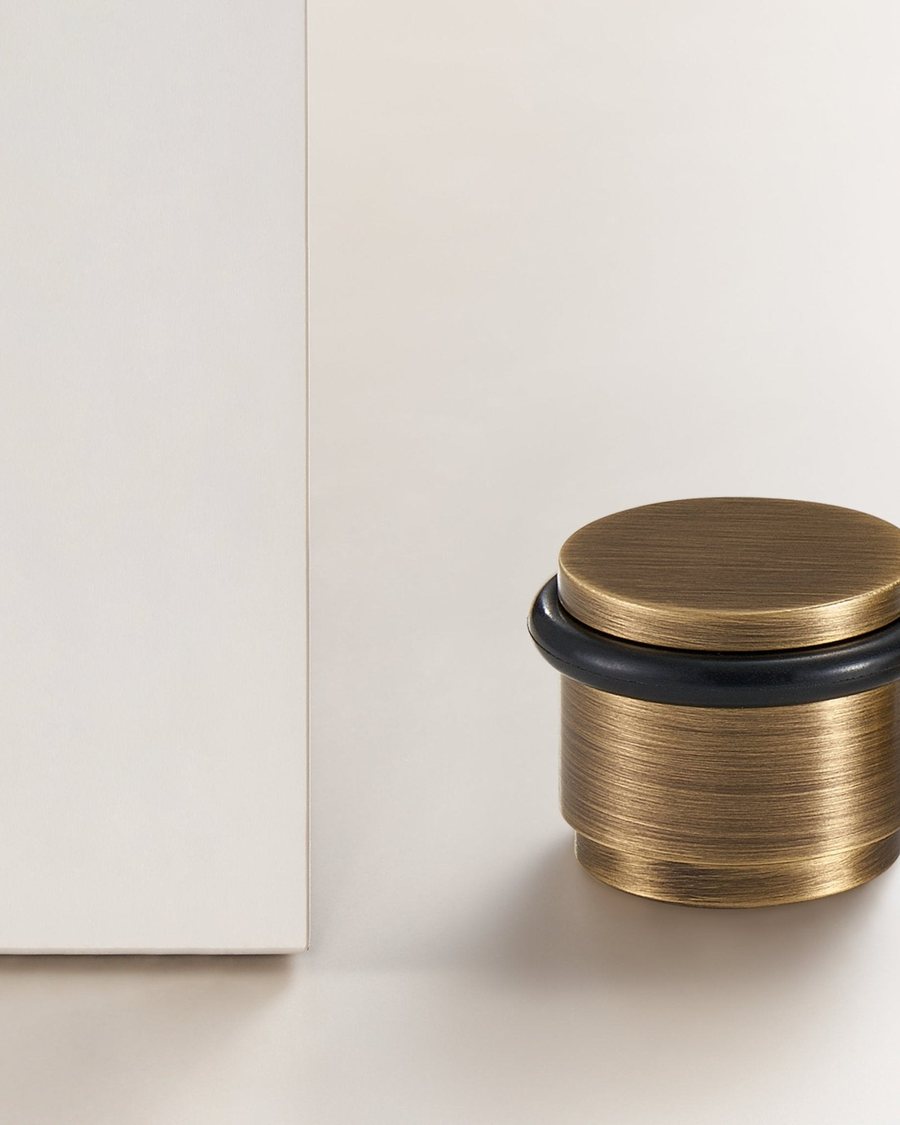
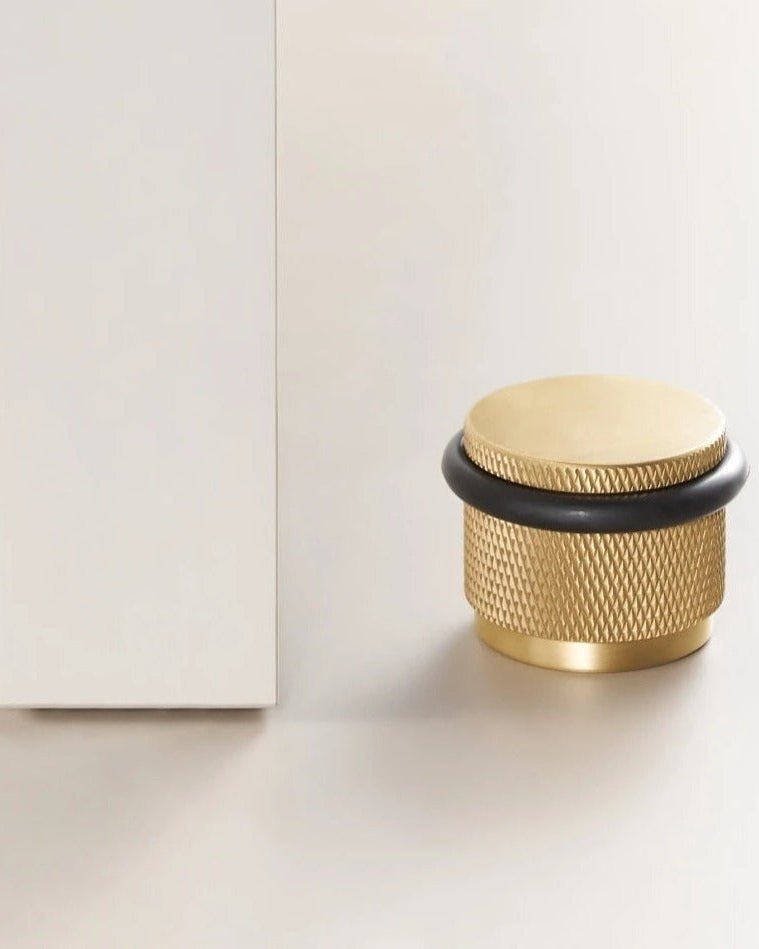
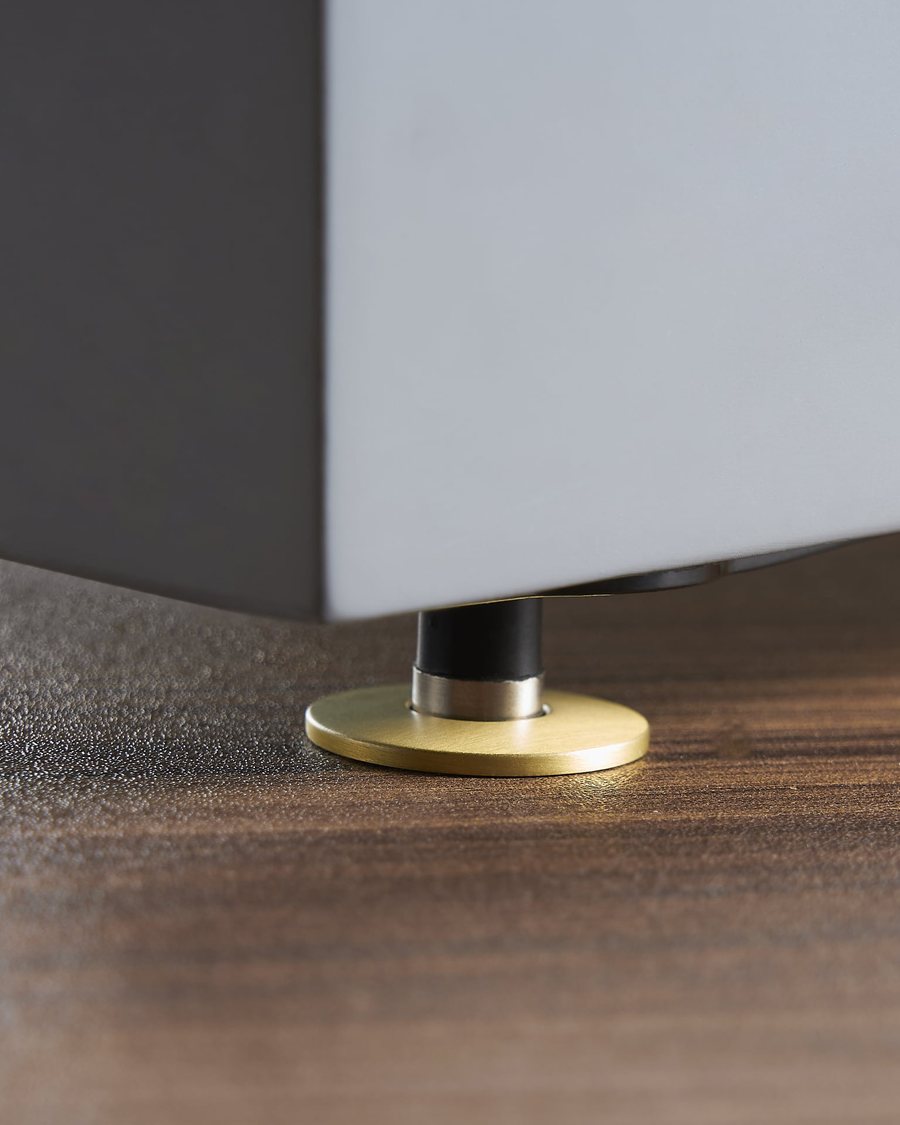
A floor door stop is screwed to the floor where the door would otherwise swing too far. It suits a door that opens into the middle of a room or towards a window or radiator, and any wall too fragile to fix into. Our floor stops are all solid brass. TERRA is 35 mm across and 30 mm high with a black rubber ring, fixed with a single screw. VORDA is slimmer, 25 mm across and 35 mm high, fixes to timber or concrete floors with one screw, and has a replaceable rubber buffer. GUM is a knurled stop 35 mm across and 30 mm high with a 5 mm rubber bumper, and TELOS is 40 mm high with a felt base and comes with 6 by 60 mm screws.
We haven’t found a designer or standard that fixes a position for a floor stop, so this is our own practice. Place it so the door meets it near its leading edge, the edge with the handle, and so the handle stops short of the wall. Avoid the hinge side, where the door acts as a lever against its own hinges each time it is pushed hard. Keep the stop close to the wall the door opens towards and out of the line people walk along; Metcalf’s point that floor stops can be a hazard is the reason. Check that the stop is taller than the gap under the door, and before drilling, check for pipes and underfloor heating.
Magnetic door stops that disappear
For a room where nothing should interrupt the floor or the walls, the magnetic stop is the answer Livingetc gives. Maya Glantz, writing in Livingetc, put it bluntly: in a sleek, neutral living room, a springy metal doorstop is the last thing she wants to see. Metcalf describes how the hidden kind works: one half sits in the underside of the door, the other is a pin set flush in the floor, and as the door swings over it the magnet raises the pin and catches the door.
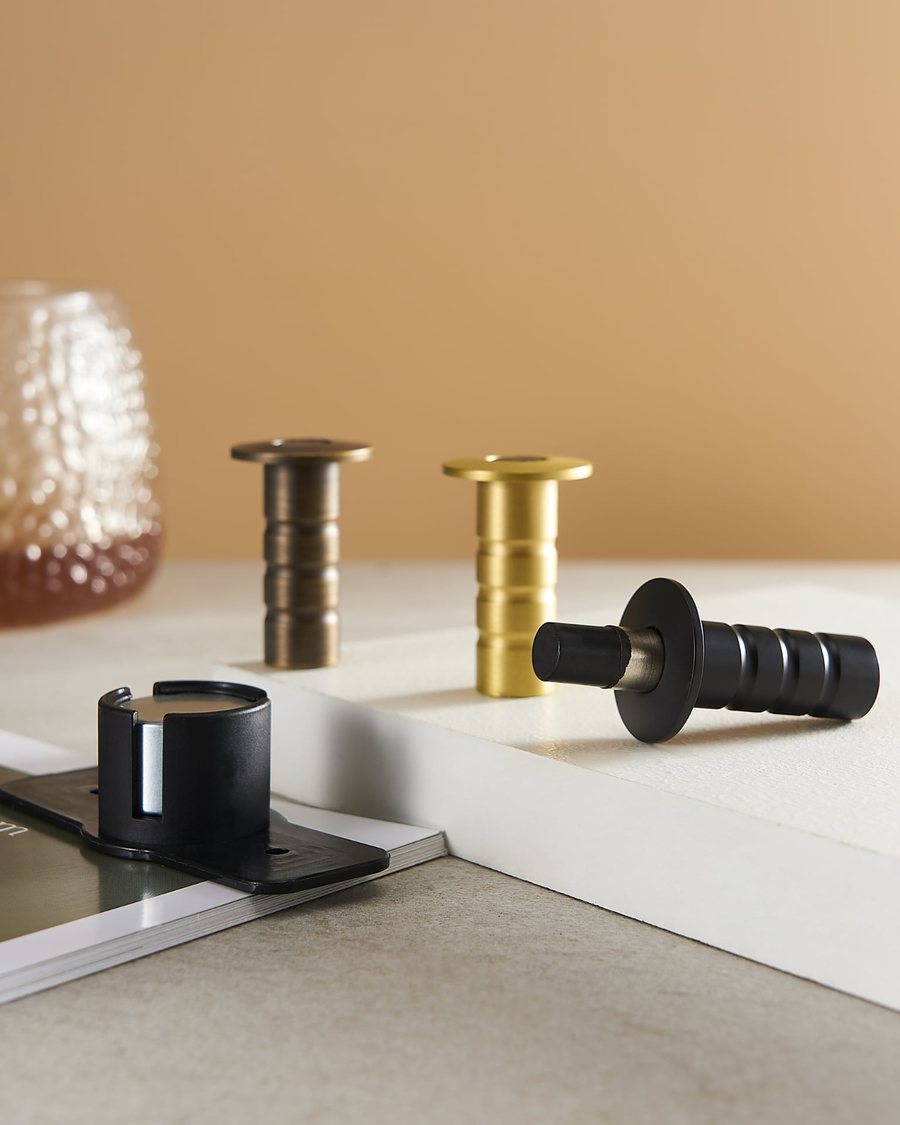
NEMA is our magnetic door stop, and it works the same way. A brass socket 26 mm across is glued into a hole 40 mm deep in the floor, and a plate with a 22 mm magnet is set into the bottom edge of the door. Pull the door gently and the magnet lets go, and the pin drops back flush with the floor. The listing gives the conditions: the gap under the door must be 6 to 15 mm, the socket suits wood, tiles, carpet or concrete, the adhesive isn’t included, and the hold suits doors up to 100 kg, with heavier doors needing two sets.
Hinge pin door stops
A hinge pin stop sits on the door’s own hinge and needs no fixing to the wall or floor. PARI works this way: you take out the hinge pin, slide PARI onto it and put the pin back. Its brass arm lets the door open 90 degrees before it stops, and it can be adjusted by repositioning it on the pin. It suits rented homes where you can’t drill, and period rooms where a visible stop would look out of place.
It needs a hinge whose pin can be taken out, and some butt hinges have fixed pins, our PETLYA among them. In an older house, our piece on period door hardware looks at the rest of the door. It is also a reason to give a door a proper stop rather than a wedge: the preservation architect Susan D. Turner notes in Traditional Building that failed hinge knuckles can come from a door being mishandled, such as being wedged open.
Matching the stop to the door and the room
A door stop belongs to the same family as the hinges and the handle. The interior designer Linda Hayslett told Homes & Gardens that hinges in the same finish as the handles can make a room feel new without major work, and we’d bring the stop into that set. In a hallway, where doors are opened most and seen together, we’d use one kind of stop and one finish throughout. Our piece on one house, door by door works through a whole house that way.
Where the aim is to see no hardware at all, follow the architects. Michael K. Chen told Livingetc that on a set of panelled pocket doors he carved the pulls from wood so that nothing showed beyond the hinges and sliding gear; NEMA or PARI is the door stop equivalent. In a bathroom or kitchen with underfloor heating, AXIO avoids drilling the floor, and in a bedroom or living room with an open floor, TERRA or VORDA is the tidy answer. Every option is in our door stops collection.
Fire doors: never wedged, never held on a magnet
A fire door is the exception to all of this. The Guild of Architectural Ironmongers says a fire door should never be held open by mechanical means, door wedges and foot-operated door holders included, and that the only device that should hold one open is an electromagnetic unit connected to an automatic fire alarm, so we’d keep NEMA and every loose stop for ordinary doors.
Our door stops compared
| Door stop | Type | Height | Fixing | Finishes |
|---|---|---|---|---|
| AXIO | Wall stop, knurled, rubber tip | 100 mm from a 50 mm base | Single concealed screw | Antique brass, matte black, satin brass, satin nickel |
| TERRA | Floor stop, rubber buffer ring | 30 mm (35 mm across) | Single screw into the floor | Antique brass, matte black, polished unlacquered brass, satin brass, satin nickel |
| VORDA | Floor stop, replaceable rubber ring | 35 mm (25 mm across) | Single screw, timber or concrete floors | Antique brass, black, polished unlacquered brass, satin brass |
| GUM | Floor stop, knurled, rubber bumper | 30 mm (35 mm across) | Fixed to the floor, fixings included | Antique brass, black, satin brass, satin nickel |
| TELOS | Floor stop, felt base | 40 mm (30 mm across) | 6 by 60 mm screws included | Antique brass, matte black, satin brass |
| NEMA | Magnetic, floor socket and door plate | Pin drops flush with the floor | Socket glued into a 40 mm deep hole, plate set into the door’s bottom edge | Antique brass, matte black, satin brass, satin nickel |
| PARI | Hinge pin stop | Sits on the hinge | Slides onto a removable hinge pin, no drilling | Antique brass, distressed black, polished chrome, satin brass |
Quick answers
Is a floor or wall door stop better?
A wall stop is better where the handle would hit plaster and you want a clear floor. A floor stop is better where there’s no suitable wall behind the door.
Where should a floor door stop go?
In our practice, near the door’s leading edge, close to the wall it opens towards and out of the walking line, so the handle stops short of the wall.
How does a magnetic door stop work?
A magnet in the bottom of the door lifts a pin set flush in the floor, which holds the door until it is pulled free. With NEMA the pin then drops back flush.
Can I use a magnetic door stop on a fire door?
No. The Guild of Architectural Ironmongers says the only device that should hold a fire door open is an electromagnetic unit connected to an automatic fire alarm.
Can you wedge a fire door open?
No. The Guild of Architectural Ironmongers says fire doors should never be held open by mechanical means, wedges included.
What door stop doesn’t need drilling?
A hinge pin stop such as PARI, which slides onto the hinge pin. It needs a hinge whose pin can be removed.
What is a door porter?
Another name for a door stop. The V&A describes its cast iron Cerberus, modelled by the sculptor John Bell around 1848, as a door stop or door porter.
Sources
- Livingetc: This “invisible” doorstop is going viral. Hugh Metcalf on spring stops, visual clutter, trip hazards and how a hidden magnetic stop works.
- Livingetc: Forget Doorstops, People With Elegant Homes All Use This Genius “Invisible” Fixing for Their Doors. Maya Glantz on spring stops in a sleek living room.
- Dezeen: Magis celebrates 40th anniversary with Milan furniture and accessory launches. Konstantin Grcic’s cast iron mule doorstop and his view of cast iron.
- Dezeen: Virgil Abloh adds giant receipt rug to upcoming IKEA collection. Abloh’s doorstop that slots over a chair leg, and why he made it.
- Wallpaper*: London Design Festival 2021. Michael Marriott’s bronze and steel doorstop for London’s Kitchen.
- Dezeen: Tjirp bird doorstop by Cas Moor. An oak bird doorstop that slides under the door.
- Gardenista: 10 Easy Pieces, Doorstops. Industrial Facility’s silicone stoppers and Koray Ozgen’s stone door stop.
- Homes & Gardens: How to elevate everyday, ordinary items in your home. Linda Hayslett on door hardware in matching finishes.
- Livingetc: 5 Lessons on How to Choose Interior Doors. Michael K. Chen on keeping hardware out of sight.
- Traditional Building: Hinge History. Susan D. Turner on hinge knuckles failing when doors are wedged open.
- Victoria and Albert Museum: Door stop, designed and modelled by John Bell, about 1848. The Cerberus door porter and Bell’s work in cast iron.
- Victoria and Albert Museum: Glass doorstop or dump, 1829 to 1900. A bottle glass doorstop, possibly made in Sunderland.
- Victoria and Albert Museum: Doorstop cast in the form of Mr Punch. A cast iron figural doorstop.
- Guild of Architectural Ironmongers: Ironmongery in a Post Pandemic World, specifier’s guide. No wedges or mechanical holders on fire doors.
- Guild of Architectural Ironmongers: Door closer safety check list. Only an electromagnetic device linked to a fire alarm should hold a fire door open.
Images: Product photographs and diagrams are our own.