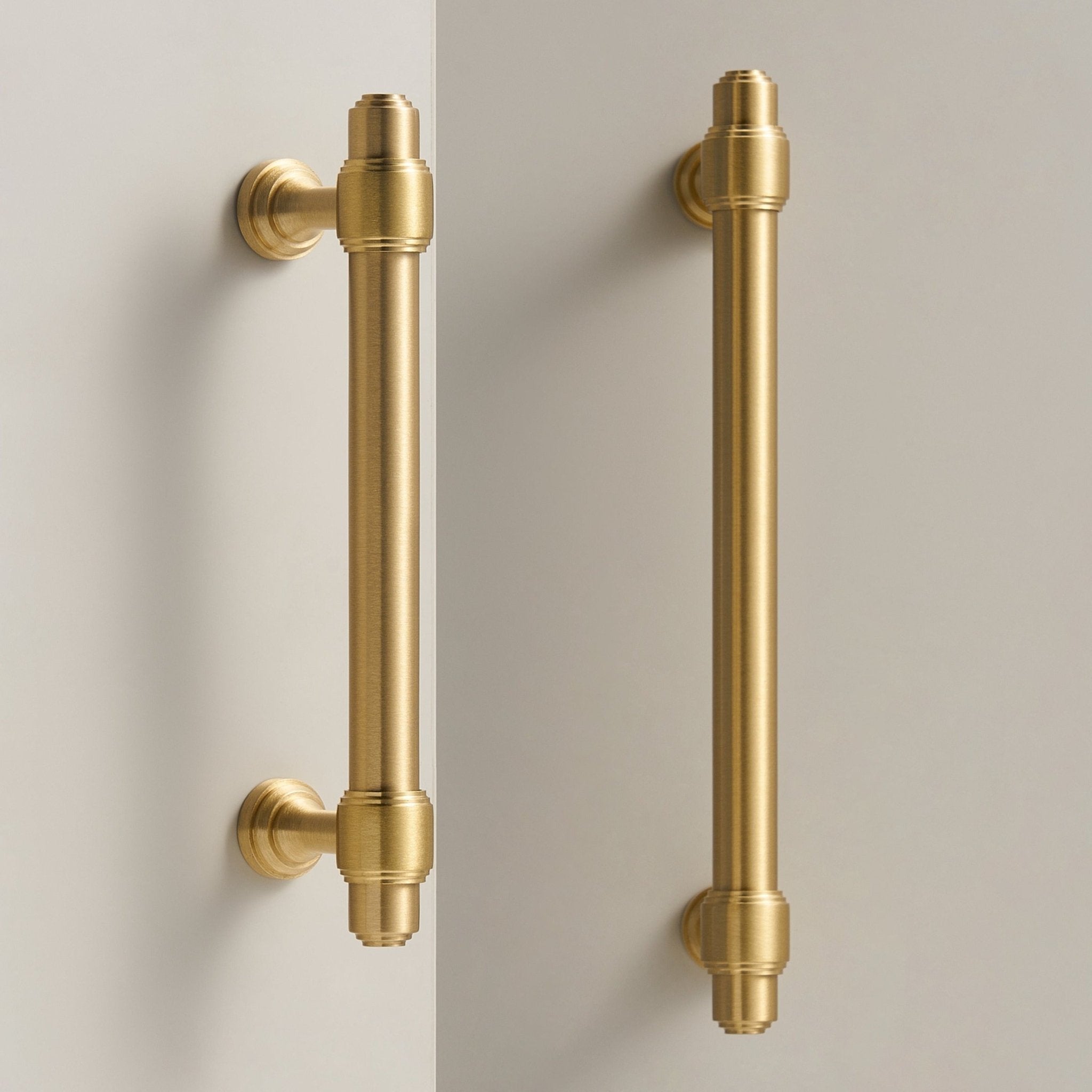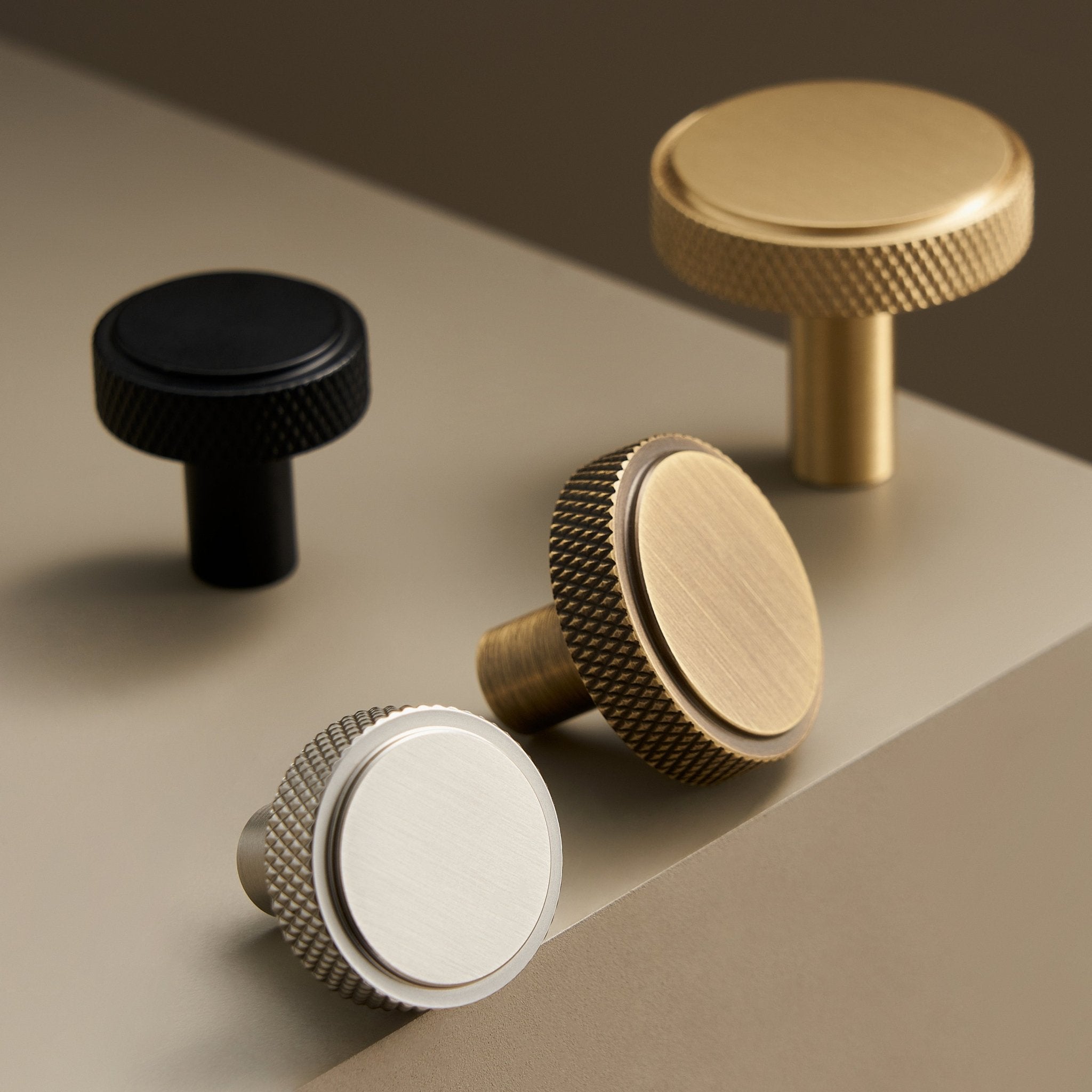












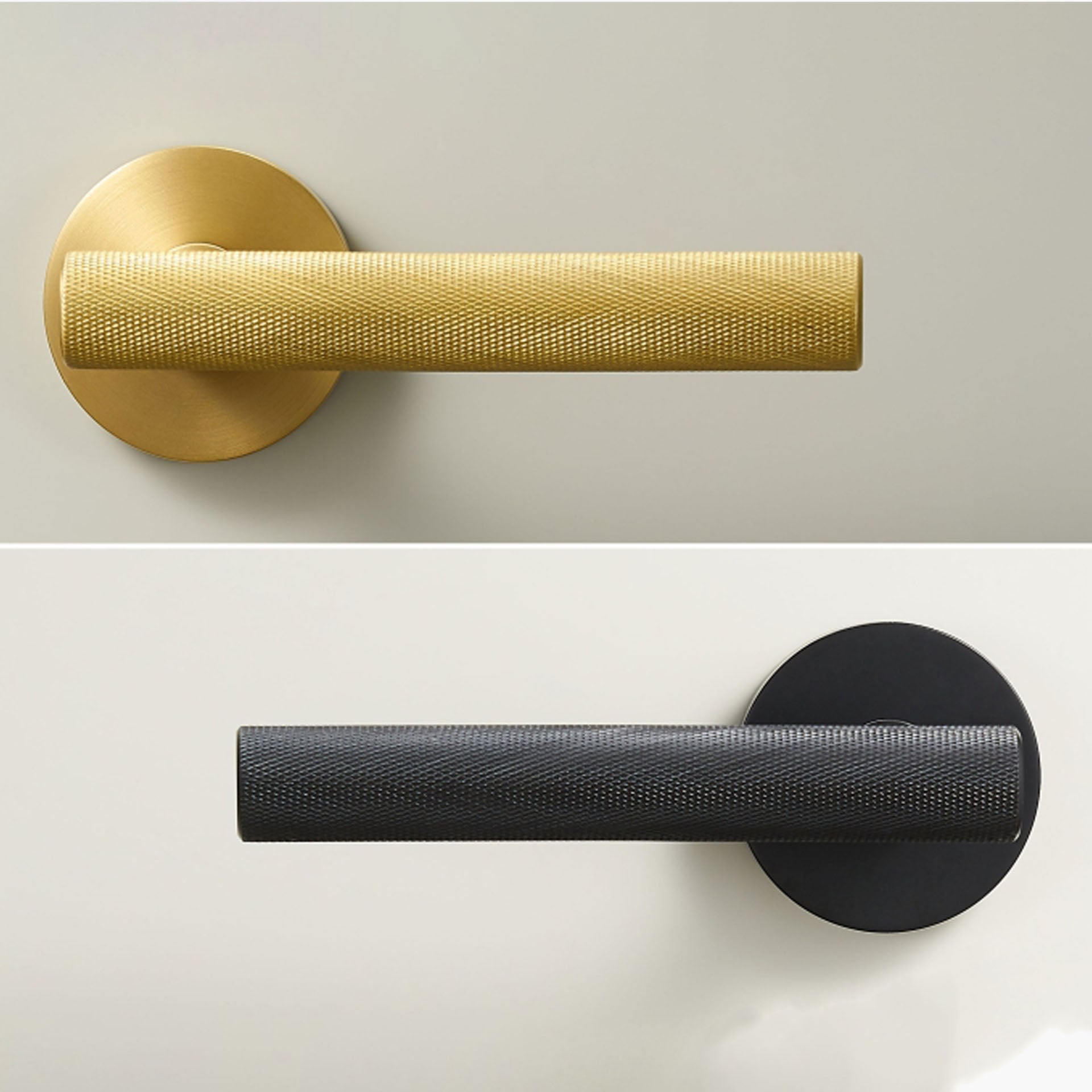
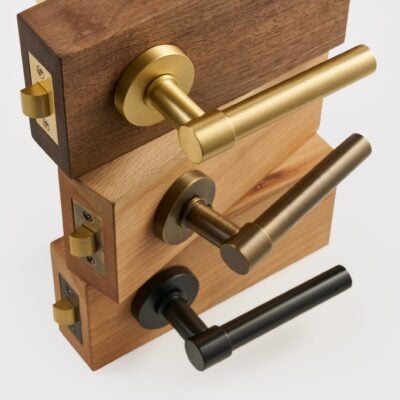


A door handle configuration is the latch and lock behaviour behind a lever: whether it retracts a latch, whether it locks, and how it locks (push-pin, snib, thumbturn or key). It decides which rooms a handle suits.
We sell the VELA and VERTO levers in six configurations and two preparations, and the dropdown gives you one short label per option to decide from. That is not enough to order a whole house on. This is the longer version: what each set contains, what it does when you turn it, and which door it belongs on.
Still choosing a lever style? Start with our guide to selecting door hardware.
What is a door handle configuration?
A configuration describes the working parts, not the lever. Passage turns a latch and nothing else. Privacy adds a lock operated from inside without a key. Entry adds a mortice lock with a key or thumbturn. Dummy does nothing mechanical: the lever is fixed to the door face as a pull.
Every configuration is a complete set: a pair of levers, roses, fixings, and the latch or lock it needs. Passage and both privacy sets include the latch; entry sets include the mortice lock case, and the key version its keys; the dummy set is a fixed pair with no latch and no spindle. One set equals one door.
The spindle is 8mm square on every operating configuration. The preparation sets the hole pattern: UK/EU sets take a tubular-case mortice latch or lock with a rectangular faceplate, morticed into the door edge; North America and Canada sets are supplied for a tubular latch to suit North American bored doors. Match it to your doors and keep it constant across the order.
Which six configurations do the VELA and VERTO levers offer?
The labels below are the exact ones in the configuration dropdown on the VELA lever and the VERTO lever.
| Site label | Latches? | Locks? | How it locks | Where it belongs |
|---|---|---|---|---|
| Dummy set (fixed) | No | No | Not applicable, lever is fixed | Wardrobes, cupboards, inactive leaf of double doors, sliding and bifold doors held by a catch |
| Passage set | Yes | No | Not applicable | Hallways, living rooms, kitchens, dining rooms, most bedrooms |
| Privacy set (rose button) | Yes | Yes | Push-pin through the inside rose; outside rose plain | En suites, dressing rooms, WCs used by adults |
| Privacy set (passage set + privacy snib) | Yes | Yes | Separate bolt with inside thumbturn and outside slotted release | Family bathrooms, WCs, any door that must release from outside |
| Entry set (mortice thumbturn lock) | Yes | Yes | Mortice deadbolt thrown by an inside thumbturn, no key | Home offices, studies, guest bedrooms, door to a garage or utility |
| Entry set (mortice key lock) | Yes | Yes | Mortice deadbolt thrown by a key | Studies with confidential records, storerooms, doors lockable from outside |

What is a dummy door handle?
A dummy set is a fixed pair of levers with no spindle, no latch and no turning action: a pull. Use it where a catch or flush bolt keeps the door closed: wardrobes, cupboards, the inactive leaf of a pair of doors.
The classic mistake is a passage set on a wardrobe: the latch needs a mortice in the door edge and a strike in the frame, most wardrobe doors are too thin or already have a catch, and the lever ends up spinning loosely.
Double doors take a passage set on the active leaf and a dummy set on the inactive leaf, so the levers match while only one operates: two sets for two leaves.
What is a passage set, and which rooms never need a lock?
A passage set is a pair of levers, an 8mm spindle and a latch. Turning either lever retracts the latch; there is no lock on either side.
Passage covers most of a house: hallways, landings, living and dining rooms, kitchens, utility rooms and, in most households, bedrooms. If nobody would ever want to lock the door, passage is correct. The reverse mistake is passage on a bathroom door: the first guest finds no way to hold it shut.
Which privacy set: rose button, or passage set plus a separate snib?
Both lock from inside without a key. They differ in where the locking part sits and in whether the door releases from outside.
Privacy set (rose button)
The lock is a small push-pin that sits through the inside rose beside the lever; pushing it locks the set. The door carries only the two levers and looks like a passage set from either side; the outside rose is plain.
If release from outside matters, for a family bathroom, children, guests or a rental, choose the snib set. If you need to know whether a particular push-pin set can be released from outside, ask us before ordering.
Privacy set (passage set + privacy snib)
This is a passage lever pair plus a separate privacy bolt with its own small faceplate morticed into the door edge. Inside, a thumbturn on its own rose, matching the handle rose; outside, a coin or slot emergency release on the outer rose. The locked state is visible from the doorway.
Position is a choice. Above the handle is the traditional UK position when a bathroom mortice lock with 57mm follower centres is used; our renders show the separate bolt fitted below the handle. With our bolt either works, provided both roses sit on the spindle centreline and line up on both faces. Mark the positions from the actual bolt you are fitting.
The same separate snibs suit other levers: the RIVO and LUNO solid brass privacy snibs come as privacy or dummy (fixed) options in UK/EU and North American versions, in our door privacy snibs collection.
Entry sets: mortice key or mortice thumbturn, and where does each belong?
An entry set includes the lever pair and a mortice lock case that throws a deadbolt as well as operating the latch: for doors where being locked matters, not just being closed.
Entry set (mortice thumbturn lock)
The bolt is thrown from inside by a thumbturn, so no key is needed and none can be lost. It suits a study you secure while in it, a guest bedroom, or the door between house and garage. It cannot be locked from outside, so it does not secure an empty room.
Entry set (mortice key lock)
The bolt is thrown by a key, and the keys come with the set. Choose it where the door must be lockable when you leave: a study holding confidential files, a storeroom, a room let to a lodger. In a family home the key usually lives in the lock, and a thumbturn would have done the same job.
One caution. Internal entry sets are not front door hardware. External doors are normally specified with a lock tested to a recognised standard such as BS 3621, and many insurers require one.
Which handle configuration for each room? A room-by-room checklist
Walk the house and write one line per door.
- Bedroom. Passage set by default. Entry set (mortice thumbturn) if the room doubles as a home office or you want it lockable from inside.
- Bathroom and en suite. Always privacy. Snib set where outside release matters (children, guests, rentals); rose button where only adults use the room.
- WC and cloakroom. Privacy, same rule as the bathroom. Never passage.
- Study or home office. Entry set (mortice thumbturn) if you lock it while working; entry set (mortice key) if it must stay locked when empty.
- Living, dining, kitchen, hallway. Passage set; double doors take passage plus dummy.
- Utility, plant room, garage door into the house. Passage as a doorway; entry set (mortice thumbturn) to secure the house side.
- Cupboards, wardrobes, airing cupboard, sliding and bifold doors. Dummy set. The catch or bolt does the holding.
- Front door. Not an internal configuration. Specify a certified external lock separately.
How do I count and order for a whole house?
Take a three-bedroom house with a family bathroom, en suite, downstairs WC, study, living room with double doors, and four built-in wardrobes. Sets equal doors, so count doors.
- Three bedrooms: three passage sets (swap one for a thumbturn entry set if a bedroom is also an office).
- Family bathroom, en suite, downstairs WC: three privacy sets. Decide rose button or snib once and apply it to all three, so every bathroom door behaves the same from outside.
- Study: one entry set (mortice thumbturn).
- Double doors to the living room: one passage set for the active leaf and one dummy set for the inactive leaf.
- Four wardrobes: four dummy sets, or fewer if some are sliding doors that take pulls instead. The VELA pull comes in 300, 450 and 600mm lengths (250, 385 and 534mm centres), single or as a back-to-back pair, with fixings for timber, glass and appliance doors.
- Front door: excluded from this order.
That gives four passage sets, three privacy sets, one thumbturn entry set and five dummy sets: thirteen sets, one preparation, one finish. Add door stops and hinges to the same order so finishes match; our hardware is made to order, so one complete count beats several top-ups.
What are the common mistakes to avoid before ordering?
- Choosing rose button where outside release matters. The push-pin set has a plain outside rose. Family bathrooms, children’s rooms and rentals want the snib set.
- Mixing preparations. A UK/EU set will not fit a door bored for a tubular latch, and vice versa. Check one existing door edge and keep the order to one preparation.
- Forgetting the inactive leaf. Double doors take one operating set and one dummy set. Two operating sets leave you with a latch you cannot use.
- Sprung against unsprung. The VELA lever has a sprung return: the rose returns the lever to horizontal, not only the latch. An unsprung lever from elsewhere needs a heavy sprung latch or it will droop; do not mix the two on one door.
- Ordering before measuring the door. The VELA lever (52mm rose, 137mm lever, 67mm projection) needs one 25mm bore plus two 8mm holes at 38mm centres in the UK/EU preparation, and a door thick enough for the latch or lock case. VERTO shares the configurations and preparations; its drilling is on its listing. See the measuring guide.
For the full range, browse internal door handles. If a door fits none of the rules above, describe it to us and we will tell you which configuration to choose.
In short
- Every configuration is a complete set: a pair of levers, roses, fixings and the latch or lock, so one set per door.
- Passage latches, privacy locks from inside without a key, entry adds a mortice deadbolt, dummy is a fixed pull.
- The rose-button set has a plain outside rose; the snib set has a coin release outside, so choose it where release matters.
- Pick one preparation and one finish and keep both constant across the order.
- Internal entry sets are not front door locks; specify the external door separately.
Frequently asked questions
What is a dummy door handle?
A fixed pair of levers with no latch or spindle, used as a pull on doors held closed by a catch or bolt: wardrobes, cupboards, sliding doors, the inactive leaf of double doors.
What is the difference between a passage and a privacy door handle?
Both latch. A privacy set adds a lock worked from inside without a key: a push-pin through the inside rose, or a separate snib bolt with a thumbturn. A passage set has no lock.
Can the privacy sets be opened from outside in an emergency?
The snib set can: it has a coin or slot release on the outside rose. The rose-button set has a plain outside rose, so if outside release matters, choose the snib set or ask us about the specific set before ordering.
Does the entry set include the lock?
Yes. Both entry sets include the mortice lock case, and the key version includes its keys. Passage and privacy sets include their latch, and the snib set includes the separate privacy bolt.
What is the difference between the UK/EU and North America preparations?
UK/EU sets take a mortice latch or lock let into the door edge; North America and Canada sets are supplied for a tubular latch to suit bored doors. The lever is the same, the hole pattern is not.
Can I use an entry set on my front door?
No. Internal entry sets are not tested as external security locks. A front door normally takes a lock to a recognised standard such as BS 3621, and your insurer may specify one.
Sources and standards
- BS EN 1906: Building hardware. Lever handles and knob furniture. Requirements and test methods.
- BS EN 12209: Building hardware. Mechanically operated locks and locking plates. Requirements and test methods.
- BS 3621: Thief resistant lock assembly. Key egress.
- Approved Document M (England) and BS 8300: accessibility guidance covering lever door furniture.