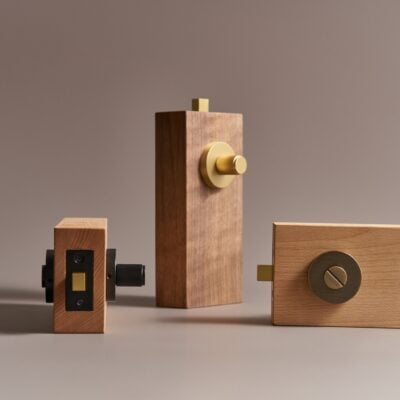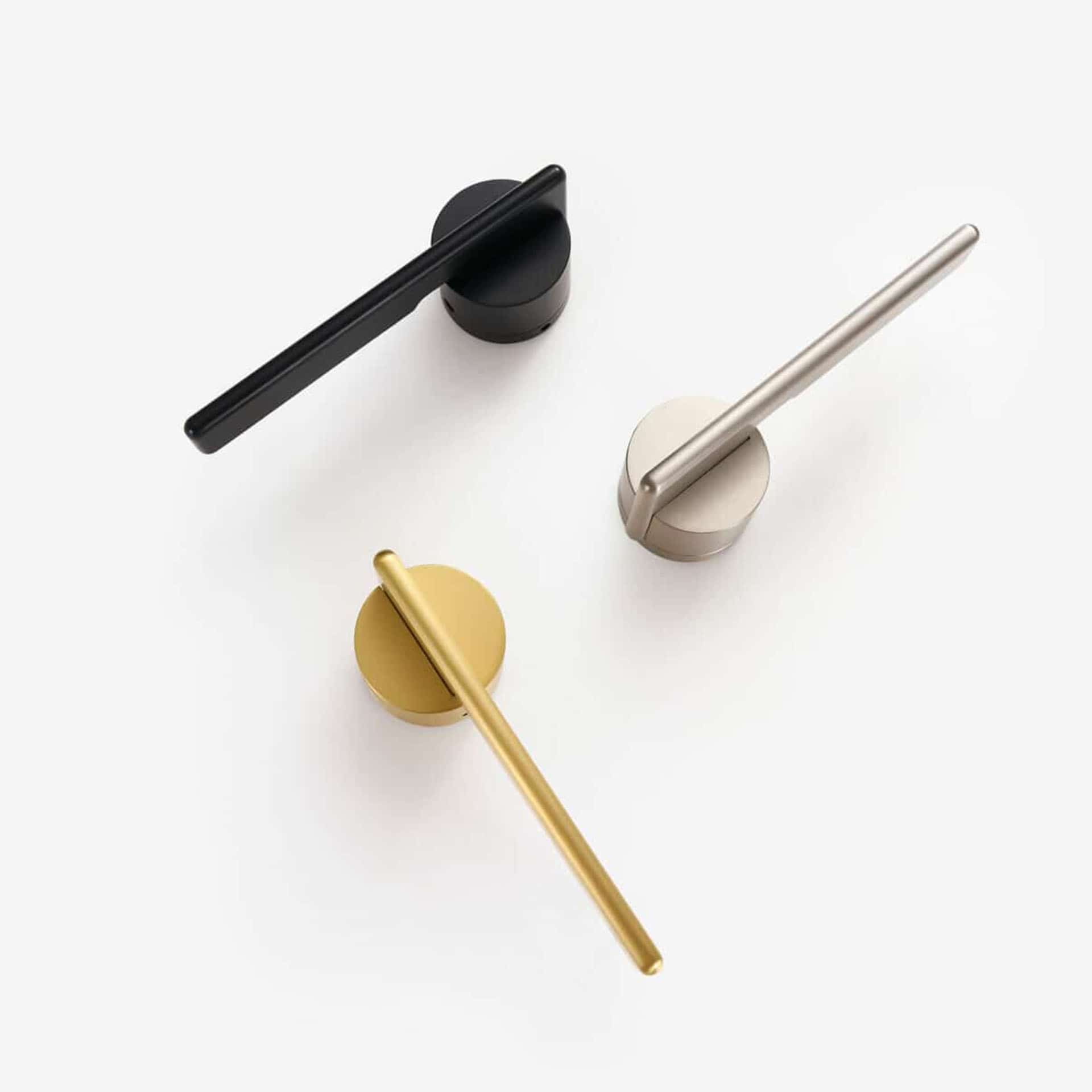












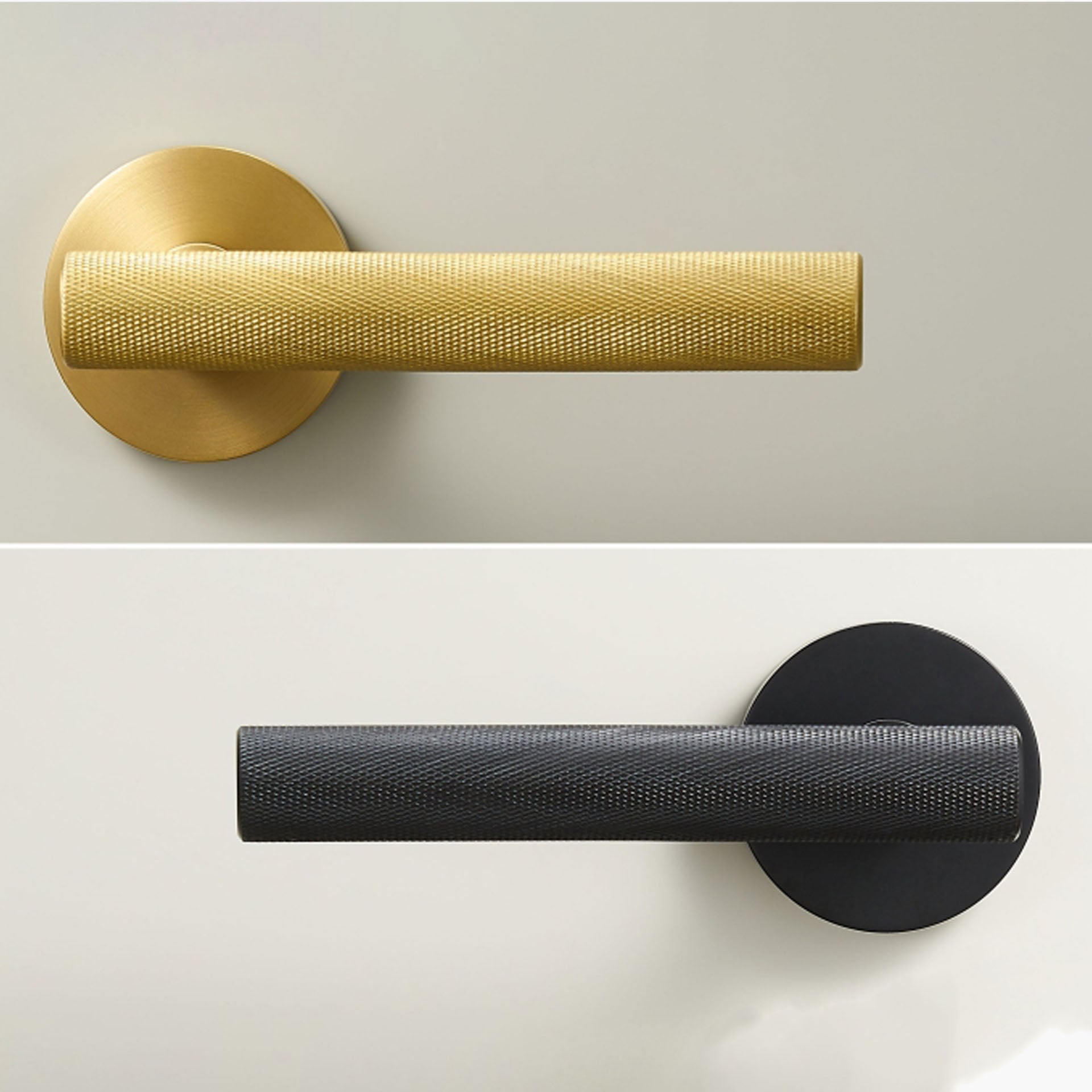
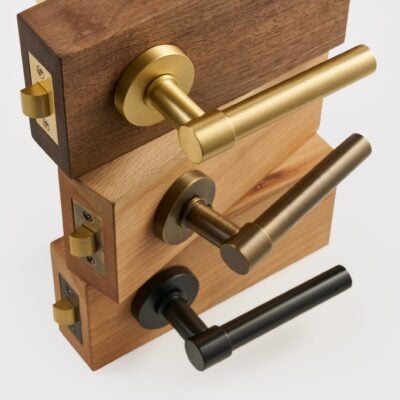

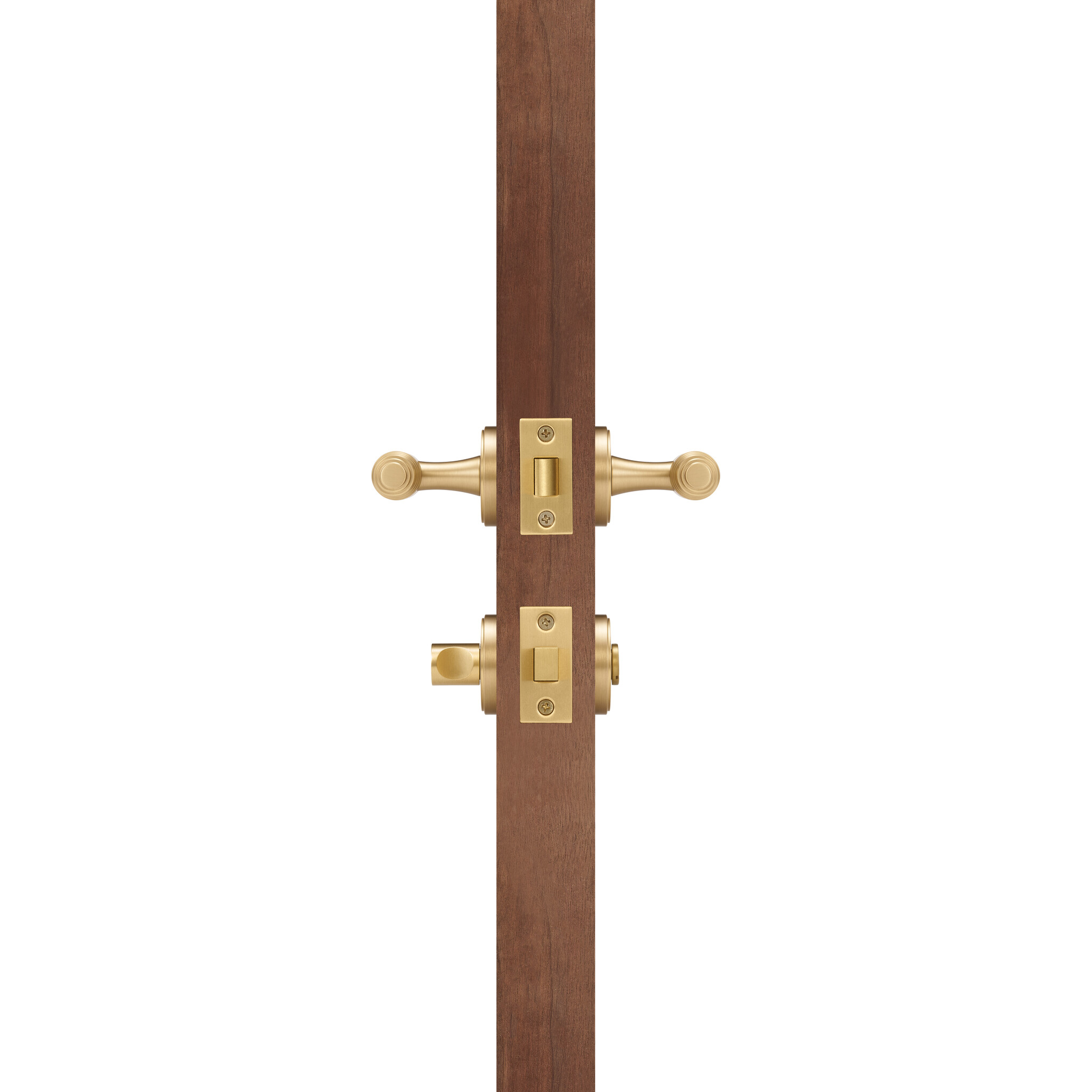
A privacy snib is a separate thumbturn bolt with an outside emergency release, fitted above or below a passage handle. A rose-button privacy set builds the lock into the handle rose as a small push-pin. Both lock a bathroom door without a key.
We sell both on the same product page, one dropdown apart, and at thumbnail size they look the same. On the door they need different preparation and behave differently from the corridor side. Here is what each is, which door gets which, and how to fit a snib so the two roses line up.
What is a privacy snib?
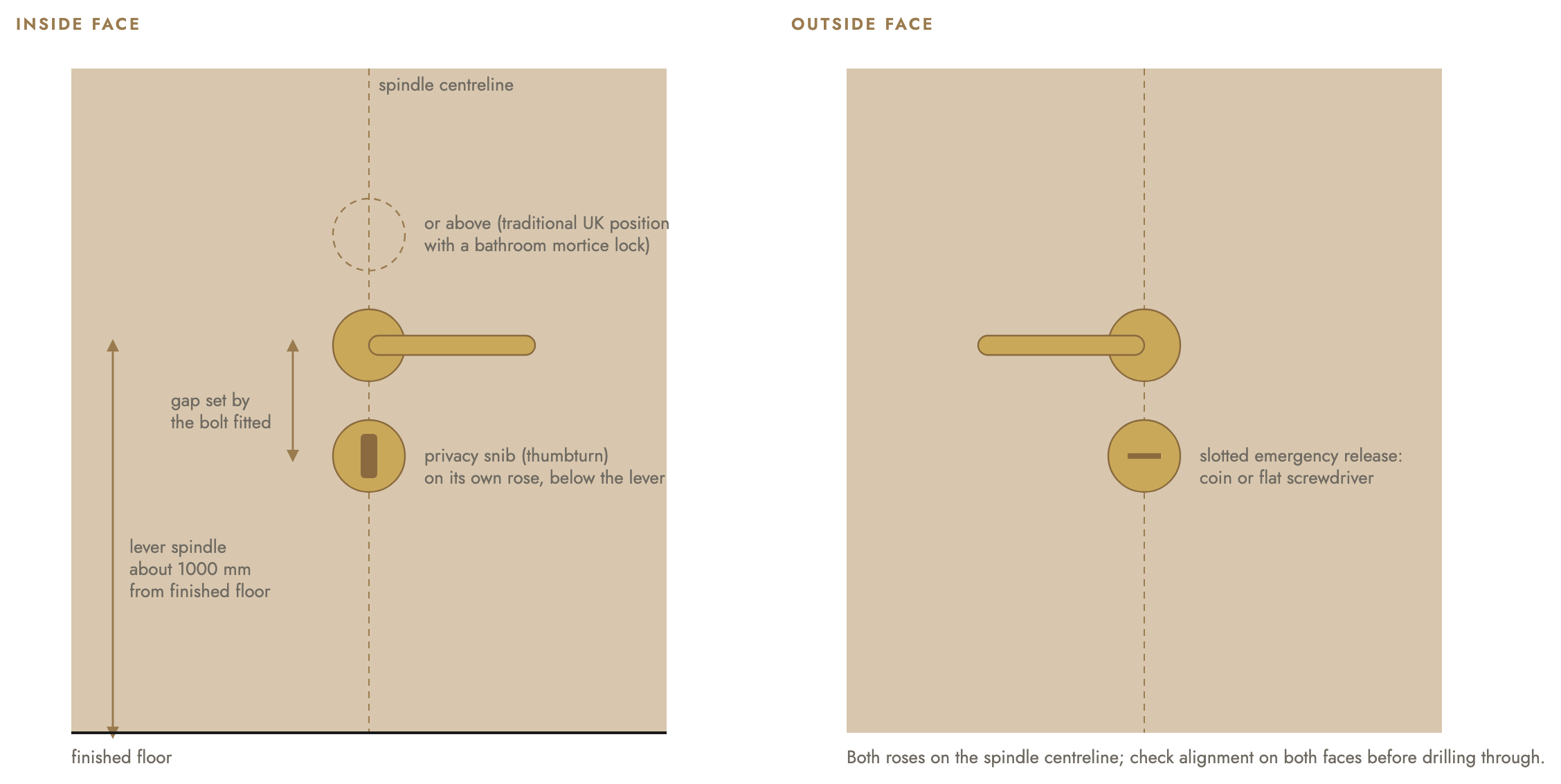
A privacy snib (also called a bathroom thumbturn and release) is a small turn on the inside of the door, on its own rose, that throws a bolt. The outside face carries a matching rose with a coin slot for emergency release. The lever beside it is a plain passage handle: it only retracts the latch.
On the site this is the “privacy set (passage set + privacy snib)” configuration. On VELA and VERTO it is a passage lever pair with its tubular mortice latch, plus a separate privacy bolt: a small faceplate morticed into the door edge, a thumbturn inside on a rose matching the handle rose, and the coin release outside. Because the lock is a separate fitting, a snib also pairs with other handles: the RIVO and LUNO privacy snibs are sold on their own, in UK/EU and North American versions.
What is a rose-button privacy set?
A rose-button privacy set puts the lock inside the handle. A small push-pin sits through the inside rose beside the lever; pushing it locks the set. Nothing else is added to the door and no second mortice is cut.
On the site this is the “privacy set (rose button)” configuration. Visually it is a passage handle with one small detail inside, which is why designers who want the quietest door choose it. On our sets the outside rose is plain.
How does each one work from inside and from outside?
Inside, both work by hand, no key. Outside is where they part company.
Privacy snib: a bolt with a coin release
Turning the snib throws a small bolt into a keep in the frame; the slotted release on the outside rose winds it back. As a separate fitting, the bolt can be added to any passage set on the same door.
Rose button: a push-pin in the rose
Pushing the pin locks the set from inside; nothing is thrown into the frame, so no second keep is needed. Because the outside rose is plain, treat it as an inside-only lock. Good practice expects a domestic bathroom door to be releasable from outside so a child or someone taken ill can be reached; a sensible default, not a regulation for private homes. If that matters (family bathroom, children, guests, rentals), choose the snib set. If you need to know whether a particular push-pin set can be released from outside, ask us before ordering.
How do a privacy snib and a rose button compare?
| Privacy snib (passage set + snib) | Rose-button privacy set | |
|---|---|---|
| Mechanism | Separate thumbturn throws a bolt | Push-pin through the inside rose locks the set |
| Latch or lock required | UK/EU: tubular mortice latch plus separate privacy bolt (both supplied). NA: tubular latch plus privacy bolt | Tubular mortice latch, the same as a passage set (supplied) |
| Fittings per face | Two: handle rose and turn rose | One: handle rose only |
| Look on the door | Two stacked roses, a recognisable bathroom door | Reads as a passage handle with a small pin inside |
| Emergency release | Coin or slot turn on the outside snib rose | Outside rose plain; ask before relying on outside release |
| Fitting effort | Higher: extra mortice, keep in the frame, two roses to align | Lower: identical to a passage set |
| Second keep in frame | Yes | No |
| Retrofit onto a passage-drilled door | Needs a new mortice and holes above or below the handle | Same door preparation as the passage set |
| Best for | Family bathrooms, guest WCs, rentals, anywhere the locked state should be obvious | En suites, minimal schemes, doors already drilled for a passage set |
Which one suits a family bathroom, an en suite, a downstairs WC or a rental?
Snib where the locked state should be obvious and outside release matters; rose button where you want the quietest door and only the occupant controls it.
Family bathroom
Snib. Children read a turned snib instantly and can operate it, and the outside release sits where an adult can find it at once.
En suite
Rose button. An en suite is locked by one person for a few minutes and is on show from the bedroom; one rose per face keeps it matching the wardrobe door beside it.
Downstairs WC or cloakroom
Either. A busy guest WC favours the snib, clearer for visitors who do not know the house; a cloakroom in a run of passage sets favours the rose button. Fit a door stop either way: cloakroom doors swing hard against tiles.
Rental or holiday let
Snib. It is self-explanatory to strangers, the release is easy to find, and a worn snib is replaced without touching the handle. See the door privacy snibs collection to match one to a handle range.
Where does a snib sit on the door, and how does it line up with the handle rose?
A snib sits on the vertical centreline through the spindle, above or below the handle rose. Above is the traditional UK position, because a bathroom mortice lock puts its turn follower 57mm above the lever follower and fixes the spacing for you. With a separate bolt like ours either works: our VELA and VERTO renders show the snib fitted below the handle. What matters is that both roses sit on the spindle centreline and line up on both faces.
Height is inherited from the handle. UK practice commonly puts the spindle at about 1000mm from finished floor, and Approved Document M and BS 8300 work within a band around that height. On a 57mm bathroom lock the snib centre then lands roughly 1050 to 1060mm up; a separate bolt lands at its own spacing. North American practice commonly bores tubular latches at about 36 inches (roughly 915mm).
Two rules save the door: mark the snib centre from the actual bolt you are fitting, not a diagram, and check both roses on both faces before drilling through. Drilling for the VELA lever (52mm rose, 8mm spindle) is one 25mm bore plus two 8mm holes at 38mm centres for the bolt-through fixings; VERTO shares the same configurations and preparations, with its drilling on its listing.
How do you fit a privacy snib? Latch first, handle, then snib
Fit in this order; each stage checks the last.
- Confirm the preparation. UK/EU sets take a tubular mortice latch with a rectangular faceplate in the door edge; North America and Canada sets are supplied for a tubular latch to suit bored doors (industry practice: 54mm cross bore, 25mm edge bore, 60 or 70mm backset, ANSI/BHMA A156.2). Handle set and snib must match.
- Mark the spindle height. Around 1000mm in the UK, or level with the other doors in the corridor. Square a line across the edge and both faces.
- Fit the latch. Mortice the case, or bore for the tubular latch, and screw the faceplate flush.
- Drill for the handle. Through both faces, to the listing’s drilling data.
- Fit the handle as a passage set. Insert the spindle, offer up both roses, tighten the bolt-through fixings evenly and check the lever returns freely.
- Mark the snib centre. At the bolt’s own spacing above or below the spindle, on the same centreline, checked on both faces.
- Mortice for the bolt. Cut the small mortice for the bolt case and faceplate in the door edge, then bore for its spindle.
- Fit the inside turn and the outside release. Align both roses with the handle roses before final tightening. The bolt should throw fully under light finger pressure.
- Fit the keep and a door stop. Cut the keep so the bolt engages without slop; fit a door stop so the lever never strikes the wall.
- Test from outside. Lock from inside, close the door and release with a coin from the corridor. If that needs force, the roses are misaligned or the bolt binds in the keep.
For a rose-button set: steps 1 to 5, a door stop, then test the pin from inside.
Which finish suits a humid bathroom?
Humidity and hand contact speed up change on any brass surface. Polished Chrome (PVD), Polished Brass (PVD) and Satin Nickel are the stable choices in a wet room: PVD is a hard vacuum-deposited coating that resists tarnish and fingerprints. Unlacquered Brass patinas faster in a bathroom than in a hallway, which some owners want and some do not. Matte Black hides water spotting but can show limescale drips beside a shower. Wipe with a soft dry cloth; keep bathroom cleaners off the metal. More in the finish care guide.
What are the common mistakes to avoid before ordering?
- Ordering “privacy” without checking which kind. The two sets are separate configurations on the same page. Decide from the table first.
- Miscounting. Every configuration is a complete set: a pair of levers, roses, fixings and the latch or bolt. Count one set per door, not levers.
- Buying a snib for a door that cannot be morticed again. The bolt needs its own mortice; if that is impossible, choose the rose button.
- Wrong preparation. UK/EU (mortice) and North America and Canada (tubular) sets are not interchangeable. Measure the existing latch first.
- No door stop. A lever projecting 67mm finds the plaster or tiles behind it very quickly.
If the door is unusual (pocket, bi-fold or fire-rated), ask us before ordering. For sliding doors, our SERA handles offer an optional integrated privacy lock instead.
In short
- The snib set adds a separate bolt, its own mortice and a second rose per face; the rose-button set is a passage set with a push-pin in the inside rose.
- Only the snib set has an outside coin release; on the rose-button set the outside rose is plain.
- Snib for family bathrooms, guest WCs and rentals; rose button for en suites and minimal schemes.
- Above the handle is the traditional UK position (57mm on a bathroom lock); with our separate bolt, above or below both work, and ours are shown below.
- Every configuration is a complete pair with its latch or bolt: one set per door.
Frequently asked questions
Can you open a bathroom snib from outside?
The snib set, yes: a slotted release on the outside rose that a coin or flat screwdriver turns. The rose-button set has a plain outside rose, so choose the snib where outside release matters.
How high should a bathroom snib be?
Set it by the handle. With the spindle at the usual UK height of about 1000mm, a 57mm bathroom lock puts the snib roughly 1050 to 1060mm up; a separate bolt sits at its own spacing above or below.
Does a rose-button privacy handle need a special latch?
No. It uses the same tubular mortice latch as a passage set, supplied in the box, because the pin locks the furniture rather than throwing a bolt.
Can I add a snib to existing passage handles?
Yes, if the door can take a separate privacy bolt above or below the latch and you can cut a second mortice; RIVO and LUNO snibs are sold on their own for this. If re-morticing is not an option, swap to a rose-button set.
Which lock does a privacy snib need on a UK door?
Our snib sets use a tubular mortice latch plus a separate privacy bolt, both supplied. The other UK route is a bathroom mortice lock with latch and bolt in one case, whose follower spacing (commonly 57mm) fixes the snib position.
Is a rose-button privacy set less secure than a snib?
Both are privacy locks, not security locks; neither secures a room. Choose on outside release, look and ease of use.
Do the VELA and VERTO levers come in both privacy types?
Yes. Both come as a privacy set (rose button) and a privacy set (passage set plus separate snib), alongside passage, dummy, mortice thumbturn and mortice key configurations, in UK/EU and North American preparations. Each is a complete set for one door.
Sources and standards
- BS EN 1906: Building hardware. Lever handles and knob furniture. Requirements and test methods.
- BS EN 12209: Building hardware. Mechanically operated locks and locking plates. Requirements and test methods.
- BS EN 1935: Building hardware. Single-axis hinges. Requirements and test methods (for the hinges the same door will carry).
- Approved Document M and BS 8300: accessibility guidance on door furniture heights.
- ANSI/BHMA A156.2: bored and preassembled locks and latches (North American door preparation).